The Shangri-La Dialogue 2026 shows an Asia preparing for a world where regional security no longer depends solely on America, and China's influence grows as US allies seek their own solutions.
Image made with AI (ChatGPT)
What the 2026 Shangri-La Dialogue says about the new security order in the Indo-Pacific
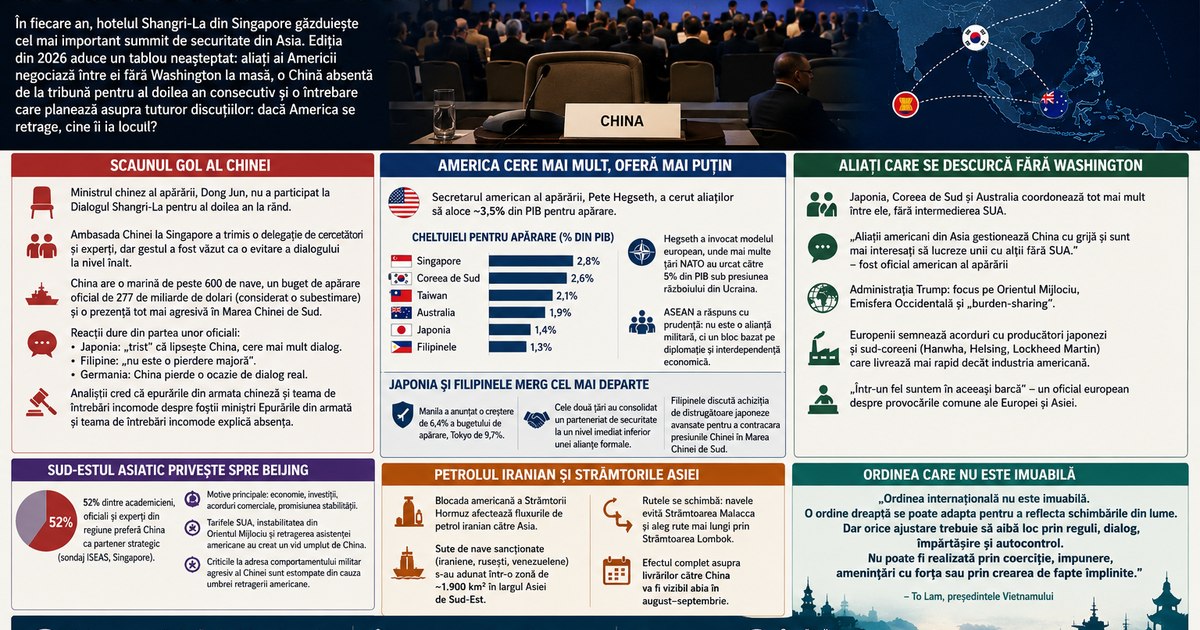
Every year, Singapore's Shangri-La Hotel hosts Asia's most important security summit — a place where defense ministers, generals, diplomats and arms manufacturers gather to take the pulse of the world's most contested region. The 2026 edition of this forum, organized by the International Institute for Strategic Studies (IISS), brought with it a picture that few had anticipated a decade ago: America's allies negotiating with each other without Washington at the table, a China absent from the main forum for the second year in a row, and one question hanging over all discussions — if America withdraws, who takes its place?
China's empty chair
The most commented event of the summit was no speech and no joint statement. There was an empty chair. Chinese Defense Minister Dong Jun did not attend the Shangri-La Dialogue for the second year in a row — an absence that officials in the region have interpreted in very different ways, depending on how dependent they are on their relationship with Beijing. The Chinese embassy in Singapore offered an optimistic explanation: a delegation of researchers and experts, led by Professor Meng Xiangqing of the National Defense University, is “best placed” to explain Beijing's policies in the region. The bureaucratic and low-stakes wording contrasted sharply with China's growing military influence — a navy of more than 600 ships, an official defense budget of $277 billion, widely considered an understatement of the real figure, and an increasingly aggressive presence in the South China Sea.
Japanese Defense Minister Shinjiro Koizumi said he was “sad” that his Chinese counterpart was not in the room and called for more dialogue with Beijing. Philippine Defense Secretary Gilberto Teodoro was much more blunt: “As a value proposition, their presence here is minimized — to push the party line, not engage constructively. As far as I'm concerned, it's not a major loss.” German General Carsten Breuer, Chief of Staff of the Bundeswehr, formulated it diplomatically: “China is losing an opportunity for real dialogue”. Analysts suggest Beijing also has internal reasons to avoid the forum. The last two defense ministers to attend Shangri-La — Wei Fenghe and Li Shangfu — were later purged and sentenced to death in anti-corruption probes launched by Xi Jinping. “I don't think the Chinese like the idea of being asked about how these leaders were removed and how it affects the PLA's combat effectiveness,” said analyst William Choong of the Institute of Southeast Asian Studies in Singapore. The year 2024 marked sudden removals of high-ranking PLA commanders, continuing the wave of purges since 2023, when 15 leaders from the defense industry and from the military leadership were removed. During 2023 and 2024, 19 senior officers were officially purged. Corruption has been commonly cited as the reason, but observers suspect other factors, including loyalty, performance issues, the building of proprietary patronage networks and factional rivalries within the EPA, played a role. According to CSIS data, 36 generals and lieutenant generals have been officially purged since 2022, bringing the total of those confirmed or potentially purged to an impressive 101 people.
America demands more, gives less
US Defense Secretary Pete Hegseth arrived in Singapore on Friday, May 29, 2026, and departed on Saturday afternoon, May 30, 2026 — spending, according to observers present, more time in the air than on Singaporean soil. However, during the short time he spent on the stand, he sent a clear message: “America's allies must spend more on defense — around 3.5% of GDP, a target that few countries in the region currently meet“. The data show the extent of the gap. According to the Stockholm International Peace Research Institute (SIPRI), Singapore allocates 2.8 percent of GDP to defense, South Korea 2.6 percent, Taiwan 2.1 percent, Australia 1.9 percent, Japan 1.4 percent, and the Philippines 1.3 percent. Hegseth cited the European model — where several NATO countries have climbed to 5 percent of GDP under pressure from the Ukraine war — but officials in Southeast Asians responded cautiously: ASEAN was never a military alliance, but a bloc built on multilateral diplomacy and economic interdependence.Here are the main points from Hegseth's speech at the 2026 Shangri-La Dialogue (May 30, 2026): The tone of Hegseth's speech was noticeably softer than in 2025, when he said the Chinese threat was real and possibly imminent, and that the EPA was repeating for “the real thing”.
Hegseth said US-China relations were “better than they have been in many years” and praised the Xi-Trump summit in Beijing as “truly historic”. He said the two presidents agreed to build a relationship of “constructive strategic stability, based on fairness and reciprocity.” Hegseth warned that there was “justified concern” about China's “historic military expansion” in the region, reiterating that US strategy is based on “deterrence by denial” along the first island chain — to counter a possible conflict in the Taiwan Strait. It said no state, including China, can impose its hegemony and endanger the security or prosperity of America's allies. Hegseth said the “era of the US subsidizing the defense of wealthy nations is over,” calling on allies to “stand up” to their own defense responsibilities. He added that the US is looking for “partners, not protectorates”.
Japan and the Philippines have gone the furthest though. Manila announced a 6.4 percent increase in the defense budget, Tokyo 9.7 percent — remarkable figures for two countries that for decades avoided expanding their military capabilities. The two countries consolidated on Thursday, May 28, just before the summit, a bilateral security partnership at a level just below a formal alliance. The Philippines is in talks to buy advanced destroyers from Japan — a purchase that would significantly change the power equation in the South China Sea, where Chinese coast guard vessels and a so-called armed “fishing fleet” regularly harass Philippine vessels.
Allies who can do without Washington
Perhaps the most significant signal of the summit came not from any superpower, but from conversations in hotel corridors and closed meeting rooms. Traditional US allies — Japan, South Korea, Australia — are increasingly coordinating with each other, without the US playing its historic role as broker and architect of regional security. “US allies in Asia are managing China carefully,” said a former US defense official, who requested anonymity. “And they are more interested in working with each other without the US.” This development reflects a deeper shift: Under the Trump administration, American engagement in Asia has been overshadowed by a deepening involvement in the Middle East, a refocused attention on the Western Hemisphere, and a discourse emphasizing “burden-sharing”—that is, the idea that allies must pay for their own security.
European officials have arrived in Singapore in force with a surprising agenda: signing deals with Japanese and South Korean arms makers who can deliver equipment faster than the overstretched US defense industry. South Korea's Hanwha, Germany's Helsing, Lockheed Martin — the list of industry participants was richer than ever, a sign that security is also becoming a business that no longer needs Washington as an intermediary. “In a way we are in the same boat,” summed up one European official about Europe and Asia's shared challenges facing adversaries without American support.
Southeast Asia looks to Beijing
Perhaps the most worrying signal for Washington came from a poll released by the Institute of Southeast Asian Studies in Singapore just before the summit. Asked who they prefer as a strategic partner — the US or China — 52 percent of a sample of 2,000 academics, government officials and policy experts in the region said: China. “It's kind of a gun-to-the-temple question,” commented William Choong, a senior researcher at the institution.
“China wins over US on this forced-choice question.”
The motivation is primarily economic: the tariffs imposed by the Trump administration, the instability generated by the war with Iran and the withdrawal of American economic assistance have left a vacuum that Beijing is filling with investment, trade deals and the promise of stability. “There are very few economic incentives that the US can offer this region, and China has a lot,” Choong added. This dynamic also explains why criticism of China's aggressive military behavior—dangerous incidents involving aircraft and ships in the South China Sea, the harassment of Philippine ships, pressure on Taiwan—was muted as the conference opened. Governments that normally speak openly about these topics have chosen caution. America's receding shadow makes reprimanding China seem like a luxury they can't afford.
Iranian Oil and the Straits of Asia
Parallel to the debates at the podium, another theme circulated in private conversations: the effects of the US naval blockade of the Strait of Hormuz on the flows of Iranian oil to Asia. Hundreds of sanctioned Iranian ships, along with ships carrying Russian and Venezuelan oil, had gathered in an area of about 1,900 square kilometers off the coast of Southeast Asia, using it as a haven to avoid ports and severe penalties. According to Charlie Brown, a former US naval officer and adviser to the organization United Against a Nuclear Iran, the blockade has begun to change routes: the last ships identified crossing the Malacca Strait have chosen an alternative route through the longer and more expensive Lombok Strait. The full effect on oil supplies to China — Iran's biggest customer — won't be seen until August or September, however, when Chinese refiners run out of stocks they bought in advance.
The order that is not immutable
In his opening address, Vietnam's President To Lam offered perhaps the most succinct formulation of the collective anxiety dominating the summit: “The international order is not immutable. A just order can adjust to reflect changes in the world. But any adjustment must take place through rules, dialogue, sharing and self-control. It cannot be achieved through coercion, imposition, threats of force or the creation of fait accompli.” The words sounded like a warning to China, but could just as easily be read as a description of a world where America itself is redefining the rules to suit its own interests. In Singapore on the weekend at the end of May 2026, the picture was clear: Asia is not waiting to find out if America comes back. He is already building an alternative.