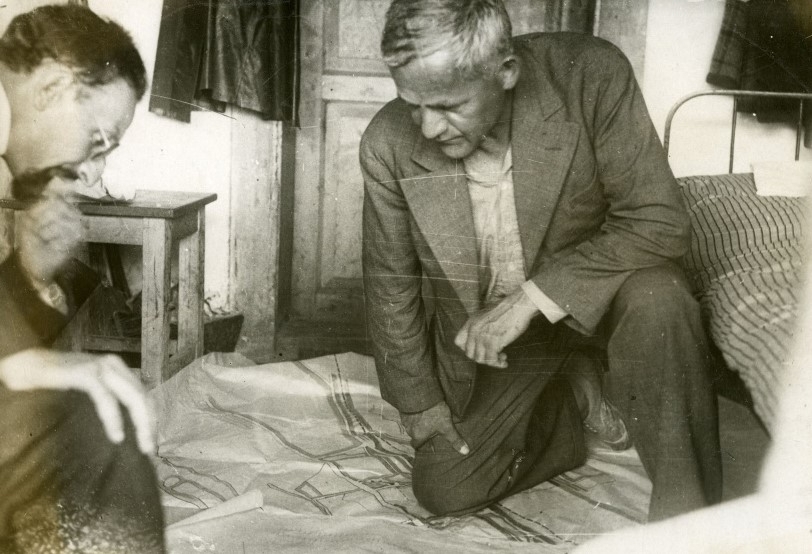
Designing a large Birobidzhan. Professor Hannes Mayer (right). 1933
Photo: State Archive of the Jewish Autonomous Region
May 31, 1928
The Far East Executive Committee issued an order that, in connection with the Jewish colonization of the Birsko-Bidzhan region and the need to carry out all activities related to the settlement of this area according to a single plan, the Birsko-Bidzhan resettlement detachment was organized with direct subordination to the Far Eastern Resettlement Administration. M. Ya. Shvartsman was appointed head of this detachment.
May 31, 1933
Thematic photo. Photo: Photo: Regional Library
I. Stalin believed that Birobidzhan should personify Far Eastern Jerusalem for the Jews of the USSR. The planning bureau, headed by Meyer, was responsible for preparing the master plan for the construction and development of Birobidzhan. After receiving a responsible assignment, the German professor and two colleagues went to the Jewish Autonomy. On May 31, 1933, H. Mayer arrived in Birobidzhan.

Drawing a geological map. 1932. Photo: Photo: State Archive of the Jewish Autonomous Region
For several months, the architects collected the necessary information, took measurements of the area and made calculations, as a result of which a preliminary project for the development of the city was drawn up with an economic development program.

H. Mayer. Project of the General Plan of Birobidzhan. Photo: Photo: State Archives of the Jewish Autonomous Region
Meyer offered several perspectives on the capital of the Jewish Autonomy. One of the options was based on the development of light industry in the city, while the other proposed the development of iron ore reserves in the Lesser Khingan mountains and the rise of heavy industry in the Jewish Autonomy. According to instructions received in Moscow, Meyer's team designed a city designed for 50 thousand people by the end of the third five-year plan, falling in the period 1938-1942.
May 31, 1966

Cinema building. 1967. Photo: Photo: State Archive of the Jewish Autonomous Region
The reference and information publication “Streets of the City of Birobidzhan: According to Documents of the State Archive of the Jewish Autonomous Region” (0+) contains information that by decision of the City Executive Committee dated May 31, 1966 No. 188, the cinema on Oktyabrskaya Street was given the name “Motherland”.
In 1935, in memory of Heinrich Lvovich Kazakevich, editor of the newspaper “Birobidzhaner Stern” (16+), the cinema under construction was given the name “Cinema named after G. Kazakevich”. After commissioning in 1937, the cinema was mentioned in documents under different names: “Birobidzhan City Cinema”, “Birobidzhan Cinema”, “Birobidzhan” Cinema.
May 31, 1979

Clippings from the newspaper “Birobidzhan Star”. Photo: Photo: Regional Library
The Plenum of the Birobidzhan District Committee of the CPSU considered the issue of the work of the district party organizations on the further development of livestock farming in the light of the requirements of the July (1978) Plenum of the CPSU Central Committee and the Letter of the CPSU Central Committee “On strengthening work to increase the production of milk, meat and other livestock products.”
It was noted that over the three years of the current five-year plan, capital investments in this industry amounted to several million rubles, the number of cattle increased by 25.3%, including cows by 15%. The volume of procurement of livestock products has increased.
The Plenum obliged the primary party, trade union and Komsomol organizations, Soviet and agricultural bodies, on the basis of further improvement of organizational and political work, to achieve accelerated development and growth in the efficiency of public livestock farming, and an increase in the sale of livestock products to the state.
May 31, 1982
The Bureau of the Regional Committee of the CPSU and the Executive Committee of the Regional Council of People's Deputies adopted a resolution “On measures for the further development of communications in the region in the Eleventh Five-Year Plan.” It noted that during the tenth and first year of the eleventh Five-Year Plan, city automatic stations with a total capacity of 2,390 numbers were built, expanded and put into operation in the region. Automation of city and rural telephone exchanges has been completed, construction of automatic telephone exchanges for 10 thousand numbers in Birobidzhan, as well as automatic telephone exchanges in rural areas is underway. The Bureau and the Executive Committee approved a plan for the comprehensive development of communications, radio broadcasting and television in the region for 1981-1985.

Telephone exchange of the ATSKU type for 10 thousand numbers in the city of Birobidzhan. 1983 Photo: Photo: State Archives of the Jewish Autonomous Region
On May 31, 1985, the Plenum of the Oktyabrsky District Committee of the CPSU discussed the results of the April (1985) Plenum of the CPSU Central Committee and the tasks of the district party organization to implement its decisions, worthy of the meeting of the XXVII Party Congress. It was noted that the communists and workers of the region warmly approve and support the domestic and foreign policies of the communist party, the purposeful and fruitful activities of its Central Committee, aimed at accelerating the socio-economic progress of Soviet society. Livestock farm workers completed the five-month milk and meat procurement plan ahead of schedule. The plan for the production of consumer goods was fulfilled by 112.6%.
The Plenum noted the existing serious shortcomings in the development of the national economy of the region and noted measures to eliminate them.
May 31, 1980
The newspaper “Birobidzhan Star” (16+) on May 31, 1980 wrote on its pages about the work of the experimental workshop of a hosiery and knitting factory.

Hosiery and knitting factory. Photo: Photo: State Archives of the Jewish Autonomous Region
On the eve of the upcoming Olympics in Moscow, the newspaper pages posted information that the Birobidzhan Power Transformer Plant produced an original design of a referee's whistle with the Olympic emblem. The department of the plant’s chief technologist, headed by Valery Kaganov, worked on their development and production.

Power transformer plant named after the 60th anniversary of the USSR. 1980s. Photo: Photo: State Archives of the Jewish Autonomous Region
In the “Chronicle” section, the newspaper published information that for success in the All-Russian Socialist Competition and for the good organization of mass sports work in 1979, the Sports Committee of the RSFSR awarded the sports organization of the Jewish Autonomous Region third place and a Certificate of Honor. In 1979, athletes from the region successfully competed in many competitions of the All-Union and Republican rank.
The newspaper wrote that I. I. Grodsky, an employee of the Birobidzhan Power Transformers Plant, was awarded the title “Judge of the Republican Category.”