Why fears are growing about a possible confrontation between Russia and NATO. Where can Putin attack

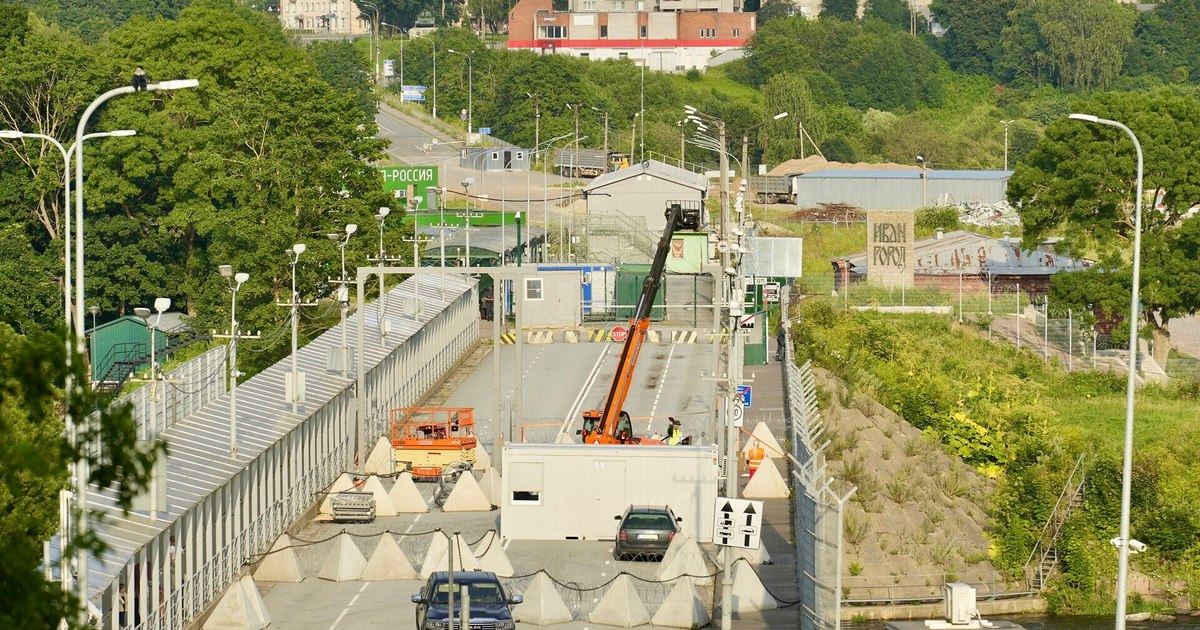
Amid the strengthening of NATO's eastern flank and the war in Ukraine, analysts and officials in Eastern Europe are increasingly discussing the possibility of new tensions in the Baltic region. At the center of these scenarios are two points considered strategically sensitive: the city of Narva in Estonia and the Suwałki Corridor, the strip of territory between Poland and Lithuania that connects Belarus to the Russian exclave of Kaliningrad.
The city of Nava has taken defensive measures/PHOTO: X
According to Reuters, NATO plans to strengthen defenses in Estonia and Latvia with a military structure capable of rapidly deploying troops in the event of a conflict with Russia. A German-Dutch military corps, which can reach around 60,000 soldiers, would coordinate the defense of the region.
The decision reflects the growing strategic importance of the Baltic states at a time when the Alliance has repeatedly warned of the risks posed by the Kremlin's foreign policy.
Moscow rejects accusations of aggressive intentions and says NATO's eastward expansion is the main source of tension.
Hybrid scenarios and Article 5 testing concerns
In Ukraine, expert opinions on the risk of escalation in the Baltic region are divided.
Ukrainian political scientist Andrii Zolotaryov believes that Russia could try, in the coming months, to test NATO's reaction capacity through hybrid methods, without a conventional military invasion.
He points to the city of Narva, located on the border between Estonia and Russia and inhabited mostly by Russian speakers, as a possible vulnerable point.
According to him, the Kremlin could try to exploit identity or social tensions to create a scenario similar to those that emerged in eastern Ukraine after 2014.
Another area frequently invoked in security analyzes is the Suwałki corridor, considered one of NATO's most sensitive regions. It is the only land connection between the Baltic States and the rest of the Alliance and separates Belarus from the Kaliningrad region.
Zolotariov argues that potential provocations could take the form of cyber attacks, drone incursions, sabotage operations or destabilization campaigns, rather than a direct confrontation between armies.
“It is more likely a hybrid scenario than a classic military aggression”he states.
The analyst also warns that Belarus could, in turn, become the target of provocations aimed at drawing the Minsk regime into more direct involvement in the war in Ukraine.
“Russia has no resources for a new front”
Other experts, however, reject the hypothesis of a major escalation in the Baltic region in the short term.
Political scientist Ruslan Bortnik states that Russia is currently focused almost entirely on the war in Ukraine and does not have sufficient resources to open a new front against NATO.
“The Kremlin's main targets remain Ukraine and, to a certain extent, the Republic of Moldova. The Baltic states are not Moscow's strategic priority now,” he says.
Bortnik believes that the risk of hybrid operations or acts of sabotage in Eastern Europe remains real, but the likelihood of direct military intervention is low.
According to him, the entire region between the Baltic Sea and the Black Sea is going through a period of rising tensions and “psychological preparation” for possible security crises.
NATO and Russia are strengthening their positions
In parallel, debates regarding Western support for Ukraine continue within NATO.
Several European states, including Britain, France, Italy and Spain, recently blocked a proposal by Alliance Secretary General Mark Rutte to allocate a fixed percentage of GDP to military aid to Ukraine.
At the same time, Russia continues to strengthen its military presence in Kaliningrad. According to information appearing in the regional press, Moscow deployed Iskander missile systems in the enclave between Poland and Lithuania.
These systems can hit targets located on the territory of several NATO states, including Poland, Lithuania, Latvia, Estonia, Sweden and Germany.
As the war in Ukraine continues and relations between Russia and the West remain deeply strained, the Baltic region is increasingly seen as a potential strategic pressure point in the confrontation between Moscow and NATO.