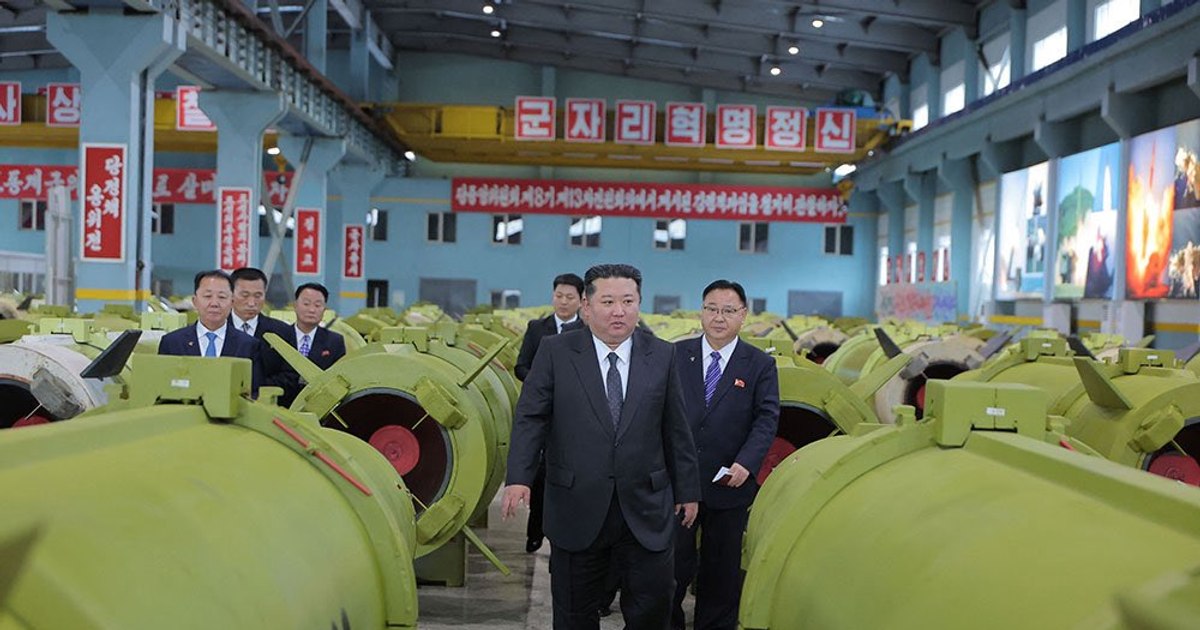
Kim Jong-un has ordered an accelerated increase in missile and munitions production, calling for North Korea's military industry to operate at full capacity to keep up with the military's growing ambitions. The announcement came shortly after the Pyongyang leader visited a strategic shipyard where the regime's newest project was unveiled: a submarine capable of carrying nuclear weapons.
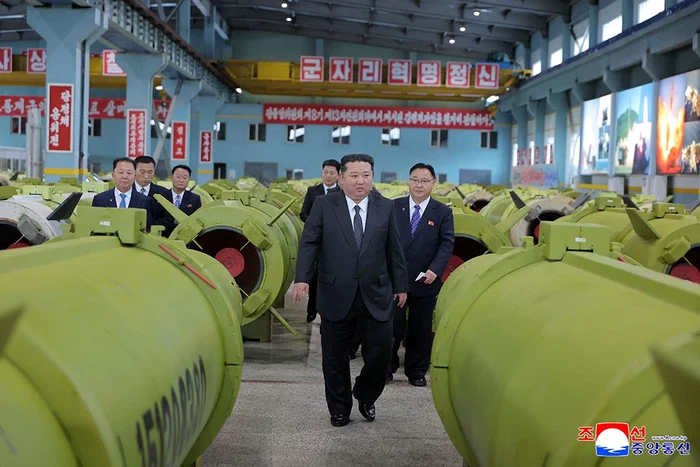
Kim Jong a visit to a strategic factory/PHOTO:X
The visit also had a strong symbolic dimension. Kim was accompanied by high-ranking generals, but also by his teenage daughter, considered by many analysts as a possible successor, in a carefully calculated signal about the continuity of power in the Kim dynasty, writes The Sun.
According to the official KCNA news agency, the North Korean leader called for expanding the “overall production capacity” of the defense industry, stressing that the missile and projectile sector is “essential for strengthening war deterrence”. Kim also ordered the construction of new military factories to support the rapid development of the armed forces.
The centerpiece of the show of force was an approximately 8,700-ton nuclear submarine, shown publicly for the first time in nearly complete form. Footage released by state media showed Kim inspecting the ship at a shipyard, describing it as a “historic” leap in North Korea's nuclear capabilities.
Pyongyang claims it is a “strategic guided missile submarine” designed to launch nuclear weapons from underwater. Contrary to previously published fragmentary images, the new photos suggest that most of the equipment has already been installed and the ship is approaching the testing phase.
“The full presentation of the vessel indicates that it is almost ready for launch,” said Moon Keun-sik, a submarine expert at Hanyang University in Seoul and a former South Korean navy officer. According to him, sea trials could begin in the coming months.
Surface-to-air missile test
The submarine announcement was accompanied by another military demonstration: the testing of new long-range surface-to-air missiles that would have destroyed targets up to 200 kilometers away. South Korea's General Staff confirmed the launches from the North's east coast, stating that the allies are analyzing the data obtained.
Kim Jong-un took the opportunity to verbally attack Seoul, calling South Korea's plans – backed by the United States – to develop its own nuclear-powered submarine a “hostile act” that would seriously infringe on the North's security and maritime sovereignty. In his logic, these initiatives only justify the acceleration of the nuclear armament of the North Korean fleet.
KCNA says the nuclear submarine is part of a larger naval modernization program that includes attack destroyers and ships being built at an increasingly rapid pace capable of carrying “various types of weaponry.”
Analysts warn that a nuclear-powered submarine would give Pyongyang a major strategic advantage, allowing it to stay submerged for long periods and launch missiles from hard-to-detect positions. But there are serious doubts about North Korea's ability to develop this technology on its own, under severe international sanctions.
Help from Moscow
Some experts suggest that the growing rapprochement between Pyongyang and Moscow – including military support for Russia in the Ukraine war – may have facilitated access to essential know-how. Others believe the reactor would be mostly domestically produced, with limited outside help.
Kim Jong-un first promised to build a nuclear submarine in 2021 as part of a broad arms plan aimed at countering what he calls growing threats from the United States and its allies. Since then, North Korea has tested solid-fuel intercontinental ballistic missiles, showcased hypersonic weapons, launched spy satellites and unveiled a new destroyer intended to boost pre-emptive strike capabilities.
All these developments take place in an almost frozen diplomatic context. Pyongyang has repeatedly rejected calls from Washington and Seoul to resume talks on curbing its nuclear and ballistic programs, talks that broke down after the failed summit between Kim Jong-un and Donald Trump in the former US president's first term.