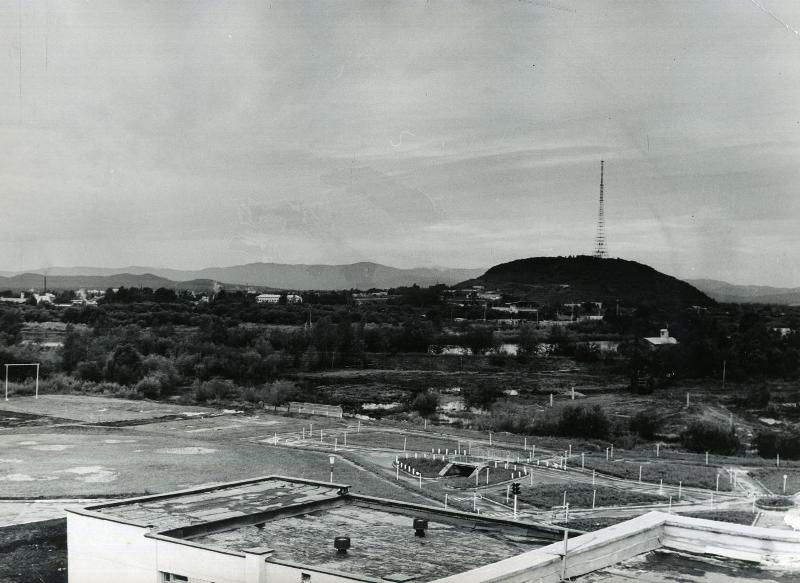
Panorama of the city of Birobidzhan. View of the hill. 1970s
Photo: State Archive of the Jewish Autonomous Region
May 28, 1936
“Birobidzhan Star” (12+) for May 30, 1936, in the note “Meeting of participants in the Orekhovo-Komsomolsk transition” said:
“On May 28, at 8 o’clock in the evening, participants in the Orekhovo-Komsomolsk ski-pedestrian crossing came to Birobidzhan. Physical education and Komsomol organizations gave them a solemn meeting. A brief meeting took place (6+). The chairman of the regional council of physical education and the Birobidzhan City Council tor. Furer warmly welcomed the heroes of the exceptional transition on behalf of the athletes of the Jewish Autonomous Region and the workers of the city. In his response, the commander transition, Comrade Vlasov said that all the millions of Soviet youth are capable of heroic deeds for the benefit of our Motherland…”
May 28, 1959
By decision of the Birobidzhan City Executive Committee dated May 28, 1959 No. 151, the village of Avgustovsky was given the name Sopka, the village of the 1046th km was given the name Amursky.
May 28, 1978
Clippings from the newspaper “Birobidzhan Star”. Photo: Photo: Regional Library
The issue of the Birobidzhan Star for May 28, 1978 is dedicated to border guards.
The article by Yu. Guryev “An example of a countryman hero calls” tells about the feat of border guard Ivan Savelyevich Fedko.
“It happened in August 1945. A group of border guards led by Captain Mironenko stormed the Japanese border police post. Sergeant Ivan Fedko, the party organizer of the outpost, ran ahead of the attackers. But the Red Army soldiers stopped in confusion in front of the adobe wall. And then Fedko shouted to his comrades: “Stand on each other’s shoulders!” He himself stood on the back of one of the border guards and boldly jumped into the yard. the enemy garrison. The rest of the soldiers followed his example.
The actions of our soldiers were so swift and stunning that most of the Japanese did not have time to occupy their defensive structures. And only from a few pillboxes the enemy unleashed a barrage of fire on the brave souls. This forced the border guards to lie down, not allowing them to resume the attack.
Pressing his whole body to the ground, Fedko crawled. His comrades watched his every move with bated breath and, if a Japanese appeared in any of the windows of the building, they immediately opened fire. Another minute, another – and now a well-thrown grenade flies into the embrasure. Behind her – the second, the third… The machine gun fell silent.
– Forward, follow me! — the soldiers heard the voice of the party organizer in the ensuing silence.
The sergeant was the first to rush to the barracks. A loud and friendly “hurray” came from everywhere. Shooting as he walked at the Japanese who had taken refuge in the house, Fedko felt a sharp blow to his chest. Something burning and sharp pierced my entire body, and immediately the earth began to float away from under my feet. The warrior swayed and fell backward.
Sergeant Fedko no longer saw the Japanese rolling down the gentle slope of the hill, and the red flag fluttered over the fortress.”
This article contains an interesting fact. In 1978, Sergeant Ivan Fedko, the nephew of the hero-border guard, one of the best soldiers of the outpost, served at the Ivan Fedko outpost.
May 28, 1991
In the newspaper “Birobidzhaner Stern” (12+) for May 28, 1991, on the first page a report by A. Mordukhovich “In the Name of a Hero” was published. It is dedicated to the opening of a memorial plaque in honor of our fellow countryman, Hero of the Soviet Union, Mikhail Styazhkin. The opening was timed to coincide with City Day.
Here's how A. Mordukhovich talked about it in his material:
“Veterans of the Great Patriotic War, residents of the microdistrict, including meat processing plant workers, students of a pedagogical institute, representatives of the city public, students of school No. 7, and guests of Birobidzhan gathered near a multi-story building on Sovetskaya Street.
On the wall of the house there is a white memorial plaque draped with linen. The orchestral melody of the familiar song “I love you life” sounds.
At the ceremonial meeting on the occasion of the opening of the memorial plaque, the oldest worker of the meat processing plant, a participant in the Great Patriotic War, N. Ya. Sychev, spoke. He worked together with M. Styazhkin before the war at the enterprise and shared his memories of that time.
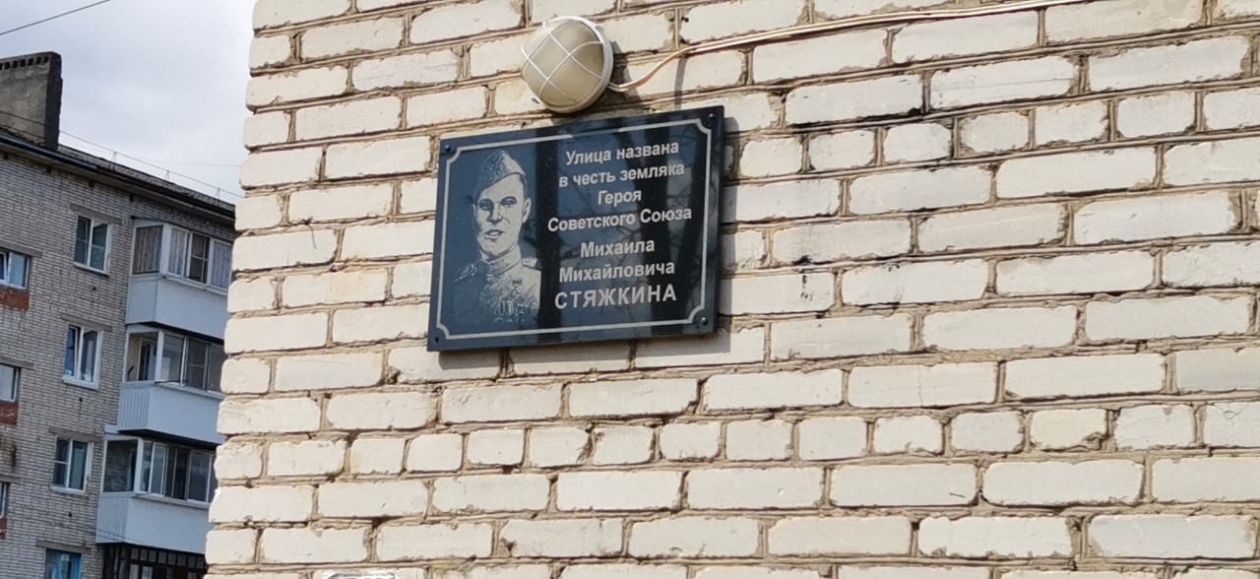
Memorial plaque to Styazhkin. Photo: Photo: EAOMedia news agency archive
Here is a story from an article by the chairman of the city section of Great Patriotic War veterans A.Z. Talisman about the military feat of Mikhail Styazhkin:
“Former meat-packing plant worker Mikhail Styazhkin began his combat journey in March 1942. On the long path to Victory, he distinguished himself more than once in battles. And his finest hour came on June 28, 1944, near the Belarusian village of Knyazhetsy, where a difficult situation was created for our advancing troops. Sergeant Styazhkin rolled out his gun for direct fire and began shooting the enemy point-blank.
In an unequal battle, the gun crew of the communist Styazhkin emerged victorious: they destroyed 13 vehicles, three self-propelled guns, approximately half a company of enemy soldiers and officers, and a fascist general. The banner of the enemy division was captured. For this feat in August 1944, Mikhail Styazhkin was awarded the title of Hero of the Soviet Union.
But the brave artilleryman’s path to Victory ended in December of the same year. After being seriously wounded, he died in hospital.”
The name of our hero-compatriot Mikhail Styazhkin appears on the mass grave in the hero city of Brest. His portrait is in the Alley of Heroes of the Soviet Union in Gorno-Altaisk, in a number of museums of military glory.
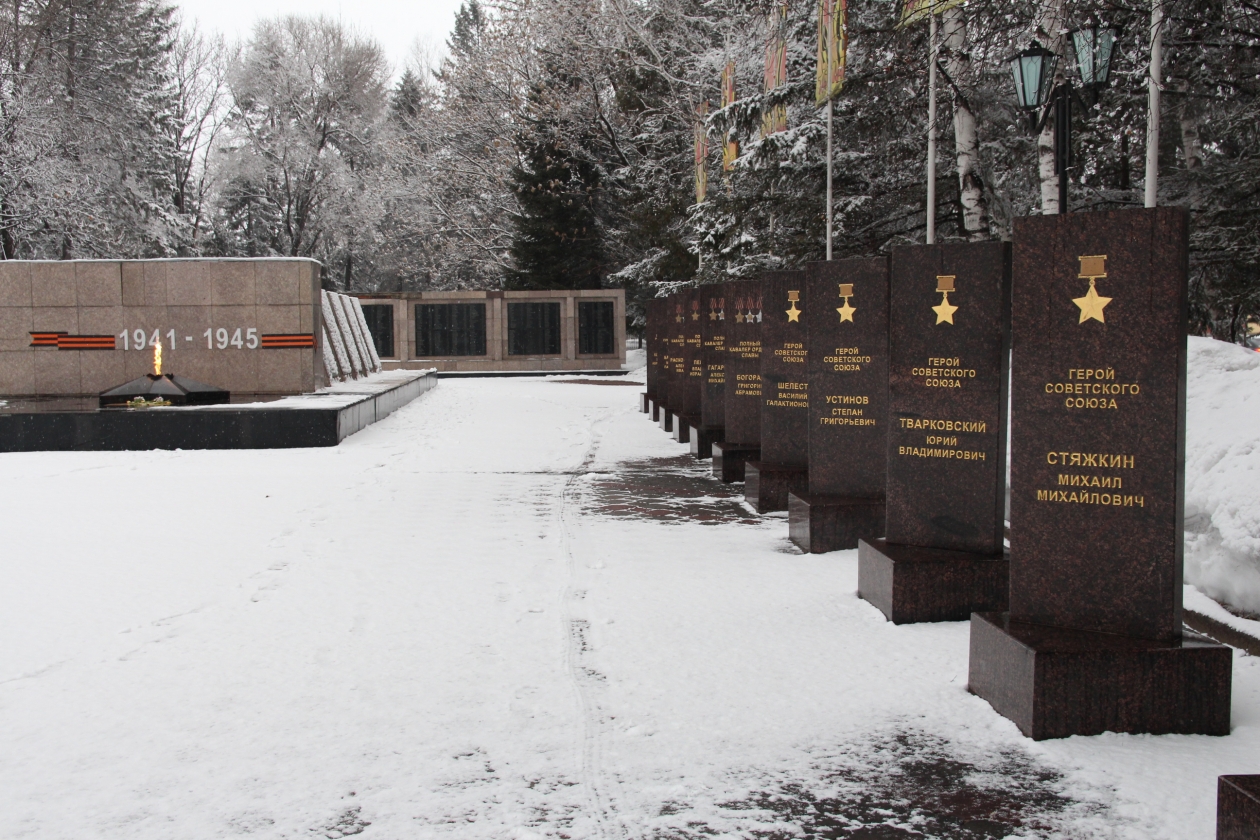
Victory Square in Birobidzhan. Photo: Photo: EAOMedia news agency
In Victory Square in Birobidzhan, the name of Mikhail Styazhkin is embossed in gold letters on the pylon of the Alley of Heroes.