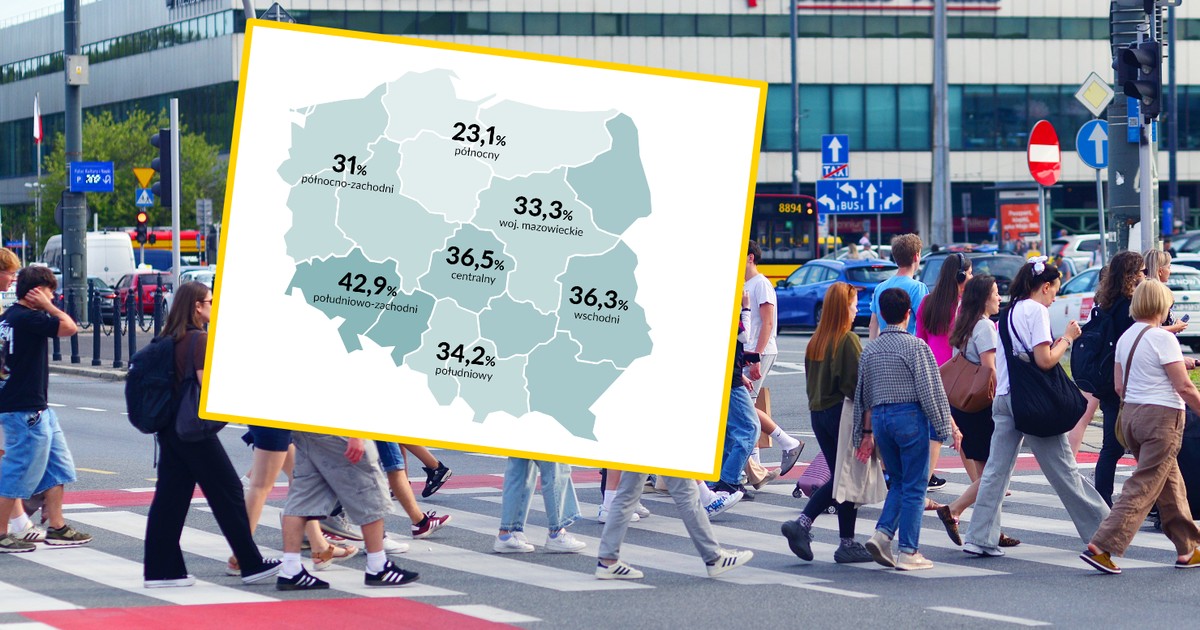
Every third working Pole is afraid of losing his job today. Just two years ago, every fourth employee declared such concerns.
Concerns about job loss have increased slightly compared to last year. Currently, a total of 33.3% of them express their opinion. respondents, while a year ago it was 31.7 percent. , and two years ago 26 percent. This means that for another year in a row the percentage of employees who do not feel confident in their current professional situation is increasing.
Young workers, women and… feel the uncertainty the most people employed in trade, production and logistics. At the same time, as many as 66 percent people afraid of losing their job are considering changing industries or changing their profession.
Today, anxiety increasingly concerns the coming months, and companies are planning employment more carefully.
Concerns about job loss Age Labor market barometer 2026
— Although most Poles still feel stable in their place of employment, concerns are growing. This is related to general uncertainty and also results from market observations. Rising operating costs, including labor costs, and the unpredictability of the economic situation mean that companies limit the scale of recruitment, focusing on key positions from the point of view of efficiency – explains Agnieszka Żak, Director of Key Accounts of Gi Group.
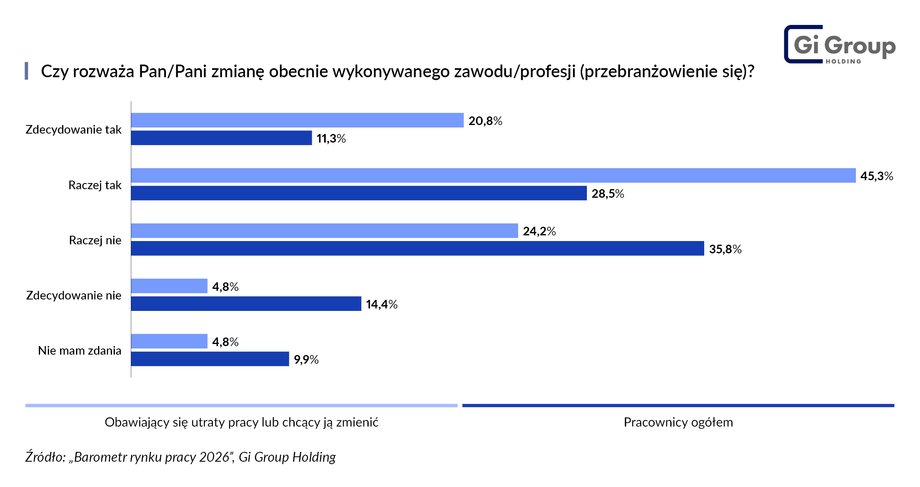
Considering changing industries Labor market barometer 2026
Employers' declarations show that companies are clearly more cautious when it comes to employment planning than a year ago. 13.7% of people plan to increase the number of full-time positions in the next quarter. enterprises, while a year earlier it was 16.7 percent.
At the same time, the percentage of organizations anticipating employment reductions doubled – from 4.9 percent. a year ago to 9.8 percent This is the highest result recorded in our study since 2017. Maintaining the current employment level is still the most frequently indicated scenario, although a slight year-on-year decline is also visible.
28 percent of surveyed companies admit that they have reduced employment in the last quarter. Large organizations decided to take such a step slightly more often (32.4%), while among small and medium-sized companies it was about 25%.
Most often, the reductions concerned companies from the trade sector (37.6%) and industry (32.7%), and the least often – the public sector. The main reason for reducing employment was the increase in labor costs – this reason was indicated by over 26 percent. companies that made cuts. This was followed by organizational changes and restructuring, a decline in demand and deterioration of the situation in the industry, as well as an increase in the costs of running a business.
Remuneration
The data show some slowdown in wage dynamics. The percentage of organizations that increased wages in the last quarter remained close to last year's level (31% compared to 31.8% a year ago), and the same is true for employers who maintained the current level of wages (55.9% compared to 56.3% a year ago).
However, it is worth keeping in mind the perspective of employees, where, according to the declaration the share of people who actually experienced an increase in salary decreased from 38.9%. last year to 34.6 percent Currently.
“This suggests that although companies continue to raise wages, they are doing so more cautiously than a year earlier, and wage increases are less common and are more likely to be limited adjustments rather than clear increases,” the report says.
Employees' salary expectations remain high, although they are noticeably weakening for another year in a row. 53.4% expect a price increase in the coming months. respondents, i.e. 2.6 pp less than a year ago, 6.2 pp less than two years ago and 8.1 pp less than three years ago.
At the same time, the percentage of people assuming that their salary will remain unchanged has increased – from just over 33%. up to 35 percent
People aged 45-54 (60.9%), managers and senior specialists (59% each) and public sector employees (59.8%) are most likely to count on pay rises. Women also expect salary increases more often – 59.2%. compared to 47.5 percent men. It is also worth noting that the relatively highest salary expectations are declared by people earning from PLN 5,000 to PLN 9,999 net per month – in these groups, the percentage of people counting on a raise is 56-58%.
The report was based on a survey conducted among over 500 employers and employees.
Source: Labor Market Barometer 2026