What hides China's economic miracle? Xi Jinping's gamble that terrifies the West but leaves its own citizens in poverty

Beijing is pumping astronomical sums into artificial intelligence, electric vehicles and military capabilities, while public confidence is collapsing and the job market offers a bleak outlook. After more than a decade with Xi Jinping at the helm, China's military has grown considerably stronger, its factories dominate global manufacturing, and its technological vanguard is rapidly closing the gap on Silicon Valley.
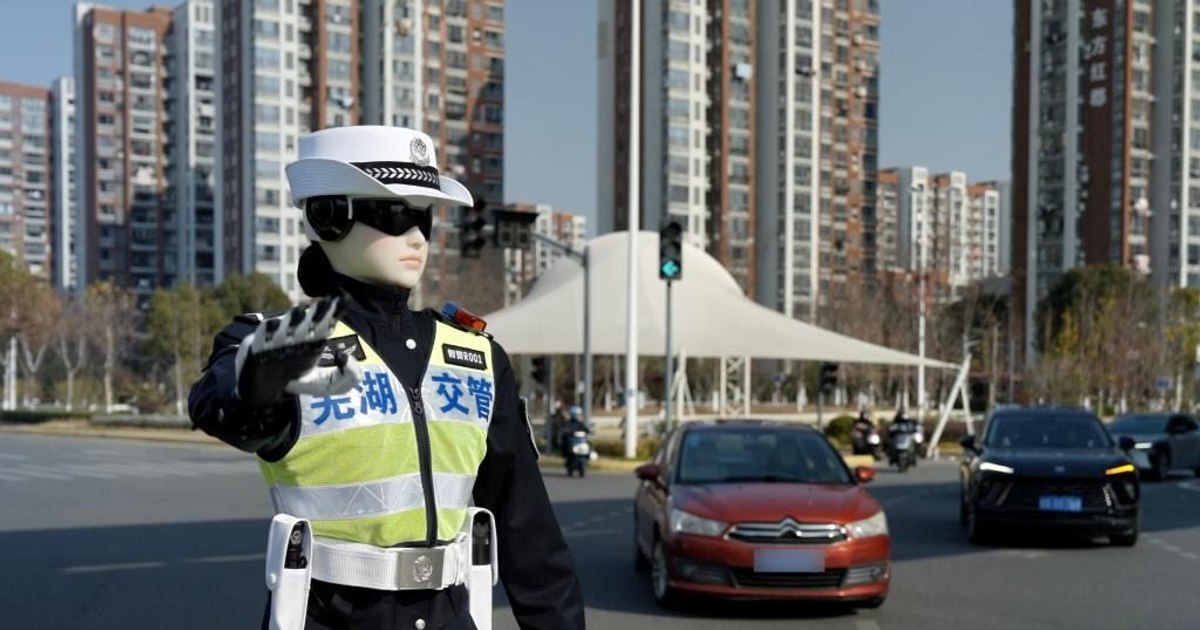
Robot policeman on the streets of a city in China/PHOTO:X
Behind this shiny geopolitical facade, however, huge segments of the domestic economy are in chaos. A colossal housing market crash has wiped out trillions of dollars of wealth overnight, domestic consumption has collapsed, and young people are looking with despair to the future.
This major discrepancy reveals an undeniable reality: Xi Jinping has placed China's national and ideological security far above economic performance. Beijing is spending hundreds of billions of dollars to achieve self-sufficiency in artificial intelligence, semiconductors and electric cars, while rejecting market economic reforms that could strengthen the middle class. Everything is subordinated to a messianic vision of “national rebirth”, supported exclusively by military and industrial force, writes The Wall Street Journal.
Guns for the military, school funding cuts
The effects of this strategy are best seen in the province. In Xi'an, the world-famous city for the Terracotta Army, local authorities slashed budgets last year for road maintenance and court operations, but pumped 80 percent more money into research and technology. As municipal revenues contracted, elementary and middle school budgets were cut by at least 10 percent, while military units in the region received millions of dollars in special funding.
In Foshan, a former prosperous manufacturing hub near Hong Kong, the atmosphere is downright grim. The local economy barely grew by 0.2% last year. Local officials are desperately trying to turn the city into a robotics hub, but the new sector is far too fragile to save the local economy. Today, entire industrial areas are deserted, and “For Rent” notices hang on the facades of buildings.
“At the moment, everyone is afraid that there will be no possibility of profit from next year,” explains Yang Guoli, a recruitment consultant for local factories.
Since the death of Mao Zedong, Chinese leaders have focused almost exclusively on economic growth, the engine of the country's global rise. Today, under Xi, triumphalist political messages collide violently with the reality on the ground. Farmers living on just a few dollars a day are ideologically urged to turn China into an agricultural superpower, while students memorize quotes from Xi Jinping about the country's greatness, even as millions of them risk ending up unemployed to support their parents, the WSJ notes.
The obsession with power in the face of the reality of numbers
China's economy today is smaller than most Western economists estimated when Xi took power. In 2024, China's GDP per capita was not even 30% of that of the United States, even after adjusting for purchasing power parity.
“In Xi Jinping's China, the economy can be sacrificed on the altar of political goals,” explains Guoguang Wu, an expert on Chinese politics at Stanford University. “Meanwhile, political priorities are never sacrificed for the sake of economic growth.”
In his latest New Year's speech, Xi deliberately avoided any reference to the domestic economic crisis. Instead, he was keen to point out that China's national force has “reached new heights”, citing as examples the launch of China's most advanced aircraft carrier and new robots capable of performing kung fu moves.
China denies report that Xi Jinping told Trump Putin may regret Ukraine invasion
This deep conviction by Beijing that its own power is on the rise—and the West is in irreversible decline—makes China a highly aggressive player on the world stage. Restrictions on exports of critical minerals to the US during the trade war and aggressive military maneuvers around Taiwan have brought the international community to the brink of major crises.
A recent analysis by the Lowy Institute, a prestigious Australian think-tank, shows that although the US remains the main superpower in Asia, China has narrowed the gap considerably based on 131 indicators covering military capabilities, economic capabilities and diplomatic influence.
Xi justifies his total state control of the economy through the dogma that security is the absolute precondition for development.
“Although the Party's regaining control of the economy costs a lot, Xi believes the price is worth paying. Otherwise, there is a risk of undermining the regime's authority,” points out Minxin Pei, political analyst at Claremont McKenna College.
China's military spending has doubled since Xi came to power, growing by 7 percent in 2024 alone. During all that time, cumulative education budgets have grown by just over 1 percent per student.
The bill of imperial ambitions
Xi Jinping's technology strategy – focused on artificial intelligence and robotics – is helping cities like Shenzhen and Hangzhou become global leaders, but it is not generating enough jobs to offset the devastation left behind by the bursting of the housing bubble. As a result, China is pouring its huge manufacturing overcapacity into foreign markets through massive exports, fueling the ire of Western trading partners.
According to research group Rhodium Group, the real estate sector's contribution to China's GDP has fallen dramatically, from 16 percent in 2023 to just 11 percent last year. In contrast, Xi's preferred strategic sectors (lithium batteries, robotics) grew modestly, reaching 6.3% of GDP. Although China reported economic growth of 5% last year, the pace is far from its glory years, and the target for the coming period has already fallen to a fragile 4.5%.
What to expect from Vladimir Putin's two-day visit to China. Moscow seeks reassurance after Trump-Xi summit
Worse, these massive investments in security deepened public debt and distorted the market. International Monetary Fund experts estimate that massive state subsidies to favored companies have reduced overall economic efficiency, causing a loss of up to 2 percent of the country's potential GDP. In addition, Beijing refuses to implement substantial social protection measures. China's social spending remains at just 9% of GDP, a level similar to that of countries such as Mexico or Turkey, and less than half the average of developed nations.
A society forced to become “humble”
Returning to Foshan, the collapse is evident, writes the WSJ. Large local brands such as the Monalisa Group (ceramics manufacturer) saw sales decline by 25% and had to lay off a fifth of their staff.
Laid-off workers, some in their 50s or 60s, are looking for informal or fixed-term work, accepting wages up to 50% lower than during the economic boom, just so they don't become a burden on their children. But the new generation does not fare better either. School-aged youth find that well-paid office jobs have disappeared.
Recently, even an adviser to the Central Bank of China warned in an op-ed that the regime is investing heavily in “things” and far too little in people. The result? As China tries to project an unshakable superpower image externally, its citizens at home are forced to dramatically lower their hopes and standards of living.