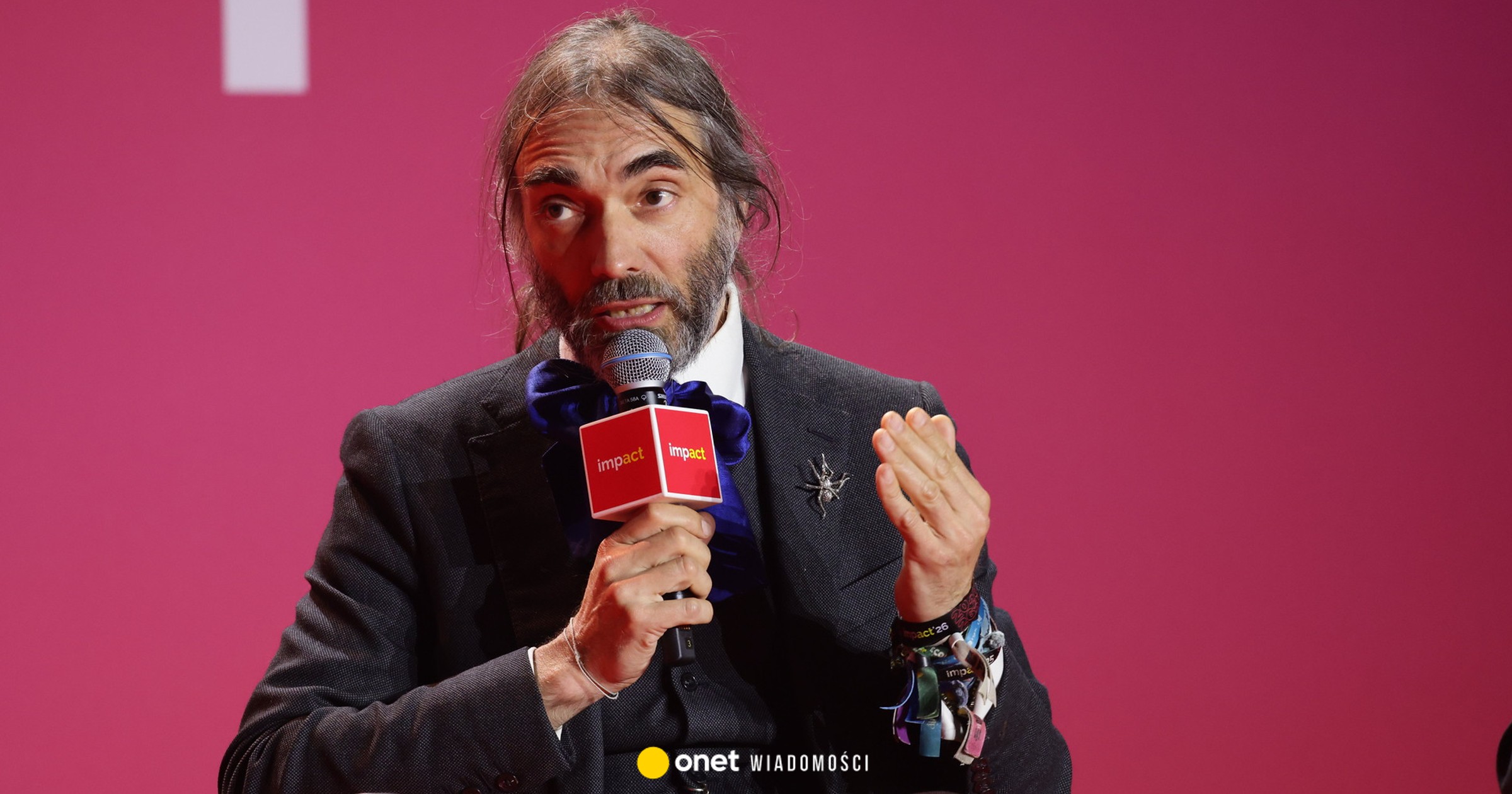
Cédric Villani is an outstanding French mathematician, professor at the Université de Lyon and director of the Henri Poincaré Institute in Paris, the main international center for the research and popularization of mathematics and theoretical physics. Winner of the Fields Medal, awarded to scientists for research that has the greatest impact on the development of mathematics. He played a huge role in shaping European and global artificial intelligence policies, and is the creator of France's national artificial intelligence strategy.
What is the biggest illusion we have come to believe about artificial intelligence?
There is a kind of hidden belief that AI is an entity. This illusion is fueled by many people and entities who want to create hype, fear and media attention in order to ultimately obtain funding and so on. Some CEOs say: I imagine my company as a partnership between humans and AI. This is complete nonsense! There is no such thing as a partnership between humans and AI.
AI is simply a mathematical formula. You might as well talk about a partnership with paper and pencil. AI is not an entity, a person, something intelligent or conscious. It's just a math tool. When you hear these big names like Zuckerberg or anyone else talking about artificial general intelligence or superintelligence or something like that… It's often just pure chaos. They do this to create hype and reinforce the grand illusion of AI as an entity.
Unfortunately, artificial intelligence has a huge impact on the way we communicate with each other, the way we get news from around the world, but also on politics around the world.
It is often said that the first modern campaign to use artificial intelligence was the Brexit campaign in 2015-2016, when mathematicians at Cambridge Analytica used personalized advertising techniques. This had a very clear effect on people. Since then, artificial intelligence has always influenced campaigns, usually changing them for the worse.
This is not a bad thing, but it usually serves to create more chaos, propaganda, false images, news that is simply untrue. This makes everything much more chaotic. This is happening now and we must be fully aware of it. While we should admire the power of mathematics implemented through computers, we should also be aware of the political implications of the development of AI. They are already causing a lot of problems.
Watch the entire video interview:
The article continues below the video
Europe seems to have missed its opportunity when it comes to the artificial intelligence revolution.
One could argue with that. We have great mathematicians in France, in Poland, in Great Britain. They present an appropriate level. By the way, we may see a bit of a reversal of the trend – some big names are leaving their jobs at big American tech companies to return to work in Europe. I have many friends in the industry whom I met when they held positions in large companies in Silicon Valley, and now they have returned to French universities, to European companies. And they do not lack brilliance, mathematical or IT talent.
As a side note, let me remind you of a fact that I love to mention when I am in Poland. If we count the number of medals won at the International Olympiads in Informatics, Poland ranks second in the world. It has a better record than France, Russia or any other country in the world except China. This shows how much talent there is in Europe. So what is she missing?
Investment – the money is in America. These are often crazy amounts, unacceptable in the realities of the European economy. In our case it is rather the opposite – too little investment is coming. In addition, there is a lack of coordination between individual countries and a lack of unity in regulations. European regulations are good, but when there are twenty-odd of them and all of them different, this is not possible. This is a huge burden.
We should be proud of our achievements, but we must coordinate our actions. In addition, there is a lack of interdisciplinary culture, which is crucial for the development of AI – one that will be applicable in the real economy, in solving real problems of this world. With all this, Europe will be able to cope with AI development as well as, for example, the USA, and at the same time with a much lower level of madness, which will be good for it.
“We are currently in a craze for artificial intelligence. However, in a few years something else may appear.”
You mentioned the lack of coordination of activities in Europe. This has been successful many times in history. We have a good example from before World War II. We are in Poznań – Polish mathematicians associated with it once broke the Enigma code and, in cooperation with French and British intelligence, made a breakthrough. Why is it so difficult today?
There is a lack of political will to deepen coordination between countries. This has been changing a bit lately – especially since crazy President Trump said he would invade Greenland, attack here or there, or since he fomented wars without any notice. Many European politicians therefore considered the US to be, at best, an unreliable partner and, at worst, a potential enemy. But for many years there was no incentive to cooperate. In each country there was a separate national agenda, international affairs took a backseat.
By the way, in this respect, countries in this part of Europe, such as Poland, are usually more Europhile than countries in Western Europe, such as France. The political debate there, which I regret, became very closed and focused on internal matters. We therefore need more political will. And we must say very clearly: if we want to have the appropriate level of cybersecurity, we need European cooperation. If we want to influence our future, including the climate future, and biodiversity, we need European coordination of actions. This is the only hope of building enough power to impose the program on the remaining regions.
Cedric Villani and Michael Hengartner, Swiss-Canadian biochemist and molecular biologistImpact'26 / Impact'26
The second thing is that we are bad at building communities – students and others. We have created the Erasmus program, but it is not enough. It should be enlarged tenfold so that the sense of European community also exists among people in rural areas, among people performing professions that are not so exposed and visible in the media, among students, everywhere. We failed to achieve this.
To sum up, without coordination of actions, there is no sustainable and prosperous future for us. And we must also, for the sake of our children, create some larger community and experience-sharing and exchange programs across Europe.
Does Europe have a chance to beat the US and China in the global race for AI?
What does it mean to overcome? Create the same super-extra connected glasses [wyposażone w rozwiązania sztucznej inteligencji umożliwiające przykładowo prowadzenie rozmów czy rozpoznawanie efektów wizualnych]? Mr. Zuckerberg seems to think this is humanity's greatest challenge. But what's the purpose? We don't need smart glasses to be happy. We need a sustainable future, clean oceans and good stories that we can tell our children while living in peace. This is the future, not connected glasses.
So why do we need artificial intelligence? We need it to serve these purposes, not to build some stupid AGI processes [Artificial General Intelligence to hipotetyczny etap rozwoju sztucznej inteligencji, w którym system przewyższa lub dorównuje ludzkim możliwościom we wszystkich procesach poznawczych]but to help us stay sane, healthy, able to communicate better with each other, etc. This will allow us to provide ourselves with everything we need.
We are currently in a craze for artificial intelligence. However, in a few years, something else may appear, and then something else. There are many more modest AI projects that are not as well known, but if you give them a year, six months, sometimes maybe even three, they will catch up with the best players in the field in terms of performance. They're already catching up.
However, this takes time [chodzi o wypracowanie podejścia do AI oraz jej użyteczności] — counted in years, not in weeks or days, as the AI industry tells us. If we are ready to work from this perspective, towards a prosperous, sustainable future, we can do it. We will be able to do this. However, the most important thing is political will.
I’m Ashley Davis as an editor, I’m committed to upholding the highest standards of integrity and accuracy in every piece we publish. My work is driven by curiosity, a passion for truth, and a belief that journalism plays a crucial role in shaping public discourse. I strive to tell stories that not only inform but also inspire action and conversation.