The first bridges and viaducts on the Sibiu – Făgăraș Highway have taken shape. How the open yard has progressed in 2025

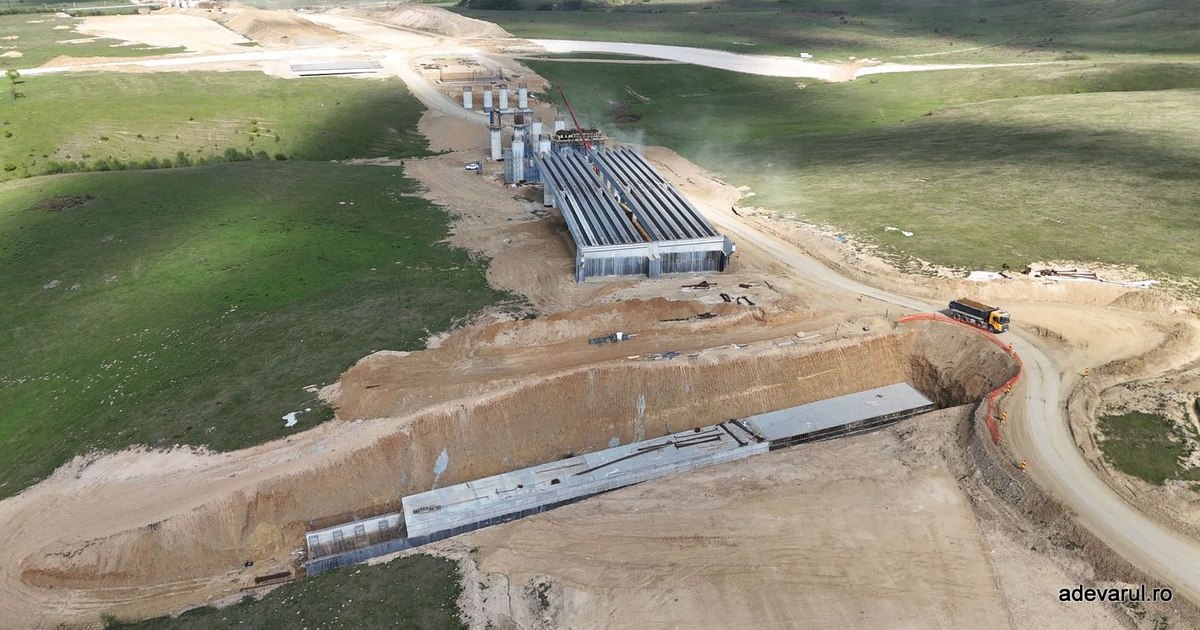
Under construction since 2025, the A13 Sibiu – Făgăraş Highway has exceeded the 30 percent threshold on some segments. The first beams of the future bridges and viaducts, the most complex works of the project, were installed on the route, next to the Boita road junction.
Sibiu – Făgăraș highway, on Valea Avrigului. Photo: Daniel Guță. TRUTH
The first bridges and viaducts took shape on the route of the A13 Sibiu – Făgăraș Motorway, which entered the construction site at the beginning of 2025. The “Tara Oltului” or “Tara Făgărașului” highway follows a route almost parallel to the Olt valley, on its upper course, between the localities of Boita, in Sibiu County, located about 20 kilometers from Sibiu, and Făgăraș, in the County Brasov.
On one side of the future highway, the villages with Romanian and Saxon origins from the hilly area north of the Carpathians line up, and on the other side, like a real wall raised over the Olt meadow, the Făgăraș Mountains captivate the attention of travelers on National Road 1 Sibiu – Brașov.
The A13 Sibiu – Făgăraș highway, with a length of 68 kilometers, was divided into four segments, all of which were built by the same company, Makyol. The Turkish consortium won the contracts, worth a total of approximately 6.5 billion lei, excluding VAT, in 2023, with 12 months for the design and 36 months for the execution of each section.
Over a year since the start of the works
The works on the A13 highway started in December 2024, on Lot 3 Arpașu de Jos – Sâmbăta de Jos, with a length of 18 kilometers. On this section, according to the Center for Road and Informatics Technical Studies (CESTRIN), within the National Road Infrastructure Administration Company (CNAIR), the physical stage of the project has reached 35 percent, and the construction has a deadline of 2027.
The Regional Directorate of Roads and Bridges Brașov recently informed that approximately 500 people and over 150 machines were mobilized in the construction site.
“The constructor is currently focusing on the construction of the 27 structures — bridges, passages, viaducts —, the concrete beam factory has also been commissioned and the first metal structures are being assembled”DRDP Brașov showed.
In May 2025, Lot 2 of the A13 Highway, on the Avrig – Mârșa – Arpașu de Jos route, with a length of 20 kilometers, also entered the construction site. Here, the physical progress of the works reached almost 30 percent, and around 400 workers and over 150 machines were mobilized on the site.
“The work focused on pouring foundations and concrete structures, and the first concrete beams on bridges and walkways were installed”recently informed DRDP Brașov. By 2028, the builders will have to complete the highway segment.
In July 2025, the builders began work on Lot 4 of the highway, between Sâmbăta de Sus and the municipality of Făgăraș, on a length of 16 kilometers, as well as on the connecting road with DN1 Sibiu – Brașov, of 5.6 kilometers. The physical stage of the project has reached 20 percent on this section, which is expected to be completed in 2028.
Section 1 of the highway, between the towns of Boita and Avrig, began work in August 2025, and currently the work stage has reached 9 percent. This segment is also the most complex of the future highway, with the Boita node being built on it, which will ensure high-speed interconnection between the A1 (video) and A13 highways and the National Road 7.
Kilometer zero of the Sibiu – Pitesti Highway. The Boita tunnel takes shape among the viaducts under construction
“The road junction includes numerous bridges, passages and even viaducts, on three levels, to be able to ensure connections in all directions”, CNAIR transmitted.
The nodes, gateways to the tourist areas of Făgăraş
Road junctions will be built on the highway route at Mârșa/Avrig, Arpașu, Sâmbăta, Victoria, Ileni and Făgăraș. Each of the six nodes will be able to be used as an exit to the tourist areas at the foot of Făgăraş.
Image 1/14:
The Făgăraș motorway under construction, on Valea Avrigului Photo Daniel Guță THE TRUTH (14) jpg
The Boita interchange connects the highway to Valea Oltului, the old pass through the Carpathians between the historical regions of Transylvania and Muntenia. Crossed by the DN7 Sibiu – Râmnicu Vâlcea and, from the following years, by the A1 Sibiu – Pitesti Highway, Valea Oltului is a gateway for tourists to the Făgăraș, Cozia, Lotrului and Parâng Mountains, but also to the spa resorts on the Oltului Valley: Călimănești – Căciulata, Govora and Olănești.
The Avrig node brings tourists to the Avrig and Porumbacu valleys, developed in recent years at the foot of Făgăraș, with investments in several amusement parks and recreational areas. From here, travelers can climb to the heights of Făgăraş, on the route of the Avrig glacial lake, or continue their journey to the hilly area studded with villages with Saxon characteristics.
New highways emptying national roads and threatening roadside businesses
The Arpașu interchange will connect the Transfăgărășan highway (DN 7C), the most spectacular mountain road in Romania, which crosses the Carpathians on the ridges of Făgărășu, connecting Argeș and Sibiu counties. Its route starts from the area of the village of Cârțișoara and climbs towards the Bâlea Waterfall and the Bâlea caldera, reaching an altitude of 2,042 meters, near Bâlea Lake. After crossing the Bâlea-Capra mountain tunnel, the road descends towards Argeșului Valley, past Vidraru Lake and Poenari Citadel, to Curtea de Argeș.
The Sâmbăta highway interchange will facilitate the access of tourists to the Sâmbăta de Sus monastery, a place of pilgrimage sought by Romanians. The monastery where the priest Arsenie Boca also served was built at the end of the 17th century by the family of ruler Constantin Brâncoveanu.
The Victoria node will connect the highway to the city of Victoria, also a starting point on the tourist routes to the highest peaks in Făgăraș: Viștea Mare (2,527 meters), Negoiu (2,535 meters) and Moldoveanu (2,544 meters).
The Ileni and Făgăraș interchanges connect the highway to the city of Făgăraș, sought after by tourists for its medieval fortress, restored in recent years.