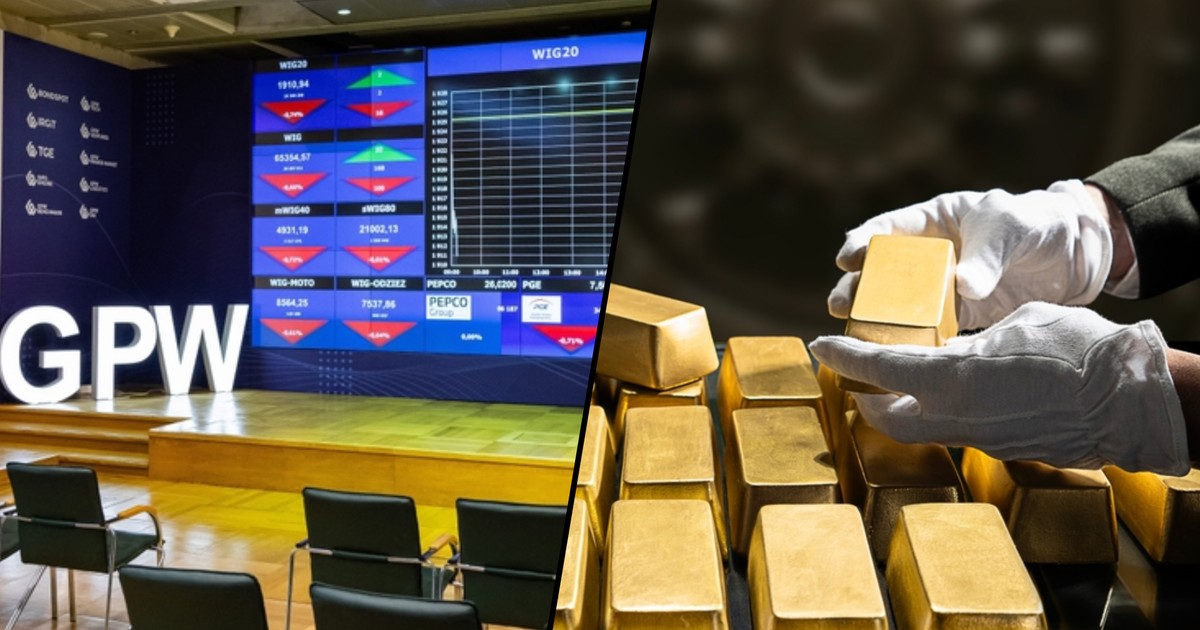
Poles are becoming more and more bold when it comes to investing their savings. Gold enjoys considerable investment interest. And you can invest in this way not only by physically purchasing the precious metal. This is why, among others, funds, including ETFs.
The first Polish gold ETF has just debuted on the Warsaw Stock Exchange – PZU ETF Gold Portfelowy FIZ. The fund tracks gold prices using futures contracts quoted on the world's most important commodity exchange, the COMEX in New York.
“Royal bullion in the form of an investment fund can be a good addition to a diversified investment portfolio” – comments Dariusz Kędziora, vice-president of the management board of TFI PZU.
See also: Record gold and silver prices may return. Experts point out the condition
“Many years of history show that gold has usually performed much better than risky assets, and in many cases recorded positive rates of return during deep declines in the S&P 500 index. It is this ability to protect capital in the most difficult market episodes that determines the role of gold in a long-term investment portfolio,” he emphasizes.
The first Polish gold ETF aims to replicate the Bloomberg Gold Subindex Total Return indexwhich tracks the performance of investments in gold futures contracts traded on the New York Commodity Exchange Inc. The fund will therefore use synthetic replication. The fund's benchmark is a component of the broader Bloomberg Commodity Index (BCOM).
The PLN-hedged structure is intended to eliminate the impact of exchange rate changes on the final investment result, so that the fund follows gold prices expressed in dollars as faithfully as possible.
ETF – what is it?
ETFs, i.e. Exchange Traded Funds, are investment funds listed on the stock exchange, the purpose of which is to reproduce the behavior of a specific index, economic sector, raw material or group of assets. They are characterized by the fact that they can be bought and sold on the stock exchange just like shares, which makes them liquid and easily accessible to investors.
See also: Gold overhyped? Arguments for and against and an alternative
ETFs are popular mainly due to low management costs, high diversity and the ability to diversify investments even with small capital. Thanks to them, an investor can invest in many companies or assets at the same time without having to buy each instrument separately.
ETFs also have some disadvantages. First of all, their value depends on the market situation, so the investor may suffer losses in the same way as when investing in shares. Some ETFs track entire indices, so during declines, all companies in the fund lose, even the more stable ones. Some funds may also have low liquidity, which makes it difficult to quickly buy or sell at a favorable price.