The leu continues its depreciation, and the euro reaches a new historical high a day before the censure motion. “We've seen a lot of money going out of the country these days!” says a dealer


The euro is approaching 5.2 lei, at the rate announced by the National Bank on Monday, one day before the vote decided by the Parliament for the Bologna Government.
On Monday, the BNR calculated an average of euro/leu transactions at 5,1998 lei for one euro.
The leu started to depreciate starting last Wednesday, April 29, when it exceeded the threshold of 5.10 lei for the first time, from May 2025 until now, both on the interbank market and at the BNR exchange rate. On Thursday, the leu depreciated against the euro to the value of 5.14 lei for one euro. It was the lowest value since 2005, when the Central Bank calculates the average at which currency transactions take place. A close value was on May 8, 2025, after George Simion had won the first round of the presidential election.
“We've seen a lot of money going out of the country these days!” says a dealer
“Foreigners are withdrawing from lei, but it is not clear if they took into account a specific result of Tuesday's vote or they simply want to avoid this period of instability. For now, the new equilibrium threshold is 5.2 lei for one euro”, says the currency dealer of a large Romanian bank in a discussion with HotNews.
According to him, the BNR has no reason to intervene and probably won't intervene if things don't slip massively. “It would be an unnecessary expenditure from the foreign exchange reserve now. We may see interventions from a threshold of 5.25 lei/euro. Anyway, we have seen large outflows of money from the country these days,” he added.
In the opinion of the quoted dealer, it does not help either that Romania's economy is still unbalanced, with large twin deficits, even if in adjustment, and with chronic political instability, which calls into question the will to carry out the reforms that the country committed to in front of investors.
What Monday's analysis of a local bank shows
“In recent years, the exchange rate served as an anchor for financial stability (among the few), because we faced multiple adversities, and the cards were not on our side”, says BRD in an analysis published on Monday.
The relevance of the artificial maintenance of the stability of the leu stems from the dysfunctional tandem between monetary and fiscal-budgetary policy:
- High inflation and the need to anchor inflationary expectations, given that exchange rate depreciation has a relatively high spread, especially in the services sector (rents, mobile phone bills, airline tickets). In practice, such a depreciation would have further fueled the inflationary impulse.
- The limited capacity of the domestic market to absorb public debt, which led to a notable increase in the share of external debt, inherently amplifying the sensitivity of debt servicing costs to exchange rate fluctuations.
- The still significant share of private credit denominated in foreign currency (about one third).
- Public anxiety about exchange rate fluctuations, a lingering legacy of the Swiss franc episode, but often also fueled by the media. While an overvalued exchange rate is commonly perceived as an impediment to foreign trade, its depreciation can provide exporters with a temporary breath of fresh air in the short term. The real factors capable of increasing and sustaining competitiveness in the medium and long term are diversification (in markets, sectors and products), efficiency gains and innovation. They should rightfully form one of the key pillars of the national development strategy.
- Equally important, the exchange rate theoretically shows parity between two currencies as dictated by economic and financial fundamentals – not a political parity. Linking exchange rate movements to political interests is a dangerous chimera, unfortunately reinforced by the leu's limited reaction to broader geopolitical and economic developments (see comparison with other Central and Eastern European currencies), the authors of the analysis conclude.
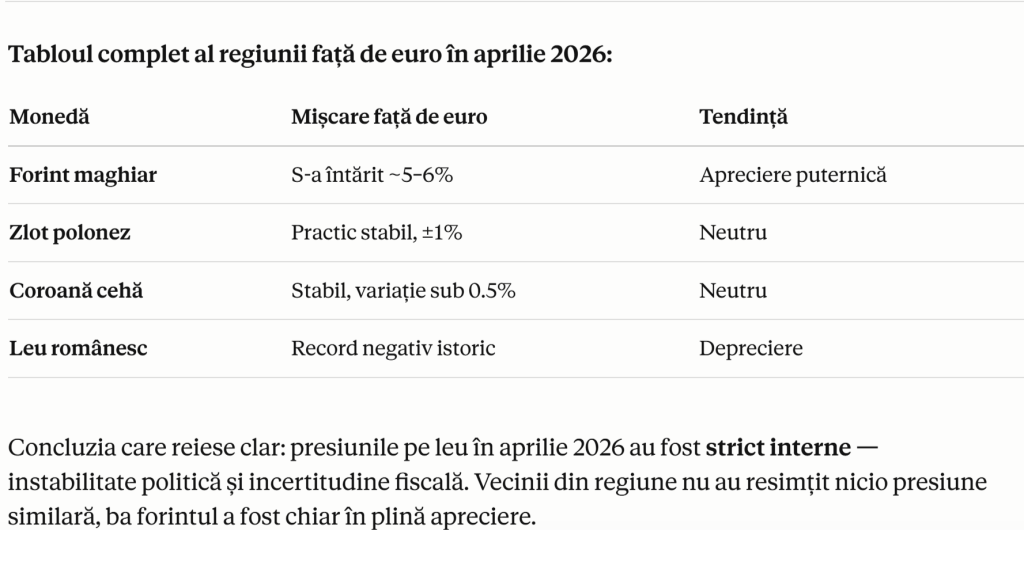
In the region, the picture is different
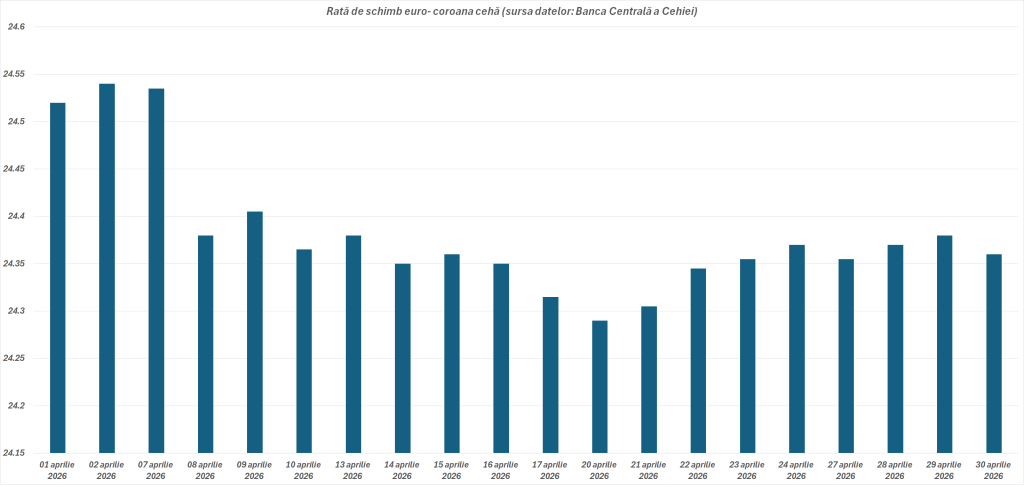
In the region, the Czech crown appreciated against the euro in April. Compared to the Romanian leu, the difference is significant: while the koruna remained practically unchanged against the euro, the leu depreciated noticeably, reaching a new historical maximum on April 30, 2026 at 5.1417 lei/euro — a sign that the pressures on the leu are internal (political, fiscal), not regional.
The forint strengthened significantly against the euro in April
The high point of the forint against the euro in the last year was reached on April 17, 2026, when one euro was worth 361.79 HUF, the strongest forint in recent years.
Over the past 6 months, the euro has lost 5.9% against the forint — a clear strengthening trend for the Hungarian currency.
In concrete figures: the forint started April at a rate of 385 HUF against the euro and ended it at 365 HUF.