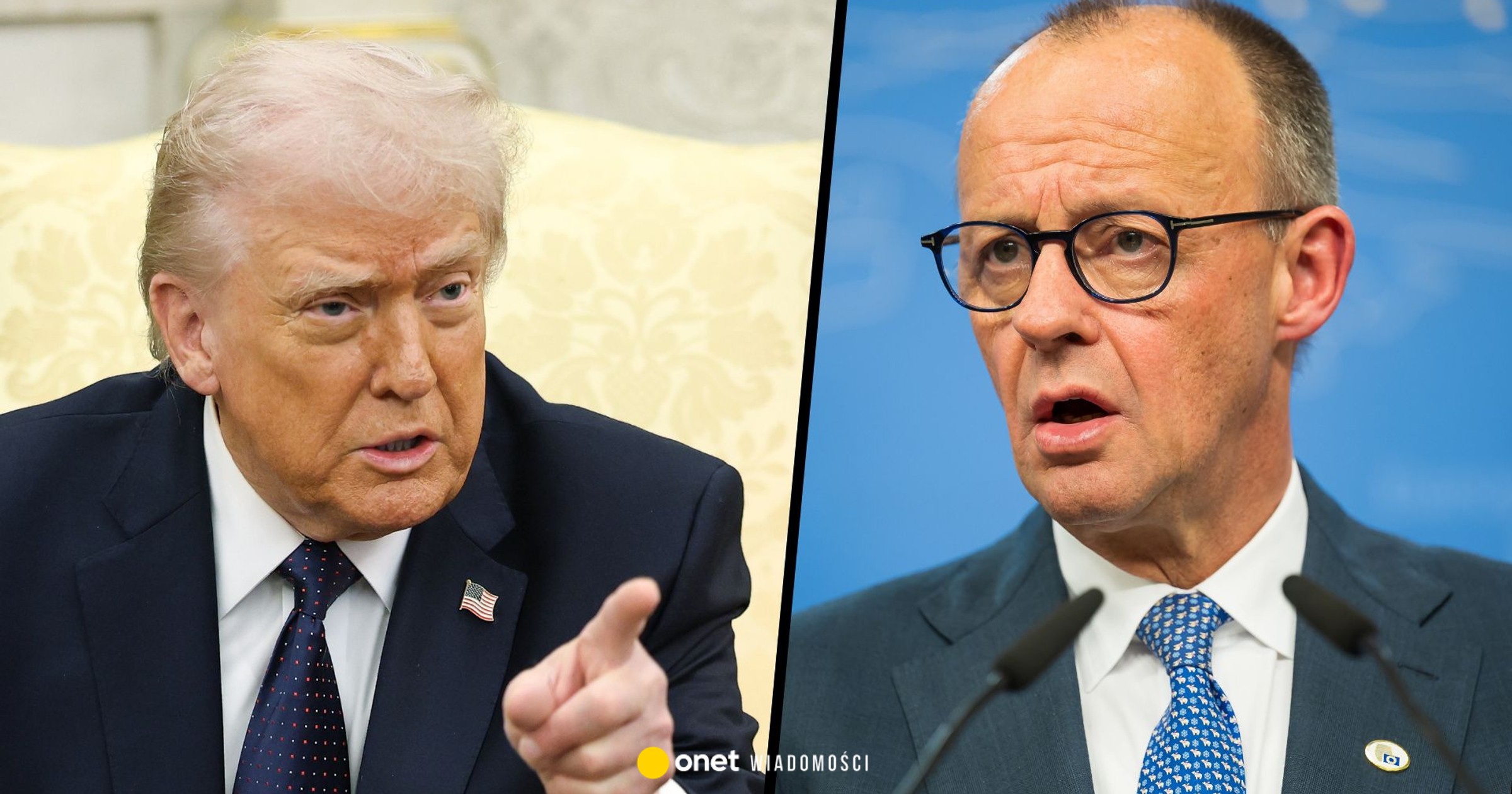
After Trump announced plans to limit the US military presence in Germany, the EU expresses concern about the relations between the two countries. The SPD doubts the US president's interest in transatlantic relations. AfD criticizes Chancellor Merz.
Relations between Germany and the United States are in crisis. Donald Trump announced over the weekend that he would withdraw some American troops from Germany. First he talked about 5,000 out of about 39,000. American troops deployed to the country, later said it would be “significantly more than 5,000.”
Moreover, the US Department of Defense announced the suspension of the planned deployment of medium-range missiles in Germany. These systems were intended, among other things, to deter Russia.
This is the result of a dispute between German Chancellor Friedrich Merz and US President Donald Trump. In recent days, there has been a sharp exchange of blows.
Merz said, among other things, that the United States is being humiliated by the leaders of the Iranian regime. German Defense Minister Boris Pistorius said the withdrawal of some American troops from Germany was a predictable step. And that European NATO member states must “take greater responsibility for their security.”
— Our Bundeswehr is growing, we are acquiring more equipment faster, focusing on innovation, and we are building more infrastructure, he said.
NATO spokeswoman Allison Hart called on the alliance's European members for greater involvement. She said Trump's move highlights “the need for Europe to continue investing in defense and take more responsibility for common security.”
— Transatlantic relations are under pressure, said Juergen Hardt, foreign policy spokesman of the CDU/CSU parliamentary group. — One of the reasons is the unilateral program of the US president, who attributes everything that goes wrong in the United States to external influences. Europe is often a scapegoat for him.
“Tool of Whimsy”
Hardt said this should be countered by a “positive transatlantic agenda” that would offer benefits for both sides. He mentioned, among others: about US interests in Latin America, the Pacific and the Arctic, as well as cybersecurity and the fight against international crime, which are also important for Germany. — Europe will consistently and noticeably relieve the United States of conventional defense tasks on our continent, he said. He added that this must be done gradually, without creating the impression of arbitrariness.
Thomas Erndl, spokesman for defense policy of the CDU/CSU parliamentary group, said that European NATO member states must assess the effects of the partial US withdrawal from Germany and draw conclusions from it. — Our ambitions to become the strongest conventional army in Europe impose a special responsibility on Germany. We will meet this goal by rapidly increasing the number of staff [armii] and expansion of key capabilities, he said. He added that the German Ministry of Defense must present an “action plan 2029” for the Bundeswehr, which also includes the ability to use long-range weapons.
The SPD (Social Democratic Party of Germany) considers the partnership between the US and Europe established after World War II to be “one of the basic conditions for prosperity and security.” Vice-chairman of the SPD parliamentary club, Siemtje Moeller, assured that her party wants to “stick to this special transatlantic relationship.” But the US president apparently has a different opinion.
The article continues below the video
“With his unpredictable policies, he makes the safety of hundreds of millions of people a tool of his whims,” she said. She added that in the face of Trump's threats, Europe must make it clear with confidence European security is also in the interest of the US. — It cannot be that one person threatens such a valuable value as the proven cooperation of many countries. We must strongly oppose this, she added.
She also noted that Trump's withdrawal from the agreed deployment of medium-range missiles in Germany would be worrying. — As a first step, we should quickly meet with France and Great Britain to, as part of the so-called E3 format to discuss how we can quickly fill the emerging gap in defense policy, she added.
“A clumsy attempt to exert pressure”
The Alternative for Germany (AfD) commented on this in a slightly different way. She noted “legitimate points of criticism” about the US war with Iran, arguing that closing the Strait of Hormuz hurts Germany more than the United States. She added that Merz must convey Trump's criticism of the port blockade. — We need to raise these issues, and not as the German chancellor saying some nonsense about humiliating the entire nation, said Jan Nolte, spokesman for the AfD parliamentary group in the Bundestag for defense policy.
“When it comes to long-range weapons systems, Europe will have a capability gap for five to 10 years,” Nolte added, saying filling it must be a top priority regardless of the stationing of U.S. forces. — NATO's deterrence ability, however, does not depend on these weapons, but on the potential of the entire alliance, said Nolte. — In the event of an emergency, these systems would have to be moved from the United States to Europe. This would mean a delay, but not a complete abandonment.
Die Linke (The Left) sees Trump's announcement of withdrawal as “a failed attempt to put pressure on Europe to make concessions on Iran”. — Trump faces defeat in the illegal international war of aggression in Iran he has started, said Ulrich Thoden, spokesman for the Left faction on defense policy.
— Now this US president, unable to accept criticism, is trying to make this failure a problem for his allies as well. However, he stopped treating Europeans as allies a long time ago, he added. He stated that Germany must refocus its foreign policy and end “unilateral dependence” in favor of “wide-ranging partnerships” with countries of the global South. — As long as Trump has the means of pressure on Europe, he will abuse them [realizacji] its political goals, he said.
In his opinion, the withdrawal of 5,000 American troops does not constitute “a significant loss of defense capabilities for either Germany or Europe.” — On the contrary, given Trump's unpredictable and contradictory policies, the presence of US troops on European soil is rather a potential threat to Europe, he said. The lack of deployment of missiles, in his opinion, is an opportunity for European disarmament initiatives. “Deploying missiles would involve the risk of an arms race using similar weapons systems,” he said.
The Green Group in the Bundestag did not respond to Die Welt's request for comment.
I’m Ashley Davis as an editor, I’m committed to upholding the highest standards of integrity and accuracy in every piece we publish. My work is driven by curiosity, a passion for truth, and a belief that journalism plays a crucial role in shaping public discourse. I strive to tell stories that not only inform but also inspire action and conversation.