The new US strategy means the end of illusions. Europe can no longer count on a miracle. But autocrats all over the world are rubbing their hands [OPINIA]
— It must be the policy of the United States to support free nations that resist external pressure or attempts by armed minorities to seize power over them by force, said former U.S. President Harry Truman during a speech before Congress in 1947. The Truman Doctrine, as the approach was called, recognized the defense of democracy abroad as a matter of vital U.S. interest — but that is not a view shared by President Donald Trump and his supporters.
If anyone doubted this – or hoped that Vice President J.D. Vance made a statement when he lashed out at Europe during the Munich Security Conference earlier this year – the new US National Security Strategy (NSS) should finally settle the issue.
All U.S. presidents announce such a strategy at the beginning of their term to outline their foreign policy approach and priorities, which in turn influence how Pentagon funds are allocated. And after reading all 33 pages of the document The world's despotic leaders have much to be happy about and democrats to worry about, especially in Europe.
The new security strategy, concretizing the meaning of the Trump administration's slogan “America First”, is a decisive break with Truman's policy and the order established after 1945 by subsequent US presidents. It is primarily about obtaining mercantilist benefits, and its main principle is the law of force.
In the future, Trump's foreign policy will not be “based on traditional political ideology,” but driven by “what is good for America” Clearly, it is to America's advantage to go easy on autocrats, both theocratic and secular, and to turn on traditional allies in a surprising act of betrayal.
Of course, the hostility that the NSS shows towards Europe should come as no surprise – Trump's closest advisers they barely hide their contempt for the EUand the president said he believed the alliance was created to “screw” the United States. However, this does not ease the pain.
Over the weekend, EU foreign policy chief Kaja Kallas tried to keep a cheerful face despite the harsh language used by the NSS towards European allies, telling international leaders at a forum in Doha: – We have not always agreed on various issues. But the general principle remains unchanged: we are our greatest allies and we should stick together.
However, other experienced European politicians recognize that the new strategy represents a significant departure from what came before.
The only region of the world where the new security strategy sees a threat to democracy seems to be Europe. That's weird
— said Carl Bildt, former Prime Minister of Sweden and co-chair of the European Council on Foreign Relations.
He's right. As Bildt noted, NSS contains no mention, much less criticism, of the authoritarian behavior of the “axis of autocracy” — China, Russia, Iran and North Korea. He also rejects an interventionist approach to autocracies or urging them to adopt “democratic or other social changes that depart significantly from their traditions and histories.”
For example, the 2017 NSS portrayed China as a systemic global competitor in a very hostile tone. “There is a geopolitical competition taking place in the Indo-Pacific region between a free and a repressive vision of world order,” the document notes. However, the latest version does not contain such wording, which is a clear signal that Trump wants to ease tensions; the new overarching goal is to ensure “mutually beneficial economic relations”.
Everything should be fine as long as China stays out of the Western Hemisphere, which is the domain of the United States – although it must also abandon any plans to invade Taiwan. “Containing conflict over Taiwan, preferably by maintaining military superiority, is a priority,” the NSS says.
Beijing and Moscow are delighted
Similarly, to Moscow's obvious satisfaction, the document does not present Russia as an adversary — unlike the 2017 strategy, which described it as its main geopolitical rival. Not surprisingly, Kremlin spokesman Dmitry Peskov welcomed the NSS as a “positive step” and “largely consistent” with Russia's vision. “Overall, these messages certainly contrast with the approach of previous administrations,” he said.
While Beijing and Moscow appear delighted with the NSS, the document contains the harshest language and harshest remarks against America's traditional allies in Europe.
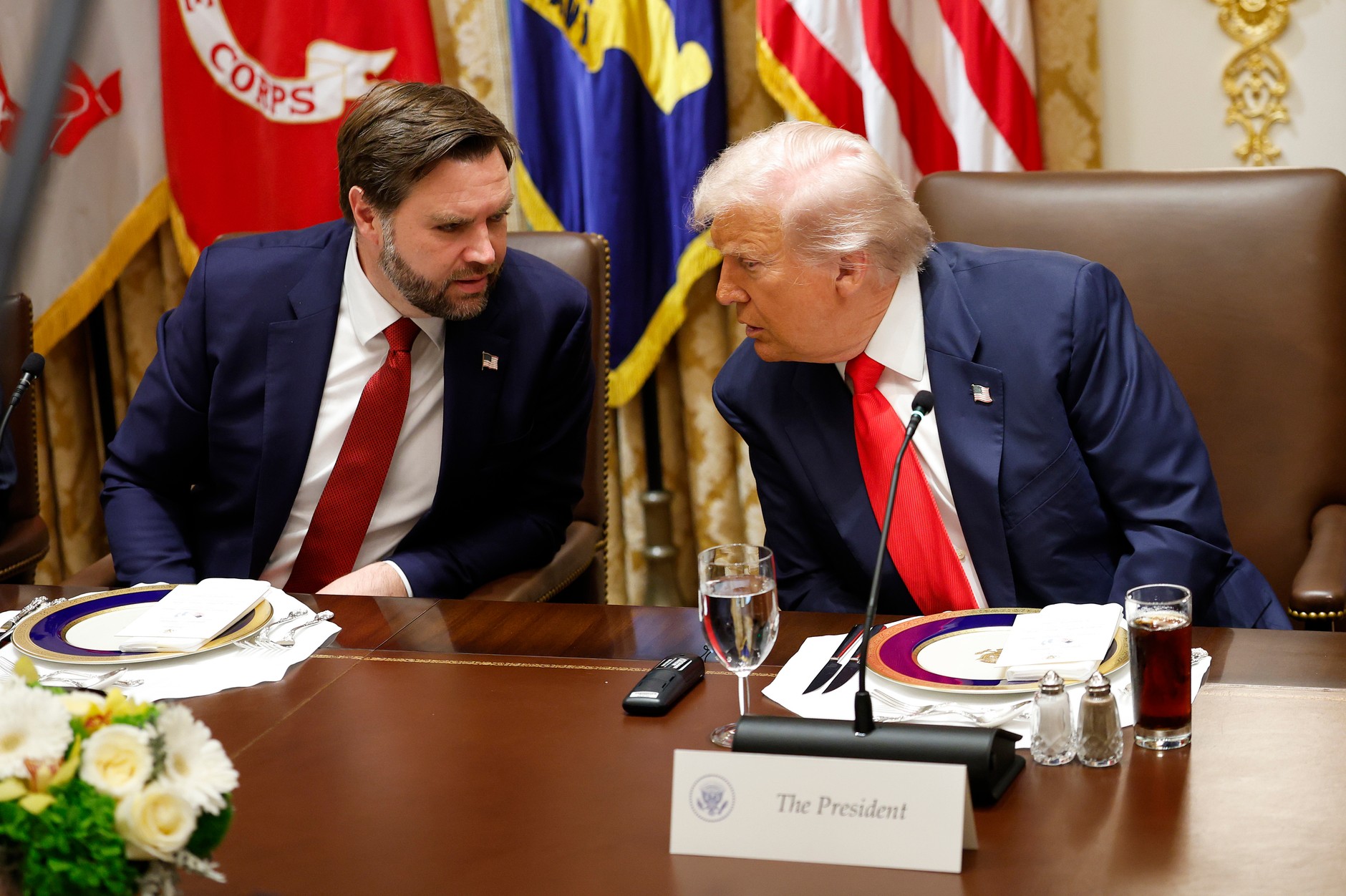
U.S. Vice President J.D. Vance and President Donald Trump at the White House in Washington, D.C., October 14, 2025.Kevin Dietsch/Getty Images/Getty Images
— According to the NSS, the fundamental problem of the European continent is the neglect of “Western” values (understood as conservative nationalist values) and the “loss of national identity” caused by immigration and the “rapid decline in birth rates,” noted Liana Fix of the Council on Foreign Relations. – The alleged result of this is economic stagnation, military weakening and the disappearance of civilization.
The new strategy also criticizes America's European allies for their alleged “anti-democratic” practices, accusing them of censorship and suppression of political opposition, an extension of Vance's criticism in Munich. What is disturbing is that the NSS talks about cultivating resistance in European countries by supporting “patriotic” parties. This threat caused much consternation when Vance first made it, but is now being portrayed as official administration policy.
Either way, Europe will pay
Regime change in Europe, but not in autocracies, is a cause for great concern. So how will Europe respond?
Will he flatter Trump as “daddy” as NATO Secretary General Mark Rutte did in June? Will it pretend that the American administration is not serious and somehow get out of it by ignoring the insults? Will it take the punishment and shut down like it did with the higher tariffs? Or maybe it will become more decisive and take the issue of strategic autonomy seriously?
Europe once again finds itself in a situation where in which he must make fundamental decisions — and quickly. However, acting quickly is not Europe's strong suit. Admittedly, this is no easy task for a bloc that makes decisions by consensus in a process designed to be extremely slow.
It won't be an easy road at the national level either, where all 27 countries face serious economic challenges and deep political divisions that Washington is trying to stoke. With the help of Trump's ideological allies such as Hungarian Prime Minister Viktor Orban and Slovak Prime Minister Robert Fico, this impasse will only deepen in the coming months.
Trump 2.0 is a sea change from the president's first term – much more triumphalist, self-confident and uncompromisingly mercantilist; more determined to ignore limitations; and more revolutionary in the way the “America First” program is implemented. NSS only makes it visible, a cries of discontent from critics will only embolden the administrationwhich sees the protests as proof that it is on the right track.
European leaders have received plenty of warnings, but beyond eye-rolling, hand-wringing and wishful thinking, they have failed to agree on a plan of action. But this time, trying to wait it out won't workand efforts to impose a very unfavorable “peace” agreement on Ukraine may ultimately lead to the collapse of the Western alliance.
Whether the EU bends or resists, it will bear the costs one way or another.
I’m Ashley Davis as an editor, I’m committed to upholding the highest standards of integrity and accuracy in every piece we publish. My work is driven by curiosity, a passion for truth, and a belief that journalism plays a crucial role in shaping public discourse. I strive to tell stories that not only inform but also inspire action and conversation.