Leningrad has become a front-line region, Russian officials complain. Evaluation of the intelligence services of Ukraine

The situation of the energy infrastructure in the Russian region of Leningrad is deteriorating amid the intensification of Ukrainian attacks, Governor Alexander Drozdenko informed former Russian President Dmitry Medvedev and current Vice President of the Security Council, in a televised briefing on April 30, Kyiv Independent reports.
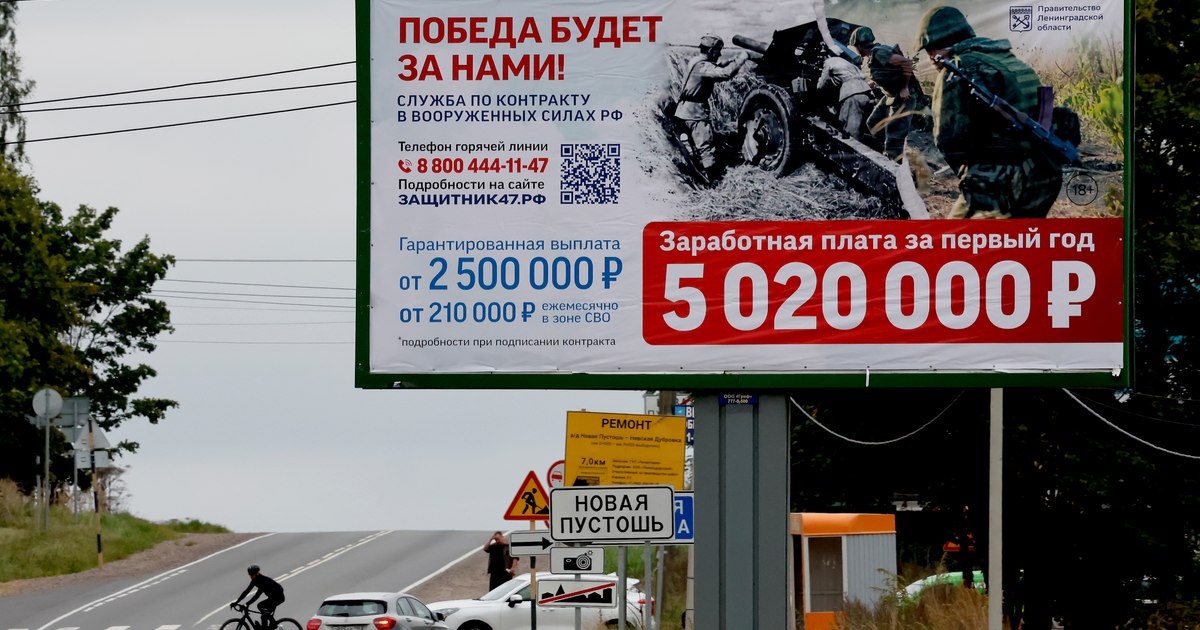
Recruitment announcements in the Leningrad region PHOTO EPA-EFE
“Leningrad is no longer just a border region, but also a front-line region”said Drozdenko. He pointed out that the frequency of Ukrainian attacks in March and the first half of April indicates that Ukraine is targeting critical infrastructure: “Judging by the intensity of the attacks in March and mid-April, the facilities of the fuel and power complex, as well as the port infrastructure, are of interest to the enemy from the perspective of causing damage.”
According to the Russian authorities, Ukraine has in recent weeks intensified its strikes on the oil infrastructure in the region, targeting in particular the terminals in the ports of Ust-Luga and Primorsk. Although the Leningrad region does not border Ukraine, its location in western Russia and access to the Baltic Sea make it a strategic target, especially in the context of Kiev's development of long-range strike capabilities.
The first attacks on the region were launched on March 22, and in the following weeks the ports were hit repeatedly, damaging fuel tanks, several oil tankers and elements of the port infrastructure.
The ports of Ust-Luga and Primorsk, located approximately 1,000 kilometers from Ukraine's nearest border, play a key role in Russia's economy. Ust-Luga is one of the largest ports on the Baltic Sea and a major hub for the export of crude oil and petroleum products. Primorsk, for its part, handles about 60 million tons of oil annually and is Russia's main oil export hub in the region.
Drozdenko also informed Medvedev that in the first three months of 2026, Russian air defenses would have shot down 343 drones over the Leningrad region.
The impact of these attacks is significant. According to a Reuters estimate on March 25, drone strikes, pipeline damage and the seizure of tankers have blocked about 40 percent of Russia's oil export capacity — the worst oil supply disruption in the country's modern history.
In recent months, Ukraine has stepped up its attacks on Russian energy infrastructure in an effort to cut off the Kremlin's main source of income amid a sharp rise in oil prices, also fueled by the conflict in Iran.
Volodymyr Zelensky: Ukrainian attacks reduced Russia's oil exports
Ukrainian President Volodymyr Zelensky said Kiev's long-range attacks are increasingly affecting Russia's oil export infrastructure as Moscow simultaneously seeks to undermine Ukraine's international defense partnerships and expands its military presence in Africa, the Kyiv Post reports.
According to a report presented by the head of Ukraine's Foreign Intelligence Service, Oleh Luhovskyi, there has been a significant drop in Russian oil export volumes through key ports. Thus, exports through Primorsk decreased by 13%, those through Novorossiysk by 38%, and through Ust-Luga by 43%. Zelenskiy pointed out that Russia's internal data may underestimate the true scale of losses.
“We will continue operations aimed at reducing Russia's oil revenues and export volumes”emphasized the Ukrainian leader.
The report also highlights Russia's efforts to counter expanding international defense cooperation in Ukraine, including so-called “drone deal” initiatives. According to Ukrainian intelligence, Moscow views Kiev's ability to attract foreign investment as a major strategic challenge.
In this context, Russia would try to block Ukraine's access to investments and disrupt bilateral agreements on security and arms production, with a special focus on limiting relations with partners in the Middle East and the Gulf region.
Separately, Ukrainian services claim that Russia has recently increased its military forces in Africa by about 8,000 soldiers. At the same time, Moscow is actively promoting the use of drones on the continent, by providing equipment, developing local production and training programs.
Zelenski warned that this expansion could have wider security consequences, contributing to the strengthening of terrorist organizations, increased cross-border crime and instability in regions strategic from a migration point of view.
“It is important to counter these developments together – we will coordinate actions with our partners“, the Ukrainian president added.