Goodzone's “Semi-Apocalypse”. How a huge mall in Moscow became the symbol of the Russian economic crisis

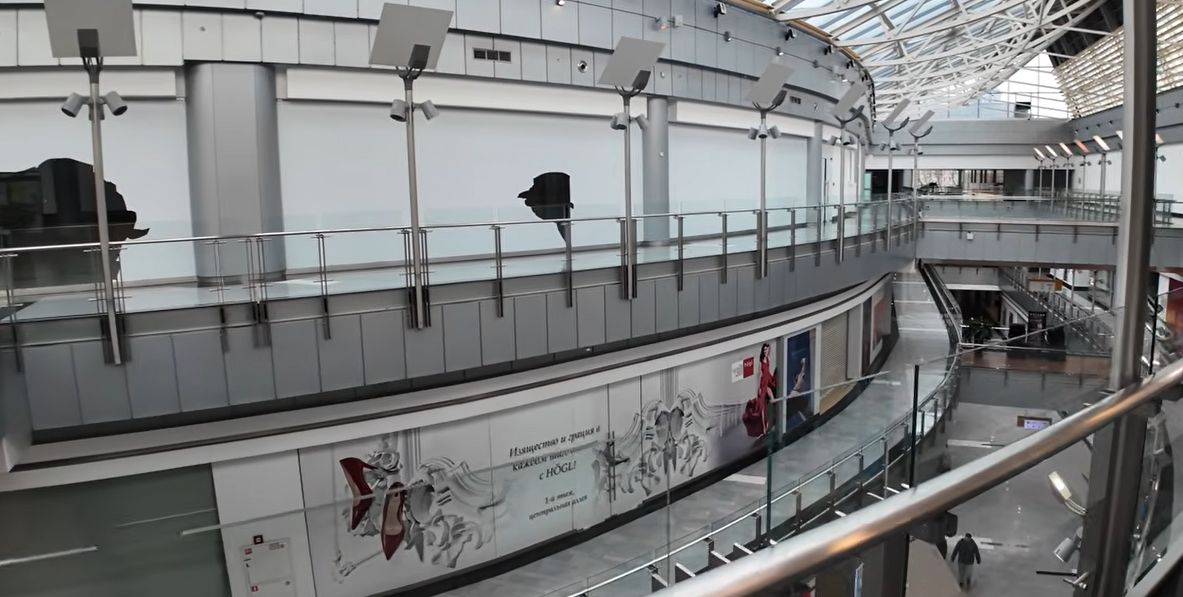
Empty commercial spaces, closed doors, padlocks on the doors, few customers, pop music in the background. This is the atmosphere in a shopping mall in a middle-class suburb of Moscow.
The almost deserted mall is a painful sign of the economic crisis in Russia, writes CNN.
The huge Goodzone mall opened in 2014. It also houses an eight-screen multiplex cinema, which now sits mostly empty, with the foyer lights turned off.
Although the mall is still open seven days a week, it now appears to be slowly dying.
In the wake of the large-scale invasion of Ukraine, an exodus of Western companies and unprecedented Western sanctions, Russia's economy has defied expectations, shifting to massive military spending and increased oil exports to China and India.
However, the economy is starting to show signs of weakness, with GDP contracting by 1.8% in the first two months of 2026.
Russian President Vladimir Putin acknowledged the problem at a government meeting on economic affairs in mid-April.
The Kremlin leader asked officials to explain “why the trajectory of macroeconomic indicators is currently not living up to expectations.”
The leader of the Russian Communist Party, Ghennadi Ziuganov, has warned that the country could face a Bolshevik-style revolution if the government fails to address the weakening economy.
Deserted mall, looks 'semi-apocalyptic'
While there have been no signs of mass social unrest in Russia, and other malls, including the giant Aviapark in northwest Moscow, appear to be doing well, several employees at Goodzone described to CNN with concern the dwindling number of customers there.
One of them was Ivan, a cashier at a branch of one of Russia's largest retailers, who asked CNN not to use his last name or reveal his job title. This is his second job and he cannot afford to lose it in the current climate, he said.
“Well, as far as the economic situation goes, that tells you something about the situation in the country,” Ivan said, pointing to his cash register screen.
The monitor shows 13 transactions so far this day, a total of a paltry 3,417 rubles, the equivalent of about $45. It's a Thursday afternoon in late April, and Ivan says that in better times the number of transactions would be closer to 300.
“(Goodzone Mall) looks semi-apocalyptic,” Ivan said. “The mall is so big, you could get lost and tired walking through it. It would seem like it was built and designed for a huge flow of people, but I didn't see it that way.”
“We use this store as a warehouse”
CNN has reached out to mall managers for a statement. The mall's website mentions that parts of it are being renovated and that new economic operators are coming in, but CNN has not seen evidence of this.
The website advertises commercial space for rent at incredibly low prices, starting at just 1 ruble (about $0.01) per square meter. Many of the empty stores were formerly home to Western brands that moved after the invasion of Ukraine.
Two women who work in the mall told CNN that very few people are knocking on the door of their store anymore. “We're basically using this store as a warehouse,” one of them said.
They said that things got worse after 2022 and that they have no hope that things will recover. He lamented the rise in prices and the stagnation of wages.
“The boom cycle is over”
To get more revenue, Russia last year raised income tax and profit tax, and the value-added tax (VAT) was raised to 22% starting January 1, 2026.
Ruben Enikolopov, a research professor at the Barcelona School of Economics, explained that at the start of the full-scale invasion of Ukraine, the Kremlin had low public debt and large reserves and pumped money into the economy through military spending.
“It works for a while, but that can't go on forever. Government spending helped the economy, but now the boom cycle is over. Reserves are dwindling and they have to find money from somewhere, that's why taxes have gone up,” explained Enikolopov.
Enikolopov said that while Moscow has benefited from high energy prices during the Middle East war, Ukrainian attacks on the Russian supply chain — particularly the continued targeting of refineries — have reduced the amount of oil Russia can sell.
The rich get richer, the poor get poorer
Another drag on the Russian economy is the state-mandated internet and mobile phone outages that have affected the capital and other major cities in recent months.
Oksana, from St. Petersburg, says the restrictions make it difficult for customers to communicate with the auto repair company they work for or prevent people from placing orders online. Putin has defended the restrictions as necessary for public safety.
Despite the restrictions and increased tax burdens, Russian billionaires have seen their combined wealth grow by 11 percent over the past year despite the sanctions, according to Forbes Russia.
“It's no secret: the war has increased inequality among the Russian population. We see the rich getting richer and the poor getting poorer,” Alexandra Prokopenko, a researcher at the Carnegie Russia-Eurasia Center in Berlin, told CNN.