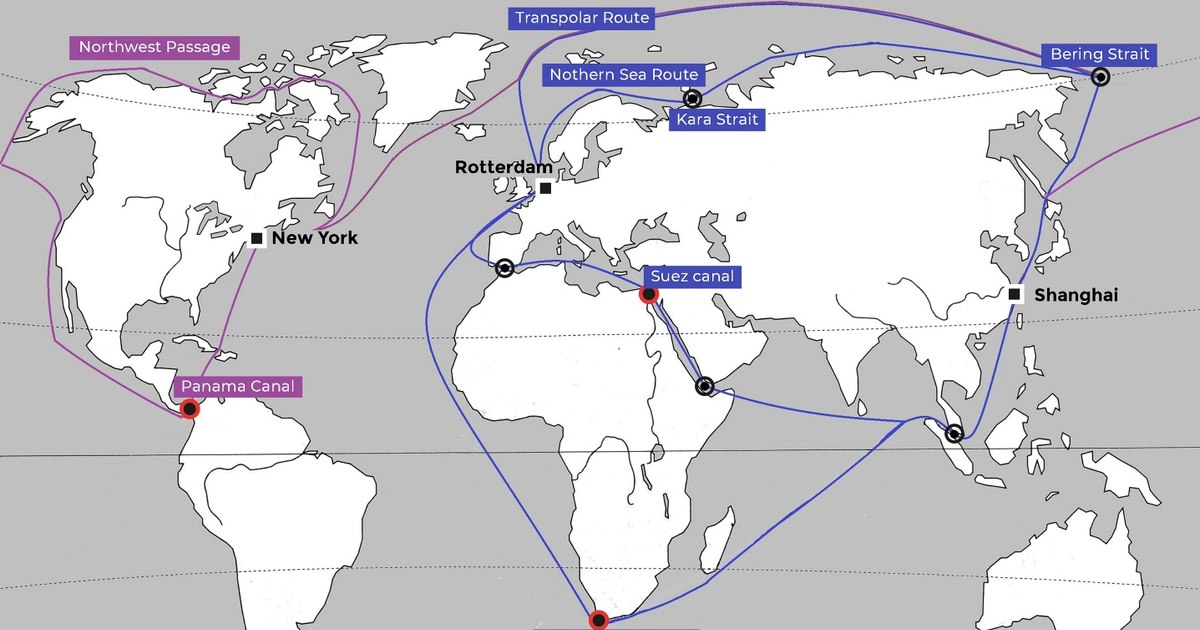
Blockages in the Strait of Hormuz and attacks destabilizing traffic in the Red Sea are forcing a rapid reconfiguration of global shipping routes, exposing the fragility of a system through which more than 80 percent of world trade flows. As traditional corridors become increasingly risky, attention is shifting to alternatives such as Arctic routes—shorter but still limited—in a world where geopolitics is beginning to redraw the map of global transportation.
Maritime routes will be reconfigured in the next five years. Photo Coface
In this context, traditional sea routes — already affected by geopolitical tensions, attacks on ships and trade uncertainties — are losing their predictability, and attention is gradually shifting to alternatives such as Arctic routes. According to a study by Coface, these routes benefit from the progressive opening generated by climate change, but their commercial potential remains limited for at least five years.
Shorter routes in an overburdened global maritime system
Maritime transport accounts for over 80% of world trade, being concentrated between three major regions – East Asia, Europe and North America – and structured around a limited number of strategic corridors. This concentration makes world trade vulnerable to geopolitical shocks.
The disturbances seen in recent months in the Red Sea, combined with tensions over the Strait of Hormuz and changes in international trade policy – particularly US policy – highlight this vulnerability. In this context, arctic routes appear to be a theoretical alternative, significantly reducing distances – by up to 40% between East Asia and Northern Europe and by about 20% to the East Coast of North America. Their increased navigability due to climate change raises questions about their economic viability.
A real potential, mainly focused on the transport of bulk goods
To assess the economic viability of these routes, the analysts compared the unit costs of shipping on Arctic routes and traditional corridors for two major routes – Asia–North Europe and Asia–North America – and for three main ship categories: oil tankers, bulk carriers and container ships.
The results show that, over a five-year horizon, Arctic routes will remain mainly dedicated to the transport of raw materials. Cost reductions are particularly significant for liquid bulk cargoes (crude oil, diesel, methanol or LNG), with reductions of up to 45%–50% in some cases. Dry bulk cargo (grains, ores, construction materials) can also become competitive, but mainly when ships can operate without icebreaker escort.
In contrast, containerized shipping remains uncompetitive despite the shorter distances. The operational constraints, limited vessel size and costs specific to Arctic shipping prevent it, at this stage, from competing with the economies of scale of traditional routes.
A limited global impact on trade, despite some sectoral winners
In total, the analysis shows, only 3.5% of trade between East Asia, Northern Europe and North America is likely to actually use Arctic routes. Their overall impact on the world trade map would therefore remain limited in the short term.
Iran will not reopen the Strait of Hormuz as long as the US maintains the naval blockade
However, certain sectors could benefit. This is especially true of the grain, energy, metal and wood industries.
“How should this be interpreted? 7% of the value of goods exported from North America to East Asia could be transported via Arctic routes. This represents $22 billion: $6 billion in dry bulk and $16 billion in liquid bulk”write Coface analysts.
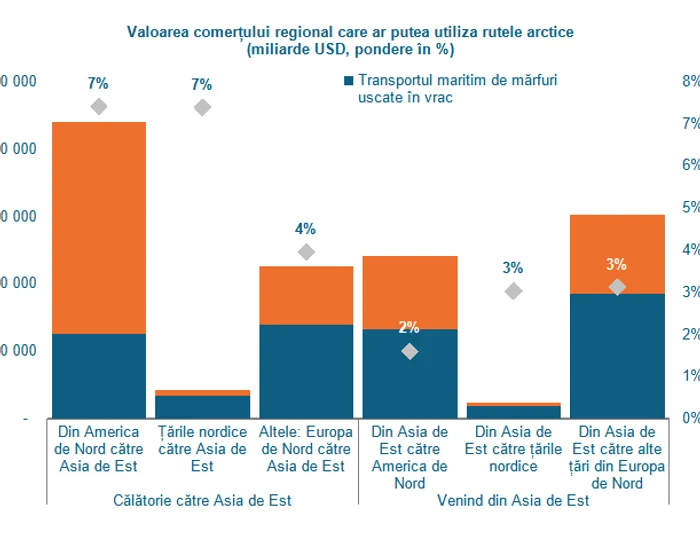
Bulk exporters based on the US Northeast coast or Northern Europe could thus improve their competitiveness in Asian markets due to lower transportation costs and shorter transit times. Conversely, certain competitors in South America (Brazil with iron ore, Chile with copper) or Africa (Democratic Republic of the Congo with certain minerals) could experience a decline in their relative transportation competitiveness.
In addition to producers, certain countries that depend heavily on traditional routes could also become vulnerable. Egypt and Panama, where revenues from their canals represent a significant share of GDP, are particularly exposed. Some major port hubs for Asia-Europe trade, such as Singapore or, to a lesser extent, Jebel Ali, could also see their strategic role called into question if some of the trade flows shifted north. The risk to these port hubs is, however, a long-term one, as Arctic shipping is not expected to open to container trade until 2030.
A trade route that represents a major geopolitical issue
Although Arctic routes offer an advantage in terms of distance, their development still faces significant constraints. Sailing periods remain seasonal, ice conditions remain variable and unpredictable, and the use of icebreakers is often essential.
The European Commission warns of the risk of an aviation fuel crisis. Blocking the Strait of Hormuz could affect flights
The Arctic thus became, first and foremost, an arena of growing strategic rivalry. The Northern Sea Route remains largely controlled by Russia, while China is gradually strengthening its polar presence and capabilities. And the United States is trying to increase its influence in the region. In this context, the development of Arctic routes is not only a matter of assessing logistical costs, but also involves issues related to sovereignty, control of critical infrastructure, access to resources and reshaping the balance of power.
In the short term, the value of these routes appears to be less commercial than political. Until container shipping on these routes becomes economically viable on a large scale, they are unlikely to radically disrupt major world trade balances.
“Arctic sea routes attract attention because they shorten distances. However, commercial interest – in the next few years – remains very limited and is mainly centered around raw materials“, the analysts conclude.