The Withdrawal of the United Arab Emirates from OPEC: Geopolitical and Economic Implications of a Historic Decision

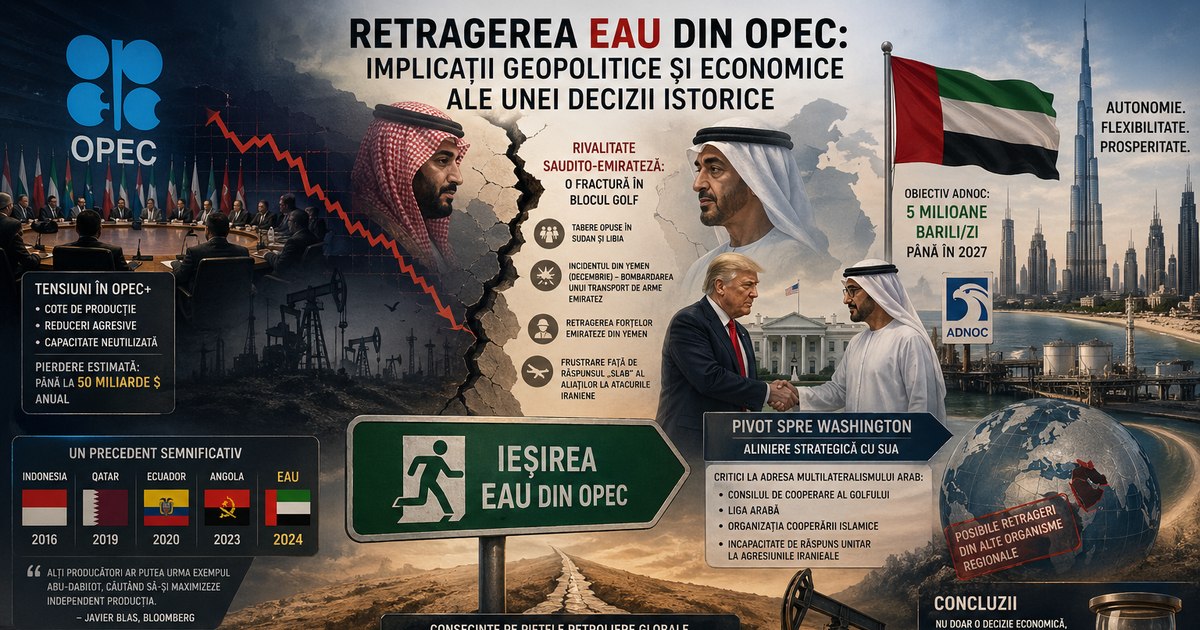
The UAE's decision to withdraw from OPEC marks a turning point in the global energy architecture and power dynamics in the Middle East. This move, long prepared behind the scenes, suddenly materialized — as Hemingway describes bankruptcy: first gradual, then sudden. This article examines the structural causes, geopolitical context and long-term consequences of this decision, which is reconfiguring not only global oil markets but also diplomatic relations in the region.
Accumulated tensions within OPEC
Abu Dhabi joined the oil cartel in 1967 and remained a relatively loyal member for decades, despite occasional internal friction. The situation has fundamentally changed since 2016, when Saudi Arabia — OPEC's de facto leader — co-opted Russia into an expanded formula called OPEC+. This expansion transformed the nature of the organization, diluting the influence of the original members and imposing a logic of political agreements with a power external to the region. The series of production quotas and aggressive cuts imposed under OPEC+ has put the UAE in a disadvantageous position. The national oil company ADNOC made major investments to expand production capacity, but the allocated quotas prevented their capitalization. According to a 2023 report by Rice University's Baker Institute for Public Policy, the UAE's unused surplus accounted for the largest share of total capacity within OPEC — a disproportionate burden with a growing trend. The same report estimated that leaving OPEC could bring an additional gain of up to $50 billion annually in oil revenues. The official reason given by the UAE authorities — the desire for flexibility to reach the ambitious goal of 5 million barrels per day by 2027 — is economically plausible, but insufficient to explain the whole picture. The geopolitical context adds essential dimensions to this decision.
The Saudi-Emirati rivalry: a fracture in the Gulf bloc
Geopolitical tensions between Riyadh and Abu Dhabi have gradually built up, manifesting on multiple fronts. The two Gulf nations have taken opposing sides in the civil conflicts in Sudan and Libya, signaling deep strategic divergences. The public flashpoint came in December, when Saudi Arabia bombed an Emirati arms shipment destined, according to Riyadh, for a separatist group in Yemen — an incident that prompted the UAE to withdraw its forces from the country.
This open rift between two states that have long collaborated in the Gulf Cooperation Council (GCC) reflects a deeper shift in the regional balance of power. Abu Dhabi has often seen itself in the shadow of Saudi influence, although it has considerable financial resources and diplomatic capacity. The withdrawal from OPEC can also be read as a gesture of asserting strategic autonomy vis-à-vis Riyadh.
In parallel, the UAE openly criticized the considered 'weak' response of the Gulf allies to the Iranian drone and missile attacks, the effects of which were mainly felt on Emirati territory. This frustration with collective regional security mechanisms constitutes another layer of motivation for recalibrating Abu Dhabi's diplomatic positioning.
The Pivot to Washington and Implications for Arab Multilateralism
The timing chosen for the withdrawal is not without diplomatic significance. The decision sends a clear signal that Abu Dhabi is deprioritizing its relations with its Arab neighbors in favor of closer alignment with the United States under the administration of President Donald Trump, who has repeatedly opposed OPEC policies. This geopolitical reorientation is part of a broader trend whereby the UAE seeks to diversify its strategic partnerships and reduce reliance on traditional regional structures.
The implications for Arab multilateralism are considerable. Emirati officials criticized not only the Gulf Cooperation Council, but also the Arab League and the Organization of Islamic Cooperation for failing to generate a unified response to Iranian aggression. There is speculation that the OPEC exit could precede similar withdrawal decisions from other regional bodies, which would further weaken the Arab world's ability to speak with one voice on the international stage.
The UAE is not, by the way, the first country to leave OPEC. Indonesia exited in 2016, Qatar in 2019, Ecuador in 2020, and Angola in 2023. But the UAE's departure is by far the most significant, given the size of its output and its geopolitical weight. Analysts such as Bloomberg's Javier Blas warn that other producers could follow Abu-Dabiot's example, seeking to independently maximize output.
Consequences on global oil markets
In the short term, the impact on oil prices is limited. Global markets are currently undersupplied, with disruptions in the Strait of Hormuz capturing investors' attention. The current context cushions the immediate shock of the Emirates announcement.
In the long term, the outlook is more complex. With a significantly diminished ability to control production, OPEC will become a less effective actor in managing price volatility. Once the stalemate in the Strait of Hormuz is resolved, a possible simultaneous increase in production by several members following the UAE's trajectory could quickly turn the current supply shortfall into a supply surplus—with significant effects on producing states' incomes and regional economic stability.
This perspective raises fundamental questions about the future of OPEC as an institution. The organization founded in 1960 to counter the power of Western oil companies and coordinate the energy policies of producing states is now facing a crisis of relevance. If the exodus continues, the cartel risks becoming a shadow of its former self, lacking the tools to exercise its historic market-stabilizing function.
ConCluSIonS
The withdrawal of the United Arab Emirates from OPEC is a multidimensional event, impossible to reduce to a simple economic decision. It is also a geopolitical statement, a signal of autonomy from Saudi Arabia and a recalibration of Abu Dhabi's diplomatic orientation. Amid the fragmentation of Arab multilateralism and uncertainties over regional security, the UAE is choosing a more independent path — gaining control over its own production but contributing to the erosion of the region's ability to act in concert.
The consequences of this decision will play out in successive waves: first in energy markets, then in the dynamics of regional alliances, and finally in the broader architecture of global natural resource governance. What appears today as a pragmatic move by an ambitious regional actor may, in retrospect, be the moment when the post-1973 energy order began to visibly unravel.
From alliance to rivalry: the relationship between the United Arab Emirates and Saudi Arabia
For over a decade, Saudi Arabia and the United Arab Emirates formed the hard core of conservative Arab politics. Their close cooperation has shaped a range of regional movements from North Africa to the Arabian Peninsula — they coordinated the blockade against Qatar in 2017, fought shoulder-to-shoulder against Houthi rebels in Yemen and supported similar camps in Libya and Syria. This alliance seemed solid and natural, founded on shared fears of Iran, Turkey and the Muslim Brotherhood. But behind this facade of unity a deep rivalry gradually built up. Relations between the two states have shifted in recent years from a close partnership to an open competition for leadership, prestige and regional influence. The rise of Mohammed bin Salman and the Saudi aspiration to rule the Arab world collide with Abu Dhabi's activist foreign policy, which seeks to break free from Saudi hegemony.
Yemen — the epicenter of the rupture
No case illustrates this fracture better than Yemen. Although Riyadh and Abu Dhabi saw the Houthis and Iran as common threats, their goals differed: Saudi Arabia focused on fighting the Houthis along the Saudi-Yemeni border, while the UAE focused on its geo-economic interests in southern Yemen. Tensions flared in late 2025. Emirate-backed forces in Yemen moved from their stronghold of Aden, capturing several oil-rich areas controlled by the Saudis. In mid-December, Saudi Arabia launched a powerful counterattack. On December 30, a Riyadh-led military coalition carried out an airstrike on two ships in the port of Mukalla, which it claimed were carrying a large arms shipment for the Southern Transitional Council, the UAE-backed separatist group. Saudi Arabia attacked Emirati arms shipments and issued an ultimatum demanding the withdrawal of all Emirati forces from Yemen. The UAE announced the withdrawal, without mentioning the ultimatum. The recent escalation between Saudi Arabia and the UAE reflects a deeper strategic rift rooted in differing threat perceptions, regional ambitions and competing visions of the Red Sea and the MENA region.
The proxy war on several fronts
The rivalry is not limited to Yemen. In Sudan, Saudi Arabia and Egypt supported the Sudanese armed forces led by Abdel Fattah al-Burhan, while the UAE supported the Rapid Support Forces of Mohammed Hamdan Dagalo—a conflict that culminated in devastating massacres. Saudi Arabia supports Sudan's central government, while the UAE backs the RSF, which controls much of the informal gold trade and routes to the Red Sea. Another source of tension is the UAE's relationship with Israel. Saudi Arabia resists pressure to normalize relations with Tel Aviv and considers the strategic alignment between the UAE and Israel tantamount to an attempted encirclement. The 2020 Abraham Accords, signed by the UAE, transformed the Saudi-Emirati relationship, even if it took some time for the divisions to fully manifest.
Economic and technological competition
Beyond military proxy conflicts, the rivalry also extended into the economic sphere. The two countries are now competing for control of economic, mineral and energy resources, but also for essential technologies such as artificial intelligence. Dubai and Abu Dhabi have become global financial and business centers that overshadow, in certain segments, Saudi Arabia's Vision 2030 ambitions.
Regional and global consequences
Saudi Arabia now views regional fragmentation not as an abstract risk but as an ongoing reality with direct national security implications. The Kingdom's response is likely to prioritize isolation, diplomatic pressure and diversification of partnerships. The rupture destroyed a rare moment of momentum in which there was the possibility of developing a common “vision of the Gulf” for the region. For Europe and the West, the stakes are high: both states have major economic and political interests that directly affect European governments, from sovereign investment to the security of sea lanes. What seemed, not long ago, an unshakable alliance has thus turned into one of the most significant rivalries in the contemporary Middle East—with effects that are felt from the Red Sea to global energy markets.