The deep cuts, which the Republicans introduced this summer in federal nutrition programs, can ruin independent grocery stores that are crucial for many low -income communities. I am talking about people who mostly voted for Donald Trump.
The heart of the financing of the Act signed by Trump on 4 July was the limitation of the Supplemental Nutrition Assistance Program (SNAP) food assistance program, the largest initiative to fight hunger in the country. This is a blow primarily in the poorest.
– I would prefer to cut my leg than allow my clients from the poorest united countries to stay without food. It simply is not at stake – said RF Buche, the owner of the only grocery store in the Pine Ridge Indian Reserve in South Dakota. “It is necessary.”
From 60 to 80 percent Buche's clients use the SNAP program, which is almost half of his revenues. Buche said he was considering release to keep the store.
People using food aid are often the majority of small grocery stores in distant areas and in areas deprived of access to fresh, healthy food. Experts beat the alarm.
Although some provisions of the new law will come into force only in three years, others, such as extended work requirements for participants of the SNAP program, may Within a few months, exclude some families from the program And hit the financial results of small grocery stores.
This is a chain reaction caused in Washington, which will probably change the way people gain access to food in more isolated communities, even if they do not use federal help.
Continuation of the material under the video
– I am a rightist, but one of the issues in which I am inclined to the left is that we are a rich country and we can help people – said the mayor of St. Johns in Arizona, Spence Udall, whose city in 2024 in the vast majority supported Trump.
– The most affected will be companies in the most difficult situation that struggle with problems, and such can be found in rural markets – he added.
The Udall community, located halfway between Phoenix and Albuquerque, but still far from both cities, has one grocery store and one local food bank serving over 3,000. 500 people. If the store is closed due to food aid cuts, the nearest grocery store will be about 30 miles (over 48 km).
“If they do this, they will not perform their functions for a long time”
Independent sellers of foodstuffs say in interviews that they are considering the reduction of staff or switching to electronic trade and delivery services to prevent some of the expected profit losses.
Republican legislators, many of whom represent districts with a large number of people using food aid, defended the new budget law, claiming that cuts will eventually help families with low income and poor communities.
George Rose / Getty Images / Getty Images
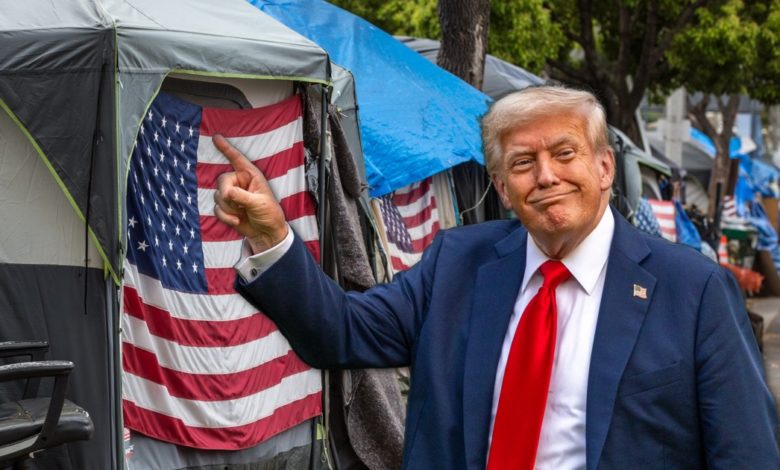
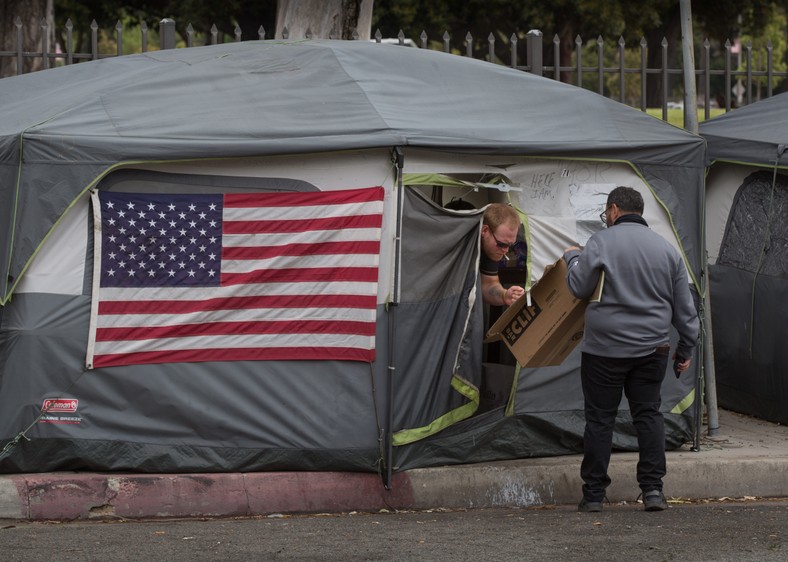
A homeless American veteran leaves his tent (illustrative photos)
– A significant number of people who currently use the SNAP program due to unemployment will have more funds for the purchase of food. Thanks to this, our food sellers will be fine – said the chairman of the Committee on Agriculture of the House of Representatives of GT Thompson (Republican from Pennsylvania), the main negotiator of the Plan Plan in Snap.
Thompson stated that sellers of foodstuffs fell “victim to the spread of fear by Democrats”, and restrictions on benefits will be a boon for their industry.
Democrats, such as Congressmenka Shontel Brown from Ohio, do not agree with such a matter and are looking for ways to soften the cuts in the SNAP program.
“We will use all the tools available to us,” said Brown, deputy chairman of the Committee of Agriculture of the House of Representatives.
Several republican and democratic state officials have already warned that it would be difficult to compensate for the loss of federal funds. They will have to consider redirecting funds from existing programs, cutting benefits, increasing taxes or finding alternative methods of protecting their budgets.
– I don't think any condition will decide to cut [świadczeń SNAP] Thompson said. “If they do this, governors and legislators are who will introduce cuts, they will not perform their functions for a long time.”
“What will these people do?”
Gabe Vasquez, Congresmen representing New Mexico, said that his condition is preparing to lose access to SNAP by “tens of thousands of people”.
– It is crucial that if we manage to maintain enough customers in local grocery stores in rural areas, these stores will have a better chance of survival – said Vasquez. “We must ensure that people have money in their pockets, and the states could cover the shortages resulting from cuts in the SNAP program to keep access to help, or provide alternative maintenance measures to others.”
Tom Charley is the owner of the Charley Family Shop 'N Save store in Greensburg, Pennsylvania, a city located about an hour from the Thompson district. Just like Buche (owner of the only grocery store in the Pine Ridge Indian Reserve in southern Dakota), Charley He is considering reducing employment by preparing for huge cuts that will reduce the small margin of his store's profit.
– We are talking about cuts of a significant part of the funds that go directly to customers. This means that fewer people will work in our stores, “said Charley.
According to Stephanie, Johnson, vice president of relations with the government at the American National Grocers Association, the loss of a grocery store, especially in the rural community, often has a broader influence on the economy than just the loss of the revenues of a given store.
In many areas, small grocery stores also perform the function of social networks, primary supplies and products of local manufacturers. According to the US Department of Agriculture, every dollar spent under the SNAP program in rural areas generates $ 1.50. in the local economy during the recession.
– The grocery store employs 15 people, maybe more, and if we lose it, what will these people do? – said Udall, mayor of St. Johns in Arizona. “It's not just about people shopping in a grocery store. He has it [cięcia w programach żywnościowych] Domino effect “.
I’m Ashley Davis as an editor, I’m committed to upholding the highest standards of integrity and accuracy in every piece we publish. My work is driven by curiosity, a passion for truth, and a belief that journalism plays a crucial role in shaping public discourse. I strive to tell stories that not only inform but also inspire action and conversation.