The public validation of the politician Octavian Goga is illegal and intolerable, believes the “Elie Wiesel” Institute

The “Elie Wiesel” Institute clarifies, in an open letter signed by dozens of public figures, in relation to the discussions about the poet and politician Octavian Goga, after “a group of Cluj intellectuals” considered that “punishing such a man” seems “an unforgivable mistake”. Dozens of public figures warn that paying tribute to a politician who used the swastika as an emblem constitutes a crime and an “attack on democratic order”.
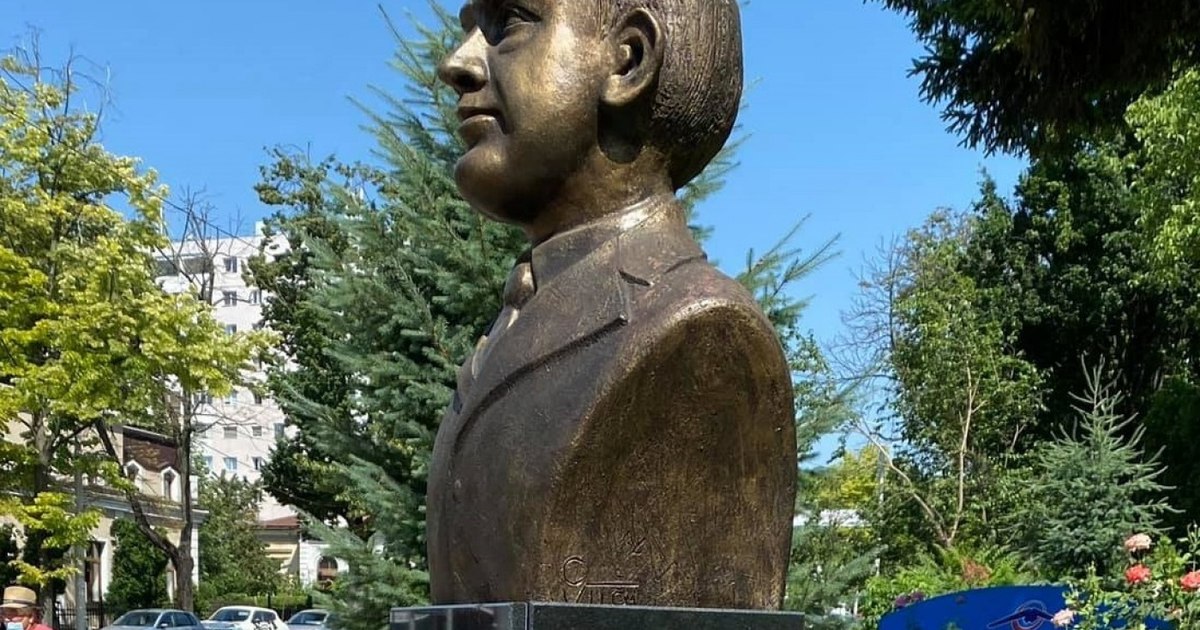
The statue of Octavian Goga in Iași was removed/ PHOTO: Facebook Adrian Cioflânca
In the open letter of the “Elie Wiesel” Institute, it is shown, in the context of the new provisions of the so-called Vexler law, which forbid the public promotion of the memory of some persons in the leadership of fascist, legionary, racist or xenophobic organizations, that Goga founded such a far-right party whose president he was until his death and whose emblem was the tricolor with the swastika in the middle.
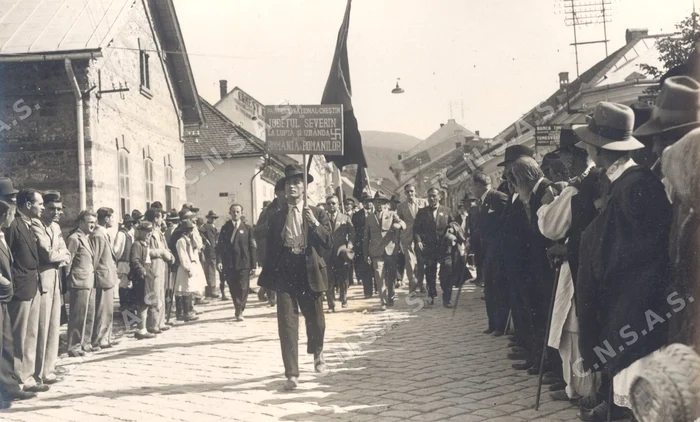
The electoral campaign of the PNC with the slogan “Romania of the Romanians!” next to the swastika sign PHOTO CNSAS
“In the Declaration from Cluj (of the intellectuals who oppose the removal of Octavian Goga's name from the public space) it is stated that “to punish such a man seems to us an unforgivable mistake, which even the ideologues of sovietization did not commit”. In fact, the protest aims to save the construction of the public memory of the poet Octavian Goga, materialized through busts, street names, public institutions, etc. Otherwise, Goga can no longer be no one punishes or saves, he has been dead for 88 years”say the signatories of the open letter, dozens of public figures.
They explain, “with reason and common sense”, “the reality of our days”recalling that in December 2025 the country's president promulgated the law amending GEO no. 31/2002. “Among other things, art. 5 has been completed and reads as follows: “The act of the person promoting, in public, the cult of persons guilty of crimes of genocide, against humanity and war, of persons who were part of the leadership of fascist, legionary, racist or xenophobic organizations, as well as the act of promoting, in public, fascist, legionary, racist or xenophobic ideas, concepts or doctrines, in the sense of art. 2 letter a), they are punished with imprisonment from 3 months to 3 years or the prohibition of certain rights”. In the sense of those from Cluj, promoting in the public space the memory of some people who, at one point in their life, fell into one of the situations provided for in art. 5, is a criminal act, therefore prohibited”the signatories mention.
According to them, Octavian Goga founded together with AC Cuza, in 1935, the Christian National Party, a far-right, fascist, xenophobic and anti-Semitic party, whose president he remained until his death, whose emblem was the tricolor with the swastika in the middle and whose slogan was “Romania of the Romanians!”.
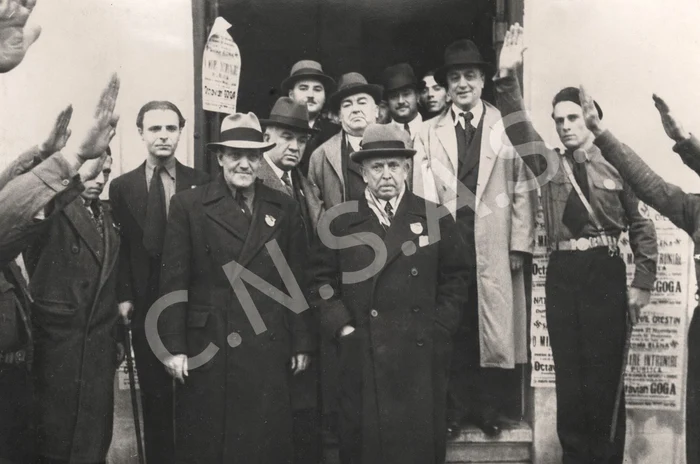
Octavian Goga and PNC activists salute with the fascist salute, 1937 photo source CNSAS
“In the 1937 election campaign, anti-Semitic posters were a support for the election campaign. In January 1938, the poet put his apostille as Prime Minister on Decree-Law No. 169 regarding the revision of citizenship. It was the first law of the Holocaust in Romania, as a result of which a third of the Jews in Romania were left without state protection. In May 1938, to mark his position as the leader of the PNC, the coffin of Octavian Goga was accompanied by a crown in the form of a swastika. Also Octavian Goga was the character that Alfred Rosenberg, the German ideologue of National Socialism, relied on to influence Charles II to direct foreign policy towards Nazi Germany. The Goga government also issued orders regarding, among other things, the banning of newspapers written and run by Jewish journalists, the elimination of Jews from the public administration Jews from the sale of products under state monopoly, the expulsion of rabbis who were not Romanian citizens and the prohibition of teaching the Jewish religion in state schools, etc.the letter states.
The same document mentions that “the group of intellectuals around the magazine “Oraşul” and the Cluj branch of the ASTRA association”, the signatories of the “joint declaration of protest”, “operate, deliberately, with confusion”, stating, “aseptically and omitting”, that the PNC was “a simple “right-wing” party”.
“In reality, the PNC was a far-right party, structurally Nazi, xenophobic and anti-Semitic. O. Goga was a pro-Nazi leader. The attempt to normalize the ideological identity of the PNC and its leader is an act of distorting history and an attack on the democratic order. The falsification of history, today, is no longer an innocent act”. the signatories state.
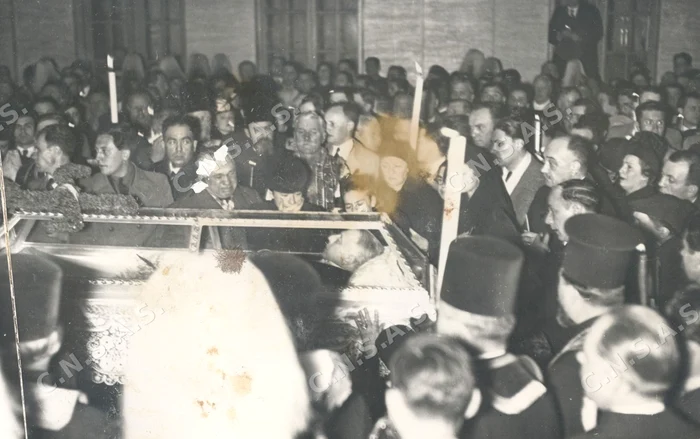
The coffin of Octavian Goga, honored with the swastika, the electoral symbol of the PNC, 1938 PHOTO CNSAS
Controversy in the case of the unveiling of Octavian Goga's bust in Iasi. Elie Wiesel Institute: “Promoted a policy in which anti-Semitism was given pride of place”
Fragments of the “thinking” of Octavian Goga
They remind the “intellectuals from Cluj” some fragments of “the thinking of the intellectual they revere”:
• “Germany, after the war, was considered a sick state, and it was invaded by parasites, and although this country had only 600,000 Jews, it could no longer resist, because they held the trade and finances in their hands, and what was worse was the fact that they had penetrated the German soul with their writing. It was considered an act of barbarism to burn books – Jewish products – in Berlin. The fact must considered as a symbol of the destruction of the Jewish brains. We have now let these Jews invade our country, almost two million, compared to 14 million Romanians. They destroy everything we want, everything we create. We are insulted, spat on, mocked by all the foreigners who come here, in ancient Târgoviște, and change their names to those of the great ones. our Basarabs” (…) “Our Romanian work will be completed through legislation in accordance with the views of the National-Christian party's program. When I said that we would remove 500,000 Jews from the country, I understood that I would make it easier for our country. When we close the Jewish newspapers, we will have the guarantee that the Jewish poison will no longer be disseminated”. (Congress of the national Christian organization from Dâmboviţa county, Târgovişte, November 6, 1937);
• “There are two categories of enemies: foreigners, as unconfessed centrifugal tendencies, parasitic elements, and the political parties, who I think have taken over the country. They said we were Hitlerites or fascists. It would not be a shame if we were, but we are not. They accused us of going to Nuremberg. I went to Rome and Berlin, I spoke with Mussolini and the Fuehrer, I congratulate myself for seeing the organization patriotic feeling and I regret that I could not take you young people to Nuremberg to see how the assault battalions parade” (O. Goga, Bucharest, PNC Central Club, October 2, 1935);
• “We, the generation of the war 20 years ago, made a big and strong country. But the country is not freed yet. There is a lot of rot that must be put aside, and the foreigner, the Jew, has stuck his claws into the body of the nation and is sucking its life. We want to dispossess Romania, to make it clean!” (O. Goga, Vaslui, December 1937).
“Any person throughout his life, public and/or private, plays several roles. Post-mortem these roles are restored, not depending on time and space, but in close connection with ethical and democratic civic principles. Therefore, an anti-Semitic and fascist political leader, who was at the helm of the country and was responsible for the marginalization or social exclusion of some Romanian citizens, has no place in the public space. This is the pantheon of civility and ethics democrats. This is what the democratic Parliament of Romania decided”say the signatories of the open letter.
They mention, in the same document, “a trivial aspect for a civic and democratic society”, that the public promotion, by any means, as saving models, values, ideas, principles, memorial representations from the arsenal of illiberalism, fascism, legionaryism, anti-Semitism, racism or discrimination of any kind, means “undermining democracy, based on the principles of freedom, dignity and human solidarity”. O. Goga. The validation of the politician Goga, through public monuments, is an action that the democratic order in Romania, built on the memory of the two totalitarianisms, considers illegal and intolerable. Democracy has two great qualities that give hope for the better to each of us: (1) no one is above the law and (2) the critical spirit is the substance of the civic spirit.”it says at the end of the open letter.
The mansion that housed Nicolae Titulescu, Take Ionescu and Octavian Goga is collapsing under the eyes of the authorities. “When the Walls Weep”
The bust of the poet Octavian Goga, removed from the Copou area
The bust of the poet Octavian Goga, former prime minister with controversial attitudes, was recently removed from the Copou area of Iaşi, after the Association for the Prevention and Combat of Anti-Semitism and Legionnaires in Arad requested this from the City Hall and the Iaşi Local Council.
The bust, which was located in an intensely trafficked area of the Copou district, was reportedly lifted on March 28 by the employees of the Iaşi National Athenaeum, an institution subordinated to the City Hall.
Octavian Goga was a controversial politician because of several statements and decisions he made before and during his prime ministerial mandate in 1937-1938. He was the initiator of a plan by which hundreds of thousands of Romanian Jews were to be deported to the island of Madagascar.
According to the historian Ilarion Ţiu, Goga was buried with the swastika on his chest, this being his wish. As prime minister, Goga adopted a decree-law that had the effect of withdrawing the citizenship of a number of 225,222 Jews from Romania.