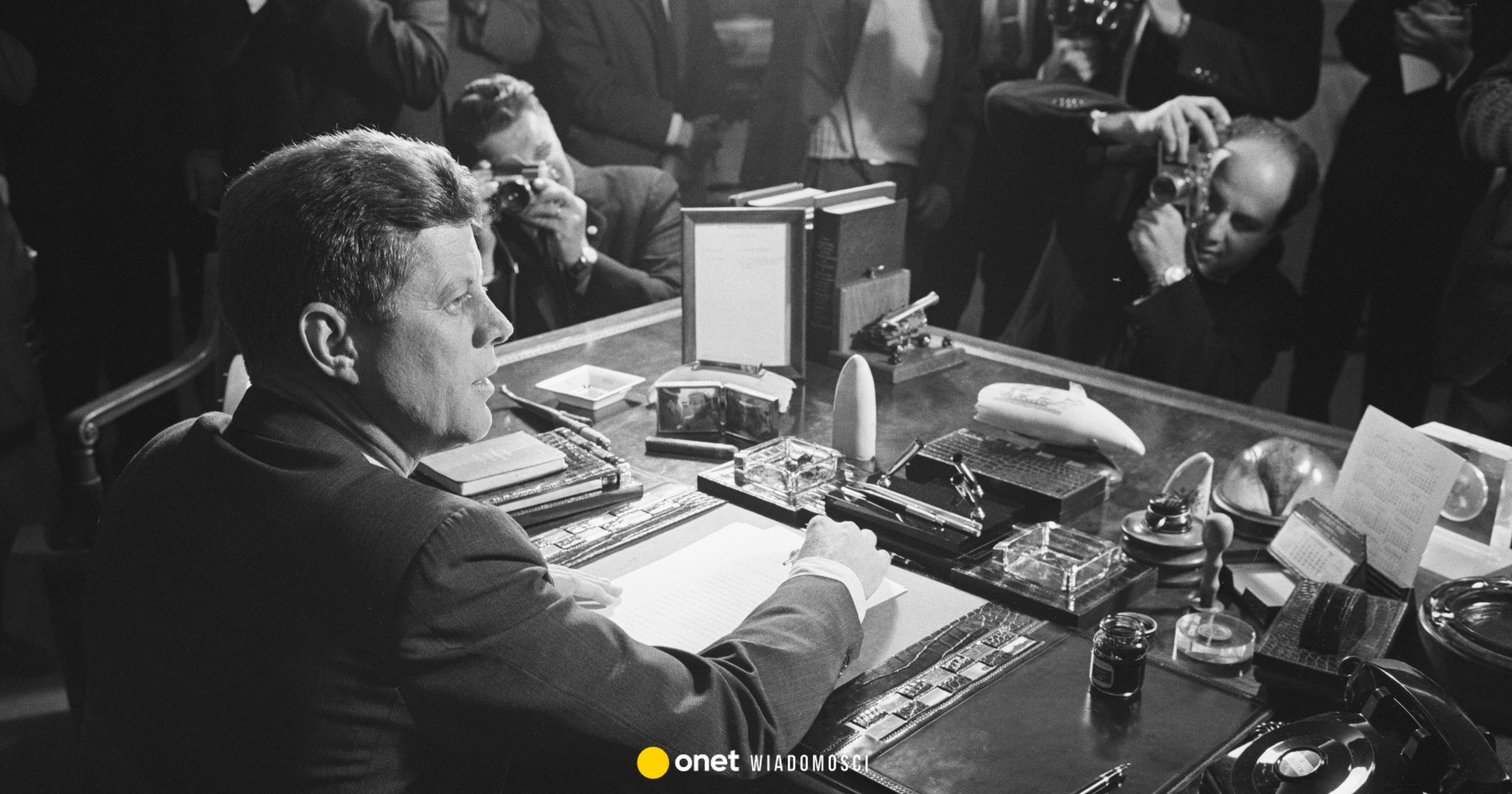
Even the most loving father sometimes gets angry with his children. An example of this was almost five-year-old Caroline Kennedy on October 16, 1962. That Monday, as she often did, she simply walked into the office of her father, the US president. It was about ten minutes before nine. This time, however, John F. Kennedy had no time for the girl.
“See you later, Caroline.” See you later, he tried to comfort his daughter. However, the child replied without hesitation. – You know what? I don't want you to work so much!
The six men in the Oval Office accepted this instruction to their superior with a short laugh, and the president himself decided not to oppose the girl. “Okay,” he replied shortly. Satisfied, Caroline left the office of the most powerful man in the world. Kennedy could return to the mission he was on—preventing nuclear war.
That morning, the US president learned that a serious threat was gathering in Florida's immediate vicinity – for the first time, his national security adviser, McGeorge Bundy, Secretary of Defense Robert McNamara, and his senior military official, General Maxwell Taylor, informed him that Soviet nuclear missiles were deployed in Cuba. Never before or since has the world come so close to nuclear annihilation as during the next 13 days.
On Sunday, two Lockheed U-2 reconnaissance planes flew over the communist-ruled island and took photos. In one of the photos from further outside the city of San Cristobal, eight Soviet missile carriers could be seen, all loaded. In addition, there were at least four positioning and launching devices for which positions were being prepared. Another photo showed six more rockets.
CIA specialists spent the night analyzing photos from old military parades in Moscow's Red Square to identify the type of missiles covered with tarps. They concluded that they were looking at medium-range missiles with R-12 nuclear warheads, called SS-4 according to the NATO code. With a range of about 2,000 km, a single missile fired from Cuba could reach — and destroy — the entire southeastern U.S. coast, as far as Washington.
The Kremlin has indeed secretly deployed nuclear weapons on this Caribbean island – The CIA has been warning about this for weeks. However, secrecy was crucial – the United States had deployed similar Jupiter-type missiles quite openly at bases in Italy and Turkey.
A difficult dilemma
Kennedy immediately established a commission of strategic and military experts called the Executive Committee of the National Security Council [Executive Committee of the National Security Council, w skrócie ExComm]. While discussions about possible reactions continued, disturbing information was to remain hidden from the public.
In the following days, ExComm discussed all possible options. The most obvious from a military point of view was a surprise attack on missile sites before they were ready for use and then an invasion of Cuba. However, hundreds, if not thousands, of Soviets would die this way, which could have unpredictable foreign policy consequences. The second option was another extreme – ignoring this fact. This, however, would infuriate the hard-liners in the American state apparatus, which were not on good terms with the liberal Kennedys anyway. And this could have had disastrous consequences in domestic politics.
The article continues below the video
Faced with a difficult choice, Kennedy opted for a complex combination: public protest, military pressure, diplomatic attack, and secret negotiations. On October 22, 1962, the president announced a “quarantine” of Cuba in a televised speech. The White House received formal approval for this from the (then) US-dominated Organization of American States, but it had no value under international law.
“Kennedy, this cool strategist, may be the very man who, at an unexpected moment, will announce: here and not a step further,” Ernst-Ulrich Fromm, head of the political department of “Die Welt” at the time, said in the daily. He added that Americans no longer want to be tricked and pushed around.
Brilliant political art
The exchange between Kennedy's former rival in the Democratic Party, Adlai Stevenson, at the UN Security Council with the Soviet ambassador to the UN, Valerian Zorin, turned out to be decisive. The two-time presidential candidate, who was sent to the post of US ambassador to the UN, asked directly.
— Do you deny, Mr. Ambassador, that the USSR is installing medium-range missiles in Cuba? Yes or no? Don't wait for the translation! Yes or no?
Zorin, thus put on the defensive, responded evasively.
— I am not in an American courtroom, sir, and therefore I do not wish to answer the question I was asked as if I were standing before a prosecutor.
— You stand here before the court of world public opinion and you can answer. Yes or no? I'm willing to wait until hell freezes over for an answer!
He then showed the Security Council, and therefore world public opinion, photos of the missile sites. This was the turning point of the Cuban Missile Crisis.
After some hesitation, Kennedy indicated that the United States was prepared to retire its Jupiter missiles in April 1963 if the Soviet Union immediately transported the SS-4 back—and the agreement remained secret. This was a brilliant political trick, because the Americans were going to withdraw the obsolete Jupiters from Italy and Turkey anyway. This way Keneedy cleverly defused the most dangerous situation of the Cold War.
I’m Ashley Davis as an editor, I’m committed to upholding the highest standards of integrity and accuracy in every piece we publish. My work is driven by curiosity, a passion for truth, and a belief that journalism plays a crucial role in shaping public discourse. I strive to tell stories that not only inform but also inspire action and conversation.