Why did the Legal Commission of the EU Parliament vote to lift Diana Sosoacă's immunity and the case in which it decided that the immunity should not be lifted

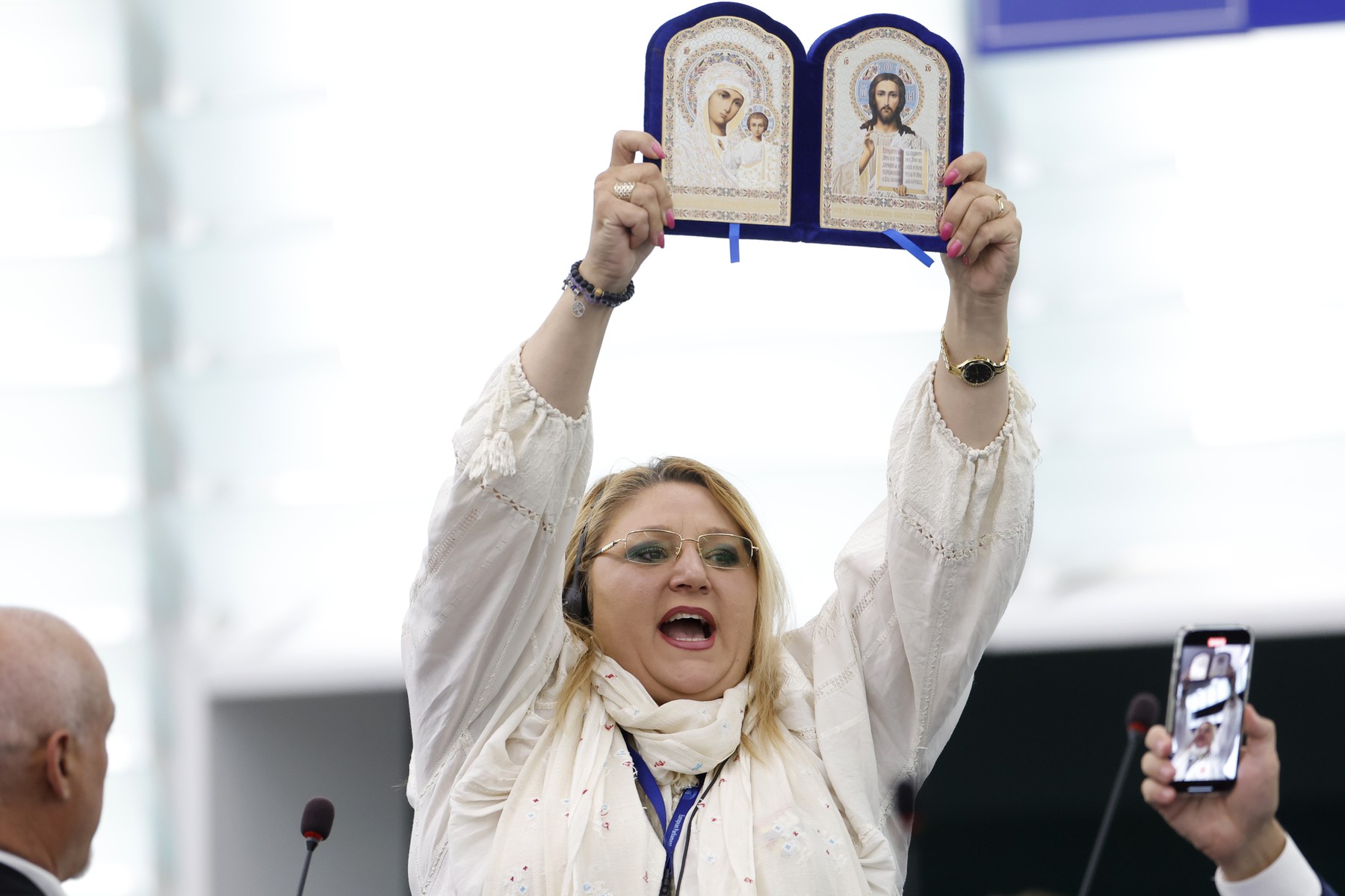
The report of the Commission for Legal Affairs in the European Parliament, published after the vote to lift the immunity of Diana Șoșoacă, says that there are no elements to indicate that the judicial procedure was initiated with the intention of undermining the political activity of the MEP.
The legal commission of the European Parliament (EP) decided on Thursday, with 17 votes in favor, zero votes against and one abstention, to lift the immunity of MEP Diana Șoșoacă, at the request of the General Prosecutor's Office in Romania.
The final step in the process of lifting the immunity will be the vote in the EP plenary, which may take place as early as next week, in the session starting on April 27. The exact date has not been set.
The votes in the EP come after the General Prosecutor's Office requested the European legislature to lift Sosoacă's immunity for committing several crimes, including legionary propaganda, last year.
In the official report after Thursday's vote, the Judiciary Commission lists several accusations in connection with which it decided to vote for the lifting of immunity, but also one in which it decided that the lifting of immunity is not necessary – a speech in the EP, in which Șoșoacă recommended his colleagues to develop foreign policy strategies according to the model of Nicolae Ceaușescu.
Lack of freedom, anti-Semitism, promotion of legionary ideas
The report shows that immunity has been lifted for almost all charges brought by the General Prosecutor's Office.
First of all, it is about the deprivation of liberty, which starts from a case from 2021, when a journalist from Italy filed a criminal complaint against Diana Șoșoacă, whom she accuses of seizing her in her law office in Bucharest due to misunderstandings related to an interview.
Then, it is about crimes regarding the promotion, in public, of the cult of persons convicted of crimes of genocide against humanity and war crimes, as well as the act of promoting, in public, fascist, legionary, racist or xenophobic ideas, conceptions or doctrines.
It is also about promoting anti-Semitic ideas or doctrines and denying, contesting, approving, justifying or obviously minimizing the holocaust or its effects.
The report says that “all these alleged crimes and the related request to lift Diana Sosoacă's immunity are not related to an opinion or a vote expressed by her in the exercise of her functions as a member of the European Parliament”.
The legal commission decided to lift the immunity of Şoşoacă in relation to all these alleged crimes.
The speech in the European Parliament, excepted
There is an exception.
The Institute for the Investigation of the Crimes of Communism and the Memory of the Romanian Exile informed the judicial authorities that, on February 11, 2025, Diana Șoșoacă held a speech in the EP plenary, in which she recommended her colleagues to develop foreign policy strategies following the model of Nicolae Ceaușescu, who was convicted of genocide based on a December 25, 1989 decision of the Bucharest Military Territorial Court.
The statement was made during the plenary session of the European Parliament in Strasbourg during a debate on “A more comprehensive EU strategy on the Middle East”.
In this case, the accusation concerns an alleged crime provided for in Article 5 of the Emergency Ordinance no. 31/2002 of the Government of Romania, which prohibits the promotion of the cult of persons guilty of crimes against peace and humanity.
The report of the Legal Commission of the EP says, however, that this statement constitutes an opinion expressed by Diana Șoșoacă in the exercise of her functions as a deputy in the European Parliament, in the sense of article 8 of Protocol no. 7 on the privileges and immunities of the European Union, which states that “members of the European Parliament may not be investigated, detained or prosecuted because of opinions or votes expressed in the exercise of their functions”.
Therefore, the Legal Commission decided not to lift Sosoacă's immunity in relation to this alleged crime.
“Parliamentary immunity is not a personal privilege”
In its report, the Judiciary Commission also says that Parliament has not identified any evidence of a “fumus persecutionis” – a legal term describing reasonable suspicion that a legal action is politically motivated.
The report specifies that there are no factual elements to indicate that the judicial procedure was initiated with the intention of undermining the political activity of Diana Șoșoăca in her capacity as a member of the European Parliament.
At the same time, the Legal Commission specifies that “Parliament cannot be assimilated to a court of law and, on the other hand, in the context of a procedure to lift immunity, the deputy in question cannot be considered an “accused person”.
The report also states that according to the rules of procedure, “parliamentary immunity is not a personal privilege of the deputy, but a guarantee of the independence of the Parliament as a whole and its deputies.”
What does Sosoaca say
Sosoacă reacted on Facebook on Thursday, after the vote in the Legal Commission.
“How afraid the Romanian and European systems are of Diana Iovanovici-Şoșoacă! And they have every reason!” she said.
Soșoacă was summoned to the General Prosecutor's Office in March, in the file in which she is accused of legionary propaganda. A week before, she had been heard in the Legal Affairs Committee of the European Parliament.
According to some officials of the Prosecutor's Office, the prosecutors wanted Diana Şoșoacă to undergo a psychiatric examination, but they need her consent to start the procedure, which is the reason why she was summoned, Agerpres wrote in March.
“It returned to everything that Soviet institutions mean: punitive psychiatry, the reminiscence of those acts of terror against those who disturbed the system. (…) I am sending myself for a psychiatric examination, all this General Prosecutor's Office full of traitors, uneducated and incompetent, who receive political orders, they must go, not to undergo an examination, but to be hospitalized for psychiatric treatment. If they still want sovietism, then let them go to psychiatry, before you ask others”, said Sosoacă to dozens of supporters, who came with flags and placards to the headquarters of the General Prosecutor's Office.