The interstellar comet that visited us last year came from a cold and isolated place in the galaxy

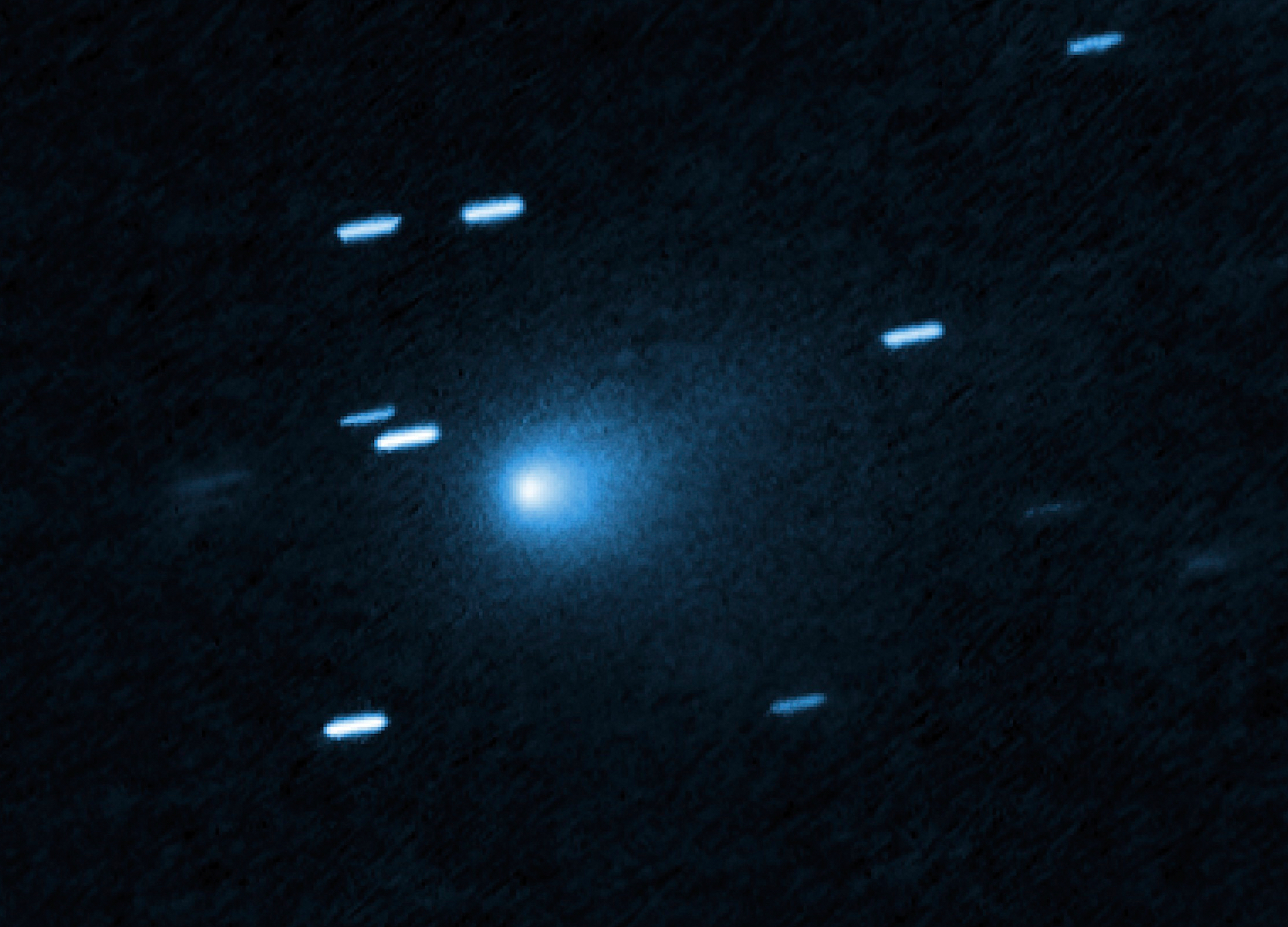
The interstellar comet that whizzed past us last year probably came from a cold, isolated corner of the Milky Way that hadn't yet condensed into its own solar system, says a new study published Thursday by astronomers and cited by the Associated Press.
Comet 3I/Atlas is only the third confirmed interstellar object, and quite possibly the oldest. Scientists estimate that it could be up to 11 billion years old, more than twice the age of our Sun.
A team led by researchers from the University of Michigan used the ALMA observatory in the Atacama Desert to study the comet last fall. The errant but harmless lump of ice was discovered last summer, giving NASA and the European Space Agency enough time to point several space telescopes at it as it whizzed past Mars in October and made its closest approach to Earth in December.
It is now well beyond Jupiter, on its way out of our solar system for good, still visible only to specialists.
The genesis site of comet 3I/Atlas, identified by a hydrogen isotope
Scientists explain in the new study published in the journal Nature Astronomy that they have detected extremely large amounts of deuterium, or heavy hydrogen, in the comet's water. This suggests that it came from somewhere considerably cooler – before this solar system's star had even formed – than our own cosmic 'neighborhood'.
Researchers believe that it is possible that our Sun was surrounded by other newborn stars during its formation, but that the host star of this comet may have been more isolated, resulting in less heating and cooler conditions.
The exact place of origin of the comet still remains unknown. Observations by the Hubble Space Telescope estimated its core to be between about 440 meters and 5.6 kilometers across. It travels at approximately 220,000 km/h.
“Putting these pieces of the puzzle together can give us an idea of what the conditions of planet formation looked like during these early times,” says Teresa Paneque-Carreno, co-author of the study.
The first known interstellar object to wander into our “heavenly backyard” – Oumuamua – was discovered by a telescope in Hawaii in 2017. Comet 2I/Borisov followed in 2019, named after the amateur astronomer from Crimea who first observed it.