
“The front looks like Terminator.” The historic first in which Ukrainian robots conquered a Russian position by themselves. General Bălăceanu's analysis

Ukrainian drones have leveled several Russian refineries and ports, according to the Institute for the Study of War, and the Ukrainian military conducts thousands of operations using unmanned ground vehicles each month. Just the other day a Russian position was conquered with only robots. General (r) Virgil Bălăceanu explains the impact of these developments on the war in Ukraine.
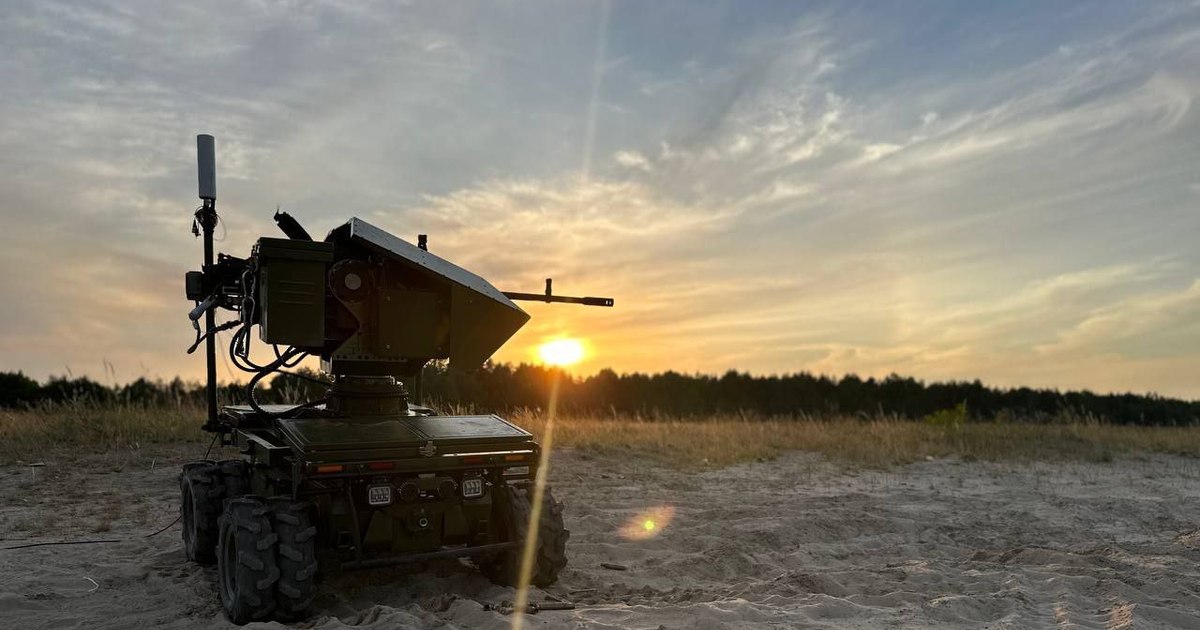
Ukrainian robotic drone PHOTO X / MAKS 25 @Maks_NAFO_FELLA
The Institute for the Study of War showed in a report published the other day that the Ukrainian military has successfully carried out several strikes on oil infrastructure and military targets in Russia and occupied Crimea.
The Ukrainian General Staff reported on April 18 that Ukrainian forces struck the Novokuibyshevsk and Sirzan oil refineries in the Samara region, an oil terminal at the Vysotk Lukoil-2 transshipment complex in the Leningrad region, and the Tikhoretk oil pumping station in the Krasnodar Territory on the night of April 17-18, causing fires at these facilities, the quoted source said.
Geolocated images released on April 18 show fires at the Novokuibyshevsk and Sîrzan refineries, and a Ukrainian Open Source Intelligence (OSINT) source assessed that the Novokuibyshevsk strike may have damaged up to three tanks. Russian regional officials acknowledged that Ukrainian drone strikes had caused fires at the port of Vysotk, Leningrad Region, and at an oil depot near Tikhoretsk, Krasnodar Territory.
The Security Service of Ukraine (SBU) reported on April 18 that Ukrainian forces also struck military and energy targets in occupied Crimea, including the large Ropucha-class amphibious ships Yamal and Azov (both belonging to the Russian Black Sea Fleet), a third unidentified warship, the antenna block of a Delfin communications system, and an MMys-M1 radar station in unspecified areas of occupied Crimea, as well as fuel tanks at the Yugtorsan oil depot near occupied Sevastopol.
The SBU also stated that the Ukrainian strikes could also have damaged a Grachonok-class patrol vessel. Geolocated images released on April 18 show a fire at an oil depot in Sevastopol, and the occupation's installed governor, Mikhail Razvojaev, admitted that the attack caused a fire at a fuel tank.
ISW also reports that Russian military bloggers have criticized Russian air defense failures following the successful Ukrainian attack campaign against Russian oil and defense industrial infrastructure.
On the other hand, the President of Ukraine, Volodymyr Zelensky, publicly presented the developments regarding the use of robotic systems developed by the Ukrainian army the other day, claiming that, for the first time since the beginning of the war, an enemy position was fully captured with the help of unmanned platforms.
“The front looks more like Terminator”
According to the Kiev leader, the operation was carried out exclusively with ground robotic systems and drones, without the participation of infantry and without losses among Ukrainian forces. He described the moment as an important stage in the transformation of the way war is waged, with an ever-widening use of autonomous technology on the front line.
Ground robots now provide about 90% of the Ukrainian military's logistics. “It is very difficult to move around because of enemy drones in first person view, so we use robotic systems”, explained Victor Pavlov, a lieutenant in the 3rd Corps of the Ukrainian army, for The Guardian.
In January, the Ukrainian armed forces conducted a record 7,000 operations using unmanned ground vehicles.
“It's not Star Wars, with lasers everywhere. The front is more like Terminator. A ground robot comes to your position and you have nothing to do”said a drone operator in the 25th Airborne Brigade. He added: “You can shoot a human and they stop shooting. If you hit a robot, they don't feel pain. There's a human behind them looking at a screen and they shoot back.“
General (r) Virgil Bălăceanu analyzed in an interview for “Adevărul” what effects these drone strikes have on Russia's oil infrastructure and how the large-scale use of drones and robots influences the fate of the war.
“The drone replaces the missile and the artillery projectile to a certain extent”
The truth: The Institute for the Study of War revealed in a report released the other day that the Ukrainian military has successfully carried out several strikes on Russia's oil infrastructure. To what extent do you think these strikes have reversed Putin's advantage of rising oil prices and the US waiver allowing countries to buy sanctioned Russian oil and petroleum products at sea?
Virgil Balaceanu: We can make a connection between the two moments, but I would go for another option. Here it would be just a coincidence. The fact that Ukraine in order to resist must keep its initiative, maintain its initiative. In a war, if you no longer initiate deep attacks, if you no longer initiate counterattacks, then it means that you have gone on the defensive on all fronts, in all directions, and as a rule, if you no longer have such a capacity, you no longer have these reserves, then your defense will not be as strong for a period of time as you would like.
'Front line is like Terminator': combat robots give Ukraine hope in war with Russia
So things have a multitude of aspects from troop morale to what striking ability means, so I'm demonstrating that I maintain deep striking ability by targeting the energy system as a response to the fact that you hit and continue to hit my energy system.
On the other hand, I have an initiative that can also reflect positively on how to counter the Russian summer offensive already launched in the Donbass area.
So these things must always be associated.
Russian air defenses have been criticized for not being able to prevent these Ukrainian drone attacks. In addition, the other day, the Ukrainian army managed to capture a Russian position using only ground robots, without the direct participation of soldiers in the assault. To what extent will this trend in the use of technology be decisive for the fate of the war?
Of course, drone technology has evolved on both sides, reflecting the lessons learned. But drones have not come to replace the bulk of the forces. The Ukrainian front could not resist only with the use of drones, if there were no infantrymen in the trenches, if there were no armored means to protect those on the defense, if there were no fire with pipe artillery systems or reactive artillery systems that would cause losses to the groups of forces that are on the offensive.
As such we must consider a balanced analysis. They have a very important role, but at the present time, from the data communicated to us, the important role is also played by motorcycles and unmanned ground vehicles (UGVs) which I see that the Russians use very often in infiltration type combat actions. So there are also new elements that appear. But these new elements do not mean that in future wars we will give up armored vehicles, artillery fire, or deep-hitting missiles.
Ultimately, the drone replaces the missile and the artillery projectile to a certain extent. The drone that reaches 1,500 km is a cruise missile. Cruise missiles usually hit at 1,500 km. Only the costs are much lower and they can be produced in a much larger quantity. Of course, the amount of explosive is not similar. A cruise missile has a much larger amount of explosives, sorry.
“The Ukrainian front is holding out. The Ukrainian defense industry, as well as the European defense industry, is supporting the front”
We no longer see calls from President Zelenski for Patriot systems, for missiles, for anti-aircraft systems, etc. Does this mean that they somehow managed to replace these weapons with their own technology? US supplies appear to be at risk from the conflict in the Middle East, and aid from Europe appears to be blocked by certain countries. what's going on
It just so happens that the Ukrainian front is holding out. It happens that both the Ukrainian defense industry and the European defense industry support the front. It happened that Great Britain provided, or is in the process of providing, including some anti-aircraft defense systems.
Zelensky announces a first for Ukraine: the capture of an enemy position exclusively with ground robotic systems and drones
At the same time the war in the East is happening which has brought very high consumption, including of Patriot missiles, in the context of a small production of Patriot missiles compared to the replacement needs in the American and Israeli stockpiles. In this context, President Zelenskiy is aware that Patriot missiles will not be delivered in a short period of time. It seems to me that recently, that is, a month, two months ago, they were delivered under the PURL system (a procurement coordination mechanism, allowing NATO countries to buy American weapons in order to quickly transfer them to Ukraine). But he no longer sees such a perspective. And then the president of Ukraine would laugh at the ridiculous when he said “we need Patriot systems, we need missiles“, when they are still being used in the war in the Middle East. And then, he has to see what the resources are and how he can use them.
Interestingly, Ukrainian specialists in air defense, but especially in defense against drones, have become military advisers in the Middle East, in the Gulf countries. An experience that many countries want to buy in the end, which means a lot for Ukraine, because it also means international visibility.
How will Ukraine hold up on the defensive line?
On the other hand, it will be increasingly difficult for Ukraine to resist on the defense line as well, but especially in terms of energy infrastructure. Because we don't expect this war to continue next winter. And things will be extremely difficult, because they will have poor anti-aircraft defenses. This in the conditions in which there will be no situations of modernization of systems such as SAMP/T of the French or IRIS-T of the Germans that come close to the capabilities of the Patriot.
Because technology will probably perform here as well. And here Europe will think that it has to ensure its own means that are competitive with American means, taking into account the uncertainty in terms of cooperation with the United States, but also taking into account the fact that the EU is investing in the European defense industry.
As such we should be buying in a relatively short time from the European defense industry, at better prices than we were buying from the American market and at a quality, at least in terms of some equipment, quite similar. These are also consequences of the war in Ukraine, but especially of the war in the Middle East.


