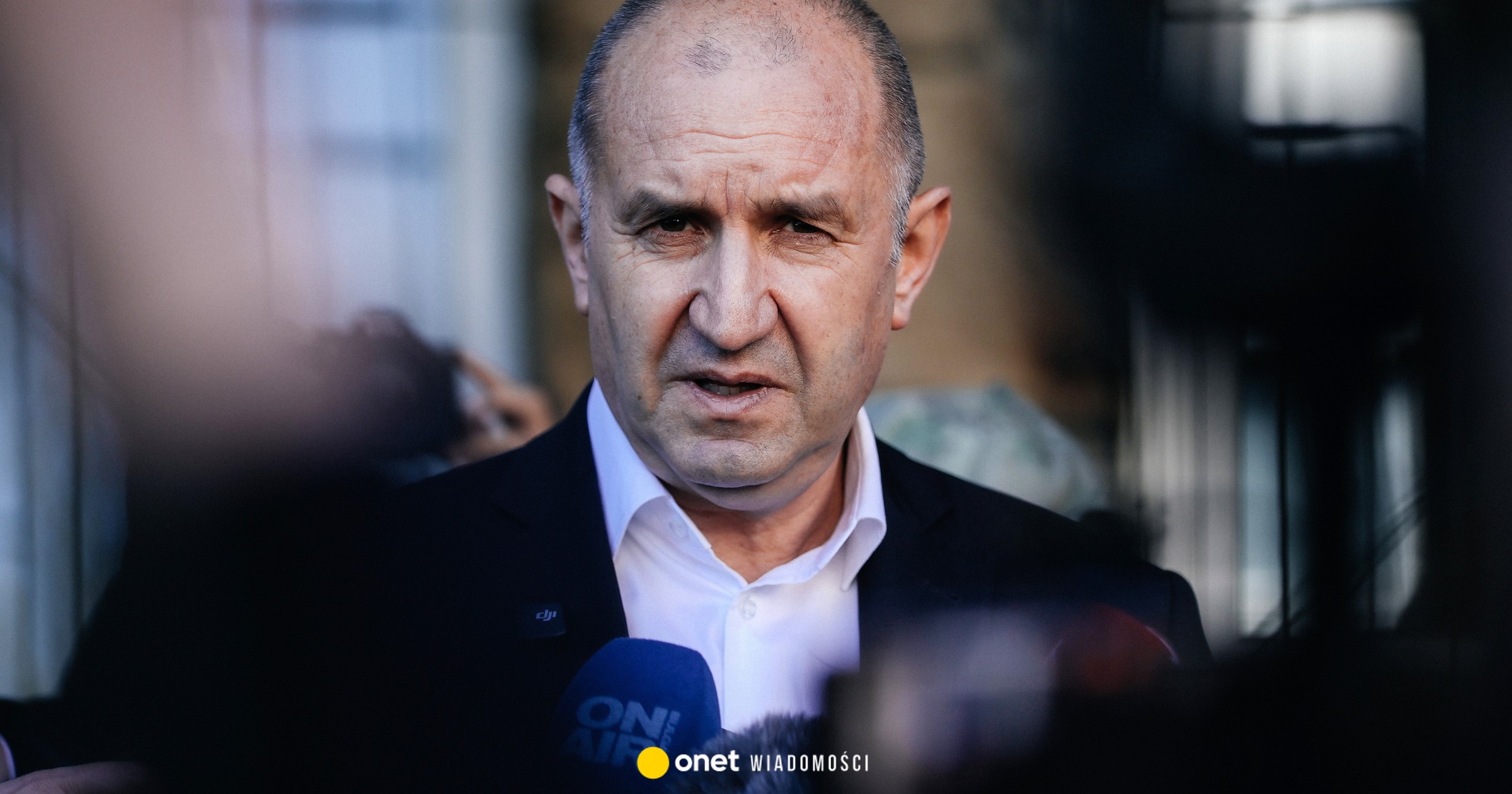
Rumen Radev should fulfill at least one promise quickly: after five years of political chaos and eight early elections, the former president announced that he would restore a stable government to Bulgaria. After counting the majority of votes in the parliamentary elections, his Progressive Bulgaria coalition obtained almost 45 percent. votes and could thus achieve an absolute majority in parliament if other parties did not exceed the five percent electoral threshold.
There is a fear, especially in Brussels, that Radev will now take over the role of Hungarian Prime Minister Viktor Orban (who lost the elections on April 12) and become a blocker at the EU level. In recent years, he has advocated, among other things, against arms supplies to Ukraine and demanded improved relations with Russia, also through the import of Russian oil.
These were loud statements he made while serving as president – without decision-making powers, from the position of the highest representative. It is certain that a change of course towards the Kremlin would have far-reaching consequences for Europe.
This NATO country on the Black Sea has a powerful arms industry and is a hub for pipelines that are intended to make Europe independent of Russian gas. Moreover, Bulgaria joined the euro zone at the beginning of the year.
If he continued this course as prime minister, the arms agreement that the pro-Western interim government in Sofia concluded with Ukraine in March would probably be terminated first. The two countries agreed, among other things, to jointly develop and produce drones – a key technology for the entire NATO. When signing the agreement in Kiev, it was stated that it was an agreement regarding “Euro-Atlantic security”. Radev had already questioned this. He said these “long-term commitments” could threaten Bulgaria's “national security.”
Voters waiting to cast their ballots at a polling station in Sofia, Bulgaria, April 19, 2026.PAP/EPA/Borislav Troshev / PAP
Also on other issues, the list of his demands in line with Moscow's line is long. However, there are important differences compared to Orban. Radew, a former pilot and commander of the Warsaw Pact air forces, always tries not to distance himself too clearly from NATO and the EU. When necessary, he talks about his education at the American military academy, from which he graduated after the collapse of the Soviet Union. Thanks to this balance, he has so far gained many supporters in a country that is divided between strong pro-Europeans and citizens traditionally associated with Russia. Bulgaria is unlikely to be suitable as the new ideological center of Europe.
To win as many voters as possible, Radev kept his political program in the sphere of generalities. When he appeared to applause at the party headquarters in Sofia on Sunday evening, he stuck to this line. Bulgaria will try to “continue its European path”, he said. At the same time, he believes that “a strong Bulgaria and a strong Europe need a critical spirit and pragmatism.” He demonstrated political flexibility.
If he needed a coalition partner, he could imagine cooperation with the pro-Western reform alliance We Continue Change – Democratic Bulgaria, which with about 13 percent votes is still fighting for second place. Right behind him is the long-time ruling party GERB, whose leader Boyko Borissov, although he has always behaved loyally in Brussels, remains under constant suspicion of belonging to a corruption network.
In the spotlight is the oligarch Deljan Peewski, who has been officially sanctioned by the US Treasury Department for corruption and influencing politics, but still quietly maintains his system. In Bulgaria, politicians who oppose these abuses continue to be arrested, most recently Mayor Blagomir Kocev from Varna. Only after six months of detention did the court rule that his detention was unlawful.
During the election campaign, Radev announced the overthrow of the “mafia state”, but it is not known whether he will actually take on these structures. Polls show that many young voters in Bulgaria voted for him for this very reason. If Radev needs a partner in the government, the question remains who he will ally with – the “pro-Western kleptocrats” Peevsky and Borissov or the pro-Western liberal reformers from We Continue to Change, something political scientist Dimitar Bechev wondered about before the elections.
The elections were overshadowed by suspicions of Russian influence. The independent Balkan Free Media Initiative (BFMI) noted that Radev's campaign received significant support through the so-called seed boosting – His posts received likes from fake accounts shortly after posting to influence the algorithm. Moreover, on the evening of the election day, the Ministry of Interior in Sofia presented secured cash of over EUR 1 million, which was allegedly used to buy votes, in a few cases also to the advantage of the party of the election winner. An investigation is underway.
There is currently no evidence that Radev or his followers are directly involved in these activities. Transferring funds that were not officially disclosed in the election campaign budget would be prohibited. The European Union watched the elections closely. From this perspective, they bring to mind the presidential elections in Romania in 2024. Then, the election of far-right candidate Calin Georgescu was invalidated by a court due to foreign interference – a decision that is still described by some parties as an alleged violation of the will of voters.
The article continues below the video
High support for the euro
Radev was already taking precautions in case the same thing happened in Bulgaria. He has already suggested that his expected electoral victory will be undermined according to the “Romanian model”. The call for help to Brussels aims to discredit the elections. “I appeal to all Bulgarian citizens not to allow this brutal and absurd attempt to steal the elections,” he urged.
In any case, Bulgaria has been inundated with disinformation campaigns for years, and links with Russia have been repeatedly documented. During the election campaign, false news circulated that Putin wanted to break off diplomatic relations with Sofia because of the arms deal with Ukraine.
Before the elections, a majority of Bulgarians indicated in polls that issues such as inflation and the weak economy were particularly pressing for them. Radev promised to take care of these matters. However, by adopting an Orban-style blocking policy, it is unlikely to come close to this goal. The country's entry into the euro zone at the beginning of the year is going well by all economic data, with polls showing growing support. Radev knows he needs Europe.
I’m Ashley Davis as an editor, I’m committed to upholding the highest standards of integrity and accuracy in every piece we publish. My work is driven by curiosity, a passion for truth, and a belief that journalism plays a crucial role in shaping public discourse. I strive to tell stories that not only inform but also inspire action and conversation.