Wind of change in Sofia. The movement that threatens the old political class: “The program is centered on the fight against the oligarchy”

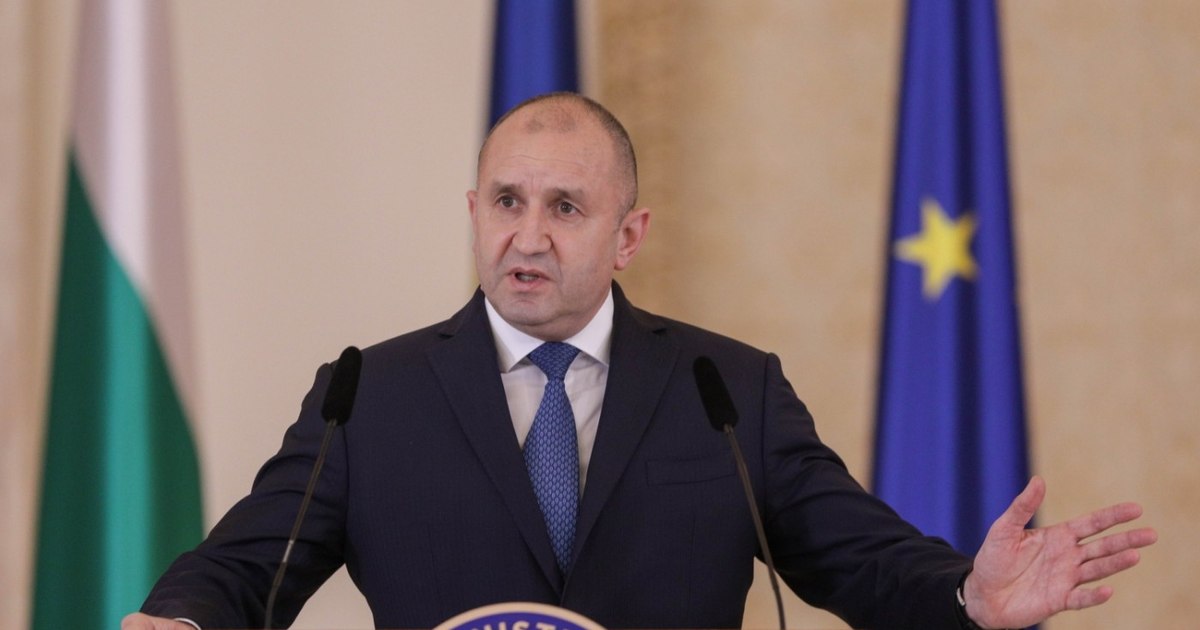
On Sunday, April 19, Bulgaria organizes new parliamentary elections, the eighth electoral round in the last 5 years. Bulgarian journalist Vladimir Mitev explains for “Adevărul” which political forces have a chance to enter the Parliament, how the election campaign was conducted and especially what the former president Rumen Radev, the great favorite to take over the position of prime minister, promises.
Romanian Radev. PHOTO: Inquam Photos
After several years marked by chronic political instability and ephemeral governments, Bulgarians are called to the polls again on Sunday to elect their Parliament and implicitly a new Government.
The country's resigned president, Rumen Radev, who is at the head of a three-party alliance called “Progressive Bulgaria”, is running with the main chance in these elections. According to a survey conducted by the Center for Analysis and Marketing, Radev's formation is in first place, with 32.1% of voting intentions among decided voters. This result would translate into approximately 90 mandates in the upcoming National Assembly, writes the Bulgarian publication Novinite.
In second place is the GERB party, with 19.4%, so about 55 mandates, followed by the alliance “Continuamu Chimbarea – Democratic Bulgaria” (PP-DB), rated at 12% and about 34 deputies. Next, the Movement for Rights and Freedoms (DPS) would obtain 11.2% and around 31 mandates, while the Renaissance party is estimated at 7% and 20 deputies. The Bulgarian Socialist Party (BSP) would barely exceed the electoral threshold, with 4.2% and approximately 10 mandates. Several formations remain below the threshold to enter parliament, including Morality, Unity, Honor (MECH), Siyanie, Magnificence and Blue Bulgaria.
Journalist Vladimir Mitev explains in detail this distribution of political forces.
“I think that, for sure, five political formations will enter the Parliament. First of all, the Progressive Bulgaria coalition, associated with the president Rumen Radev, which is credited with more than 30% of the votes. Then, GERB-SDS, the formation led by Boiko Borisov, affiliated to the European People's Party, with an estimated score between 18 and 20%. The next place would be the We Continue the Change – Democratic Bulgaria alliance, a reformist formation, anti-corruption, with about 11–12%. There is also the DPS, which is traditionally supported by the Turkish minority, with Delian Peevski as its central figure. It is not clear whether the Bulgarian Socialist Party will pass the electoral threshold. In general, what notice is that Rumen Radev manages to absorb a part of the populist or sovereignist electorate, which was previously distributed among several parties”, Mitev explained.
Pro-business economy, anti-corruption fight and “energy pragmatism”
The popularity of the political movement grouped around Radev is based on a smart strategy and well-calibrated messages. Instead of launching frontal and loud attacks, the former president prefers a subtle approach, focused on solutions and economic reforms. The proposed political program is directly aimed at the destruction of oligarchic networks. This is an extremely popular topic among the Bulgarian population, a society weary of corruption scandals.
However, externally, the position of the new coalition raises some question marks in Western chancelleries and in Brussels. Certain messages about Russian energy resources suggest a foreign policy with its own, more nuanced emphases.
Bulgaria's accession to the euro zone has not led to a doubling of prices, and inflation is at a historic low
“Incidentally, Progressive Bulgaria is, at the moment, a coalition of existing parties, as Radev has not had time to register his own party. It is expected that in the future he will take this step. Radev's program is centered on the fight against the oligarchy, although without explicitly naming targets. However, it can be inferred that Delian Peevski is one of the targeted figures. At the same time, the program is pro-business and does not propose tax increases, but rather a model in which the state supports the business environment, including in the area of IT and finance. In foreign policy, there are signals of “energy pragmatism”, which can be interpreted as a greater openness towards energy resources in Russia, in contrast to the European line of reducing dependence”. emphasizes Vladimir Mitev
An atypical election campaign
The election campaign was not without incidents. The police confiscated over one million euros and detained dozens of people. Law enforcement officers talk about organized networks, which pay voters about 50 euros for a commissioned vote. The interim prime minister warns that there are huge amounts of fake banknotes in circulation, used for the same purpose. In another operation, the Ministry of the Interior discovered almost 15,000 euros and a list of names. People from the criminal background were checked, as well as leaders known to have influence on the electoral process, as well as company owners, with the aim of preventing corporate voting.
“The campaign, as a whole, is relatively free of direct confrontations. Each party seems to be talking to its own electorate rather than trying to convince the voters of others. In terms of vote buying, the authorities seem to have stepped up controls. The Ministry of the Interior has carried out operations in several cities – Ruse, Veliko Târnovo, Sliven, Lom, Kiustendil – and the seizure of significant sums of money, around one million euros, has been announced. suspected of being aimed at buying votes. There is a greater focus on certain vulnerable communities, including minorities, where DPS influence has traditionally been strong. At the same time, the authorities have rejected allegations of selective action, saying that all parties are being targeted equally.” explained the Bulgarian journalist.
Rumen Radev could take over the position of prime minister
At this moment, taking into account the projections made on the basis of opinion polls, “Progressive Bulgaria” could be the pole around which a new political majority would be formed.
“Regarding the post-election scenarios, there is a lot of uncertainty. Some polls suggest that the formation associated with Radev could get more than 100 mandates, close to the majority needed to govern alone, but these estimates vary. Most likely, if a government is formed, it will involve an alliance between the first political force and one of the pro-European parties in the ranking. But there are also scenarios in which no agreement is reached and early elections are reached. De also, there is the hypothesis that the Bulgarian Socialist Party could support a government led by Radev, if it enters the Parliament”, stated Vladimir Mitev.
Sunday's parliamentary elections have a colossal stake for the future of the Bulgarian state, but also for the European balance. A stable, predictable and economically strong Bulgaria is absolutely essential for the entire Balkan and Black Sea region.