Will there be peace with Iran? The S&P500 made up for war losses and reached close to 7,000 points

2026-04-14 22:09
publication
2026-04-14 22:09
Hopes for ending the war with Iran and unblocking the Strait of Hormuz on Tuesday brought the S&P500 index to its highest level since February. The level of 7,000 points and new bull market peaks are at hand again.
US President Donald Trump told the New York Post that further talks with Iran could take place in just two days. Meanwhile, the US Navy has blocked Iranian ports and navigation through the Strait of Hormuz remains marginal. Despite this, Brent crude oil futures prices fell by over 4%, to USD 95.31 per barrel. Texas WTI crude oil fell by almost 7%.
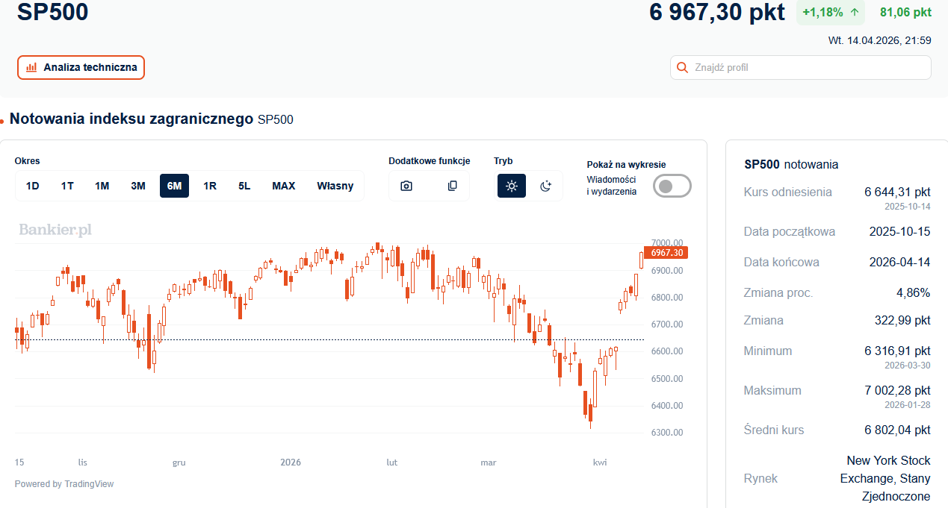
Hopes for an end to the conflict in the Persian Gulf on Tuesday sent the main US stock indexes upwards. The S&P500 gained 1.18% and reached 6,967.38 points. This is the highest closing price since February. In this way, the S&P500 erased war losses in just two weeks and was just a hair's breadth away from the January peak of the bull market (7,002.28 points).
After an increase of almost 2%, the Nasdaq Composite reached 23,639.08 points. and set an over two-month maximum, also returning close to the autumn-winter boom peaks. Dow Jones increased by 0.66% and finished with a score of 48,535.99 points. The VIX volatility index went down again, returning to values considered neutral.
Advertisement
There was also good news about the start of peace negotiations between the envoys of Israel and Lebanon. This front of the war in the Middle East is still active and without its extinguishment, there is unlikely to be a lasting peace with Iran.
Unexpectedly good news also came from the macroeconomic front. March producer inflation (PPI) increased by only 0.5% month-on-month – only half of what was expected (1.1% month-on-year). However, the annual price growth in American factories accelerated from 3.4% to 4.0%, although it was expected to be as much as 4.6%. The core PPI (i.e. excluding fuel, energy and food prices) also turned out to be very calm, amounting to only 0.1% month-on-month and 3.8% year-on-year. If these data turn out to be true (because PPI statistics in the US are regularly and very significantly revised), then the March inflation shock does not look as bad as originally feared.
Let's also not forget that the reporting season for the first quarter has just started on Wall Street. Analysts estimate that this was the sixth consecutive quarter of double-digit growth in profits of American corporations. Profits attributable to the S&P500 index were expected to increase by 12.6% y/y, according to FactSet data. After correcting this result for the usual “beat” above the market consensus, we get a nearly 19% increase in EPS. And that's really a lot. Even when the S&P500 is almost 29% higher than last year.
K.K
The publication contains affiliate links.