“Romania is one of the easiest preys for Putin”. Why Orban's landing does not bring peace to Bucharest

After the loss of influence in Hungary, Russian efforts to capture the goodwill of the European electorate will continue and intensify in Romania as well, claims historian Cosmin Popa, a researcher at the Romanian Academy specializing in the history of the Soviet Union.
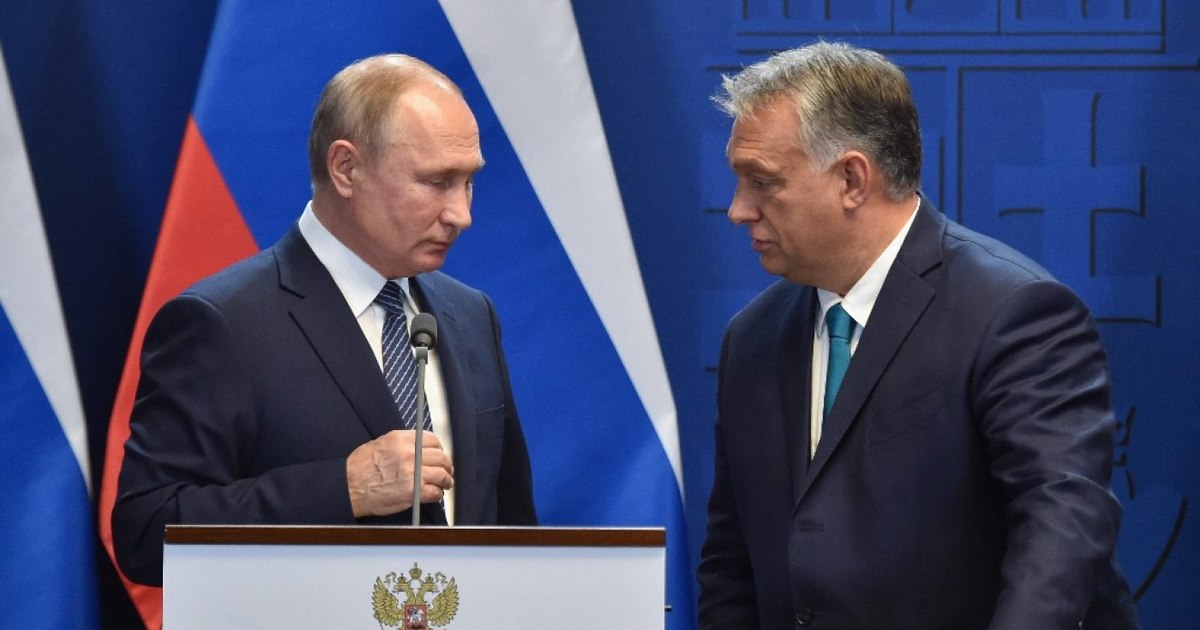
Putin is looking for a new Viktor Orban in the EU. PHOTO: AFP
“The Russians will redouble their efforts in Romania after losing Hungary”wrote Sorin Ioniță, the president of Expert Forum, on Facebook, one day after Peter Magyar's victory in the elections in the neighboring country.
The analyst is of the opinion that, in the context in which the leader of TISZA, the party that won the elections in Hungary, “will have a great window of goodwill in the West this year“, Romania will be considered by the Kremlin regime as “the next easy prey“.
“Conversely, our epaulet-wearing epaulettes, with their incompetence and obscure complicity, blocking the investigation of the political disaster of 2024 so as not to be seen to be owed, and lacking useful contacts outside (other than mobsters from Dubai and Belgrade), are currently assessed in the Kremlin as the next easy prey. By contrast with its neighbors, including Moldova, Bucharest gives the impression of Brezhnevist stagnation. Our moment of glory is it was 2025 and we let it go to a standstill. Now we are only good land to exploit.” explains Ionita.
Historian Cosmin Popa, researcher of the “Nicolae Iorga” History Institute of the Romanian Academy, specialized in the history of the Soviet Union and European communism, explained to “Adevărul” how Russia will change its strategy in the EU after the loss of Hungary and how Romania is seen in this context.
“Hungary's position regarding the Hungarians in Romania will become somewhat more blunt”
The Truth: How important is losing influence in Hungary to Russia?
Cosmin Popa: The result of the elections in Hungary is important not only for Russia, it is important for the whole of Europe, as were the elections in the Republic of Moldova. First of all, for Russia it is the loss of an ally, say, within the European Union. Within NATO, in the last period, it is certain that the opposition held by Hungary was in a certain consonance with the American positions, from certain points of view, with the American political positions. But within the European Union, the existence of a pro-Russian ally, as Orban's regime was, was, I would say, invaluable for a country like Russia, in several ways.
First of all, Hungary was a source of parasitism, of blocking some of the European mechanisms, it was, of course, also an important source of information, and it was also a country that started a series of initiatives aimed at weakening the sanctions regime to which Russia is subject.
So, from that point of view, Orban's loss to Putin is a major shock, but I don't think we should be under any illusions. Orban may leave power, and most likely he will, but Orbanism and the main messages and fears that this regime has peddled, especially in the last years after accepting the war in Ukraine, will not leave Hungary anywhere. And this can now be partially seen from the statements of Magyar, who is trying to manage this type of electorate and especially these types of sensitivities in Hungary.
What effects does this result have for Romania?
I think that many people are tempted to see in the victory of those from TISZA the beginning of a period, let's say, of good collaboration, I wouldn't say relaxation, because it is not about strained relations, but a period of consolidation of the Romanian-Hungarian partnership, including regarding Transylvania.
But, judging from the perspective of simple political logic, I think that, from this point of view, I don't think that Hungary's position regarding the Hungarians in Romania will change, but it will become, from my point of view, I think, a bit more blunt, a bit less harsh, but precise and clear regarding the way in which the national minorities in Romania must be organized. Why? Because the TISZA party will surely remove from Hungary's agenda a series of issues that have so far enjoyed the support of an important part of Hungarian society and, one way or another, it will have to compensate with a type of political constancy in other directions.
Traditionally, the Hungarian minority in Romania has been for the politicians from Budapest a direction for settlement of internal pressures, whether we are talking about the 80s, the 90s and, to a good extent, also at the beginning of the Orban regime. So, from this point of view, I think that the traditional discussions between Romania and Hungary regarding the Hungarian minority, the autonomy of the Szeklers and so on will continue, and I think that the new government in Budapest will somewhat increase the pressure on Bucharest to obtain these rights.
“Russian efforts are successful in Romania”
Do you think that, in this context where a door has been closed for Russia in Hungary, Russia will intensify its efforts to influence the politics of other countries, such as, for example, Romania?
Peter Magyar's victory shakes Putin's influence in Hungary, but the country cannot afford to completely break away from Russia
I think it is an interesting perspective that you propose, but know that even with the existence of a friendly regime in Budapest, Russia has not reduced its efforts to achieve a political overthrow in Bucharest.
And surely we are all happy with the signing of the documents preceding the strategic partnership between Romania and Ukraine, but, from many points of view, in Bucharest too, things remained exactly as they were, with an, I would say, exaggerated caution of Romanian politicians not to hurt the sensitivities of, let's say, the populist spectrum. And I don't see any change, at least so far, that would indicate that the Russian efforts are not succeeding.
Will Russia try to compensate for the loss of influence in Hungary with an intensification of efforts in other EU countries?
Of course, but Russian influence in Europe is not a matter of pure arithmetic.
It is, if you like, a matter of algebra rather than arithmetic. Russian efforts to capture the goodwill of a significant part of the European electorate will continue and intensify. Not only in Romania, but also in Romania, because at the moment these efforts are successful. All the more so since up until now, at least declaratively, the US administration's policy of, let's say, continuous undermining of the North Atlantic Alliance, to a good extent, represents a kind of invitation for Putin to test the limits and the ability of the North Atlantic Alliance to intervene in defense of its members. And that's why I think that, at least in the near term, it will take full solidarity to combat the Russian threat. A danger that will increase in intensity and against the background of the efforts, which it is obvious that Putin is undertaking to achieve some favorable results in Ukraine, although the actions on the front give him nothing to hope for. So what remains for him to do is to consolidate his authoritarian regime inside Russia, probably to increase the military resources allocated to the war, including human resources, either through a new mobilization or a partial mobilization, and of course to test, let's say, the limits of the solidarity of the North Atlantic alliance, because Putin understands very clearly that at the moment the mechanism of European rearmament has been triggered. Sure he doesn't work or deliver results as quickly as we'd like to see them, but he's fired up. Europe is on a course of rearmament and regaining, let's say, operational autonomy, including from a military point of view. And it is a direction that will continue regardless of the outcome of the war in Ukraine. If the result is negative for Europe, for democracy, it will only accelerate this trend. And if we have at least a Russia, if not defeated, at least moderate in its claims, this direction will continue.
So, from this point of view, Putin knows exactly that when he did not attack Ukraine on a large scale in 2014, he made a strategic mistake, delaying the attack against Ukraine by a few years, and therefore, I think he realizes very well that in some time Europe will be a prey with a much sharper flesh and a much thicker skin than it is now. So I see no reason why it should not test the ability of Europe and the North Atlantic Alliance to react, as the treaties say, to an external danger.
“Romania is one of the easiest preys that could tempt Putin”
If Putin now looks at the map of the European Union, which are the countries, I know, “weaker”, where the pro-Kremlin policy could be more successful? In Romania, for example, a party like AUR with results of over 40% in polls.
The first official reaction of the Trump administration after the Hungarian elections. JD Vance is 'saddened' by Viktor Orbán's defeat
Do you know what the problem is in Romania? It is that populist tendencies are fueled by bad governance or insufficiently competent governance by the democratic parties in power. So, from this point of view, if we think from the perspective of the domestic political equation, I think that Romania is one of the easiest preys that could tempt Putin. But its geopolitical and geographical data complicates the situation a lot. From a military point of view, certainly the Russians will always be tempted, when we talk about Europe, to push the northern borders of the Western space, given the proximity, I would say, of an extremely important area for Russia, the one around Saint Petersburg. But there, for sure the Baltic countries are not great military powers, but they have a population with a high degree of resilience, with a fairly high degree of civic education, which makes, if not very unlikely, at least very, very difficult a potential peaceful Russian intrusion, as is happening in Romania. So judging from this point of view, we could certainly say that in Bulgaria there are also some pro-Russian tendencies that are based on a fairly consistent historical layer, but if we look at the governance performance of the Bulgarian government, of the Bulgarian politicians, even against the background of instability, we see that they are much better than in Romania and as proof, we see the recent accession of Bulgaria to the Eurozone. This obviously places Bulgaria in a different economic reality and, I would say, superior to Romania.