The first essential tests for the new Hungary. Romanian professor from Oxford: “He will have to specify the future relationship with Russia”

Political scientist Corneliu Bjola, a professor at Oxford University, explains, in an analysis for “Adevărul”, what the tests will be for Péter Magyar's Hungary.
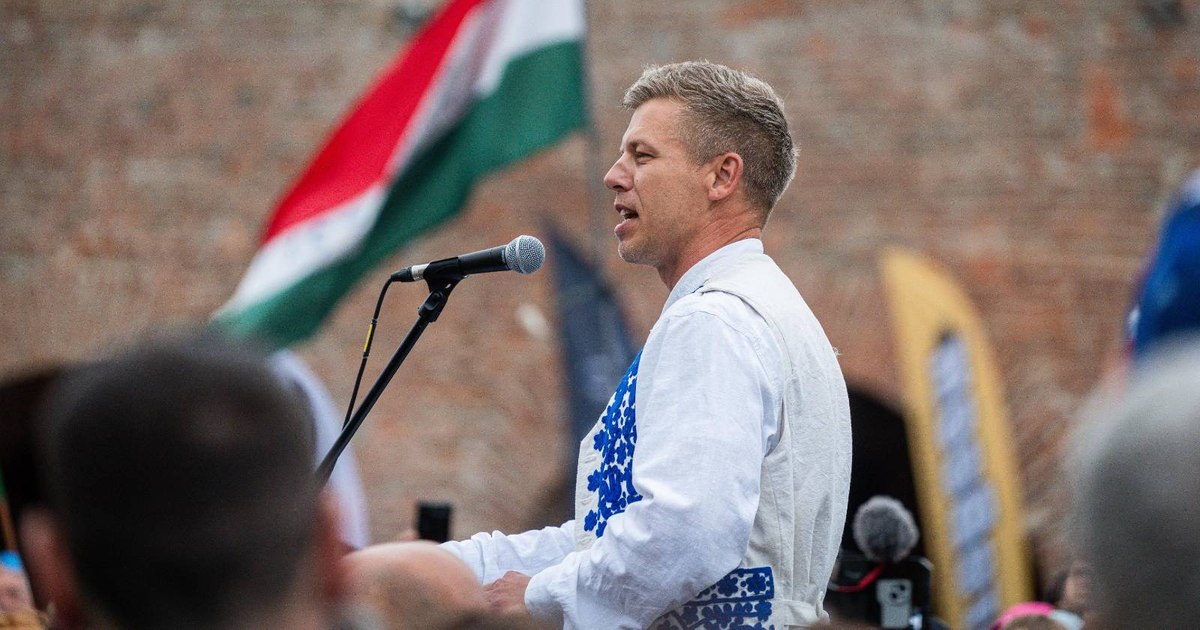
The new leader of Hungary, Magyar Péter. PHOTO: Tisza Párt
Political scientist Corneliu Bjola, a professor at Oxford University, explains, in an analysis for “Adevărul”, what will be the real tests that Hungary will have to pass in order to be able to consider that this country has really returned to democracy and the economy specific to a liberal society.
Budapest celebrated with pomp the victory of the opposition, after almost two decades under the sign of Viktor Orbán. The enthusiasm of the first hours of the change has gradually been replaced by concern, and Brussels and the big European chancelleries are now waiting with interest for Péter Magyar's next moves.
Professor at Oxford University, Corneliu Bjola leads the Oxford Digital Diplomacy Research Group. The Romanian displays cautious optimism in his analysis for “The Truth” and starts from a reality: Péter Magyar is, after all, one of Viktor Orbán's closest former collaborators, and for now it is not at all clear how Hungary's interests will align with those of the European Union.
Europe is coming back down to earth
The victory of Péter Magyar and TISZA caused excitement from Budapest to Brussels, but the hardest part is yet to come. It is the warning of several experts and political analysts in Europe, who draw attention to the fact that beyond the rhetoric of the electoral campaign and the pro-European speech, Péter Magyar has been Orbán's ally for years and comes from within the system. Last but not least, despite some promises, Magyar does not seem so determined to completely remove Hungary from the map of Moscow's interests, as he does not seem at all enthusiastic about the prospect of supporting the European integration of Ukraine.
In Corneliu Bjola's opinion, Péter Magyar's victory is not a surprise, but what might surprise him is its proportions.
“It's a surprise, not necessarily in terms of victory, but in terms of the magnitude of the victory. In fact, Péter Magyar won a constitutional majority that allows him to make many changes, including, if he decides to do so, to dismantle the Orbán regime. So here is a surprise, because Orbán has managed, as much as he has left since he came to power in 2010, to build a system to his advantage. Well, this system, it seems, at the moment betrayed and this also comes against the background of this strong desire for change among Hungarian society”says Bjola.
Why there are reservations about Magyar
The categorical victory of the opposition also shows the fact that European radical parties no longer have the same popularity, and in many countries they are beginning to show signs of weakness.
“This shows that society has reached a point of saturation with the economic, political, geopolitical orientation of the Hungarian regime. I think it is explained by the fact that the Orbán regime has failed massively in three areas. From an economic point of view, Hungary is at the moment at the tail of the EU, although it was somewhere in the leading platoon. At the time Orbán came to power, he was now also overtaken by Romania. And this was due to the way in which he managed the finances public, as well as the fact that it entered into an open conflict with the European Union. Two: the democratic problem was taken over by Orbán in 2010, with a rather vibrant media system that balanced each other. At the moment, it is difficult to see how a democratic system even works like that. which affected us all. I am referring to the way in which Orbán, despite this facade of sovereignty, has actually turned his country into a vassal state of Russia. And this was also seen with the conversations of the foreign minister, in which he spoke with Lavrov and Putin. He had turned his country into a poisoned pawn of Russia, but also of China.” explained Bjola.
Hungary, he says, had a choice between two directions and chose the European one. This means that this country has a good chance of breaking out of the impasse it was in. However, there are no guarantees, warns Corneliu Bjola.
“All this constellation in fact, both economically, and on the democratic side, and on the geopolitical side, have brought the situation to an impasse. That is, from here on there were two trajectories: either to go back, towards the European democratic zone, or to advance even further in a Belarus-type system. Of course, without Russian annexation, but on the model we see at the moment in Belarus. Probably, many finally understood that the direction is not good and that a change must be made. It remains to be seen how strong this change will be.” says Bjola.
What Coposu was saying four decades ago about the Russian danger and how it evolved. History: “The moment can no longer be put off”
He explained why there are some reservations, including in Brussels, although official statements abound with optimism. Foreign policy analysts in Europe are reserved, especially since there are no guarantees that Magyar and the new power will not decide to continue the patronage-clientelism logic to their advantage by replacing the Orbán “system” with an equivalent and favorable one, resorting to substitution and co-optation mechanisms.
“The reserve arises from the fact that Péter Magyar comes from within the system. That he was inside the system for a very long time. He worked with Orbán, he admired Orbán. But from 2024 this rupture occurred also against the background of these personal relationships with his ex-wife, Judit Varga, Minister of Justice in the Orbán government. And it worked very well”, claims Bjola.
Hungary's European tests
As for the future of relations between the European Union and Budapest, the real test lies ahead.
“The signals sent are good. After that will come the test for Magyar, let's see to what extent he confirms the realignment he is talking about on a rhetorical level, if it is confirmed. Tisza was part of the EPP together with German Chancellor Friedrich Merz's Christian Democratic party. We will see how things develop in the EPP, but it is a medium-term topic. In the short term, the test for Péter Magyar would be to see what he will do beyond this pro-European rhetoric. And these tests will come very quickly. A first test is related to the unblocking of the 90 billion for Ukraine. And I think that Hungary will pass this test, especially since it needs the unblocking of European funds.” points out Bjola.
The second test for Budapest also indirectly concerns Romania and depends on how Magyar will agree to the unblocking of negotiations for the integration of the Republic of Moldova, along with Ukraine, into the European Union.
“The second test we must follow is the unblocking of negotiations between the European Union, Ukraine and the Republic of Moldova. These negotiations were blocked by Orbán. Attention, Péter Magyar is also rather reserved about the accelerated admission of Ukraine, but he promises that he will have a different attitude than Orbán. The start of negotiations, that is, the opening of some chapters, is the first step and will convince us if Péter Magyar will accept that the two states are part of the European Union. That he will introduce conditions, that he will introduce timing, it is the second part, we can expect these, but it remains to be seen if he will really agree to unlock these negotiations”, explained Bjola.
And that's not all. Péter Magyar will give another test by the attitude he will have towards Russia.
“The third test we should follow is the signal of reducing energy dependence on Russia. Péter Magyar said, for example, that he wants Hungary to give up by 2035. Or 2035 is a bit far, especially since it involves two mandates. Here it seems more like a statement by which he wants to please the European Union, but not very convincing. To really give a stronger signal, he needs to say with subject and predicate that will reduce much more this dependence on Russia, i.e. specify what Hungary's relationship with Russia will be”Corneliu Bjola also points out.
Viktor Orbán could call for the election to be annulled if the opposition wins. Romanian analyst from Great Britain: “They could be inspired by us”
Domestic challenges
Finally, Péter Magyar will have to pass a series of tests internally. After this success, Péter Magyar and his associates will have to find solutions to destroy the clientelism system and put an end to corruption or at least give a signal of the fight against corruption. But there are fears that once in power, the opposition will not resist the temptation to continue Orbán's policy, only replacing the main actors in office, the people of the former Hungarian prime minister, with their own people. Thus, the new power could now take advantage of its advantages and abuse them.
“Let's take into account the fact that Péter Magyar also comes with a political movement that has developed rapidly, in two years. So he benefited a lot from this negative vote against Orbán, such a movement does not last long. He probably has six months in which he has to make some changes, start a serious reform. Along the way, as it always happens, there will be problems. There will be fragmentation, divergent political interests and fissures among his allies. So he also has a rather small horizon in which they have to do something before they slip again into an area that will not be in any way favorable to Hungary and will not help this country to change its relationship with the European Union“, concludes Corneliu Bjola.