INTERVIEW “Something that no Hungarian politician has done before.” How the Hungarian opposition leader succeeded in ousting Viktor Orban from power

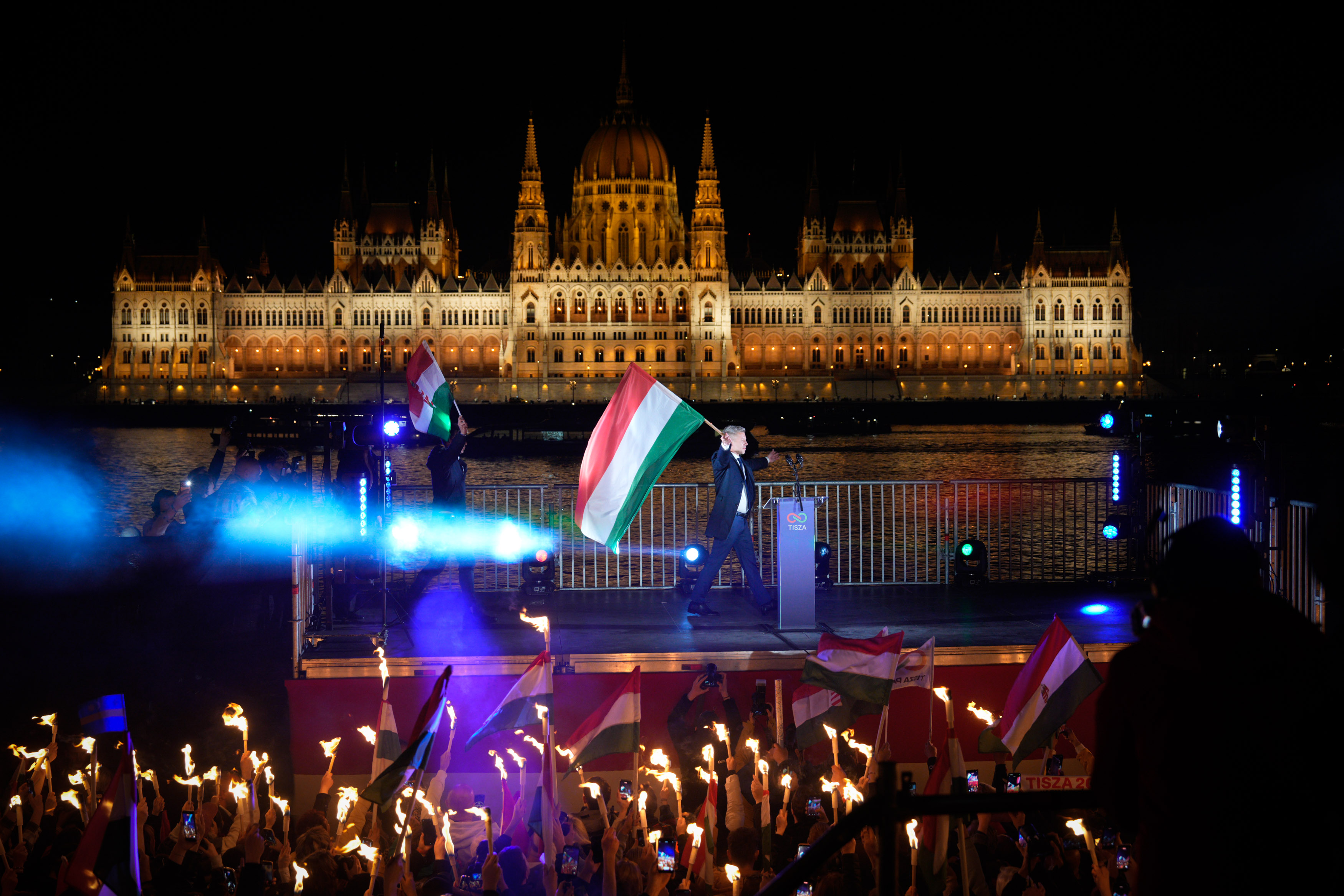
Péter Magyar, winner of Sunday's elections in Hungary, has a difficult task – to maintain cooperation with the United States, repair the relationship with Ukraine and manage Viktor Orbán's influence on the Hungarian minority in neighboring countries, says Zsuzsanna Végh, political analyst of Hungarian origin at the German Marshall Fund, in an interview for the HotNews audience.
With more than 98 percent of the votes counted, the center-right, pro-EU Tisza party led by Péter Magyar won 138 seats, a crucial two-thirds majority, in the 199-member parliament. Orbán's Fidesz party collected 55 seats.
“For Fidesz and Viktor Orbán, this result means that they have no chance to contest such a score. If the difference had been smaller, they could have contested certain constituencies to prolong the process. But the vote was so clear that Viktor Orbán didn't even wait – at 10:00 p.m. he conceded defeat,” says analyst and CEE expert Zsuzsanna Végh.
She speaks of “a major change of tone, which Hungarian society really needs” after 16 years with Viktor Orban in power.
“Tisza beat Fidesz and Orbán by their own rules, at their own game”
Hot News: – It was a huge victory for the opposition and a defeat for Viktor Orban after 16 years in charge of Hungary. Why was there such a big difference between Fidesz and Tisza?
Zsuzsanna Vegh: – What we saw in the polls is that Tisza had a significant, double-digit lead, but it was not clear how widespread this support was in the country – whether it was concentrated only in the big cities and Budapest, or whether it really reached the countryside as well. Because of this, the expectation was that, yes, there is a big lead, but in the end Tisza will maybe get a simple majority, not a constitutional one.
But when the results started coming in, we saw an overwhelming victory across the country. Not just in big cities, not just in Budapest, but everywhere. The map was colored blue, the color of Tisza, and Fidesz managed to keep only a few mandates in rural areas, in certain constituencies. Budapest was won outright by Tisza, and this exceeded expectations.
Then, the electoral system is distorted. It was designed by Fidesz to favor the largest party. Tisza managed to build such a level of support and ended up benefiting from the very distortions Fidesz initially created for them. Basically, Tisza beat Fidesz and Orbán by their own rules, at their own game.
The moment, similar to the Fidesz victory in 2010
– What does this result mean for Viktor Orbán, for Péter Magyar and for their parties?
– For Fidesz and Viktor Orbán, this result means that they have no chance to challenge such a score. If the difference had been smaller, they could have appealed to certain constituencies to prolong the process. But the vote was so clear that Viktor Orbán didn't even wait – at 22:00 he admitted defeat. This was completely unexpected and took many by surprise.
Now, Fidesz will enter the opposition. It will be a completely new experience for the party after 16 years, especially for the younger generation within, who are used to being in power. It will be very interesting to see to what extent the party will manage to stay united or if, over time, internal fractures will appear.
For Péter Magyar, this is an absolute mandate. He also has a majority of the popular vote, and this two-thirds majority in parliament allows him to amend the Constitution and change the institutions that his Government decides to reform. Basically, it is a popular mandate for regime change, not just for taking over the government. It remains to be seen what he will do with this mandate. It is as important a moment as the Fidesz victory in 2010 and the post-communist regime change. It could open a new chapter for Hungary. The question is how it will be written.
“Changing the leadership of some key institutions will be a long-term process“
– What concrete changes do you think will take place in the next period in Hungary?
– Magyar only mentioned a few concrete things. One of them is that Hungary would join the European Public Prosecutor's Office. He also wants to establish a new anti-corruption agency, which will investigate and sanction abuses of resources, including during the Orbán regime. These are the clear commitments he has made so far. Otherwise, we do not yet know exactly what the reform process will look like.
He intends to change the leadership of key institutions, currently occupied by Fidesz loyalists, from the president to the leadership of the highest court, the Constitutional Court, the Court of Accounts and others. He can request these changes, but it will be a long process.
The current government is still in office, but given Tisza's overwhelming support, it is highly unlikely that it will make any more significant decisions during this time.
– Péter Magyar was a leader of Orbán's party. What should we expect from a government led by Péter Magyar?
– He is a conservative politician and in many ways will follow right-wing policies, including in the institutional reform process. With such a majority, he can basically do whatever he wants.
For now, it seems his approach will be inclusive and pluralistic, and he is sending messages of unity, national unity and reconciliation. It's a radical change from the rhetoric we've heard for the past 16 years or more. It's a major change in tone, which I think Hungarian society really needs.
However, we do not yet know exactly how he intends to use this mandate to reform the state.
“It will be a completely new and unique situation”
– So far the results look like this: Tisza – 138 mandates, Fidesz – 55, Mi Hazánk – 6. What will a three-party parliament mean for Hungary?
– These figures are not yet final, but it is likely that we will indeed have a parliament with only three parties and all of them are right-wing.
Behind Tisza, however, is a more ideologically diverse electoral coalition. It will be very interesting to watch how the political landscape will change, beyond the parliament. Parliament will be dominated by Tisza, but all Tisza representatives are basically new politicians. They have no experience and will learn as they go. It remains to be seen how united this group will be and to what extent they will manage to represent the diversity of opinions of the voters who supported them, because it was a broad audience that includes the right, left and liberals. This inevitably involves ideological contradictions. In practice, it will be a completely new and unique situation.
– And it will be a difficult mission for Tisza.
– Yes, for sure. But it was also very difficult to defeat Fidesz, and yet they succeeded. I think now there will be a very high level of trust from society, but also very high expectations.
“Something that no Hungarian politician has ever done before”
– How much did it matter to Tisza that it is a party made up of people without a political background?
– It mattered, but it was not the only factor. Péter Magyar wanted to separate himself not only from Fidesz, but also from the old opposition. For him it was important to attract people who are not connected to the existing parties, who can bring about change and can be credible figures of it. It was an important factor, but not the only one.
Equally important was the fact that Péter Magyar traveled the country for two years, visiting hundreds of cities, towns and villages. This is how he built his credibility and a wide base of supporters. This is something that no Hungarian politician has ever done before.
Fidesz has, in the past, built a local network at the level of the smallest constituencies, but it has done so as a party, not through Viktor Orbán's constant tours of the country. He never did that. This direct connection with voters was extremely important for Péter Magyar to build his credibility and make people not just hope, but really believe that change is possible.
What will change in the relationship with the EU
– Orbán was considered an ally of Vladimir Putin within the European Union. What changes can we expect in Hungary's relationship with the European Union? What about Ukraine?
– In the relationship with the EU we can expect a more cooperative approach. Péter Magyar would treat the European Union as Hungary's “home”, a space to which the country wants to belong and in which it wants to build its future. This does not mean that there will be no confrontations or conflicts, but essentially, Hungary's EU membership will no longer be questioned.
As for Ukraine, there will of course be a process of normalization of relations, and Péter Magyar will have to make efforts to balance the relationship between the two countries and resolve the existing disputes. Later, this relationship could turn into a partnership based on mutual efforts, which could support Ukraine's European path.
Péter Magyar is not a pro-Ukrainian politician, but he approaches Ukraine as an important neighbor of Hungary and wants to normalize relations with neighboring states.
“The ideological alignment between the US MAGA camp and Fidesz will continue”
– I saw that JD Vance came to Hungary to support Orbán. How will this result affect Hungary's relationship with the United States?
– At the interstate level, there will continue to be bases for cooperation. The ideological alignment between the MAGA camp in the United States and Fidesz will continue, but the relationship between the states has other dimensions where governments can collaborate.
I think Tisza's geopolitical goals are closer to how the Trump administration would like the Central European countries to position themselves to protect their regional interests. So I expect there will be a basis for cooperation, even if the relationship will not be as cordial as with Fidesz. The focus will be more on concrete policies.
– Can this result have any impact on Europe's relationship with the US?
– Not directly. I think that at this point Péter Magyar will try to normalize relations and return to classical diplomacy. Perhaps the impact will be that we will no longer see an alliance between the Hungarian government and the Trump administration – especially the wing associated with Vice President Vance – to attack the EU and try to undermine its unity on ideological issues important to them.
Tisza will have to manage Fidesz's connections with Hungarians outside the country
– We know that Viktor Orbán has a significant influence on Hungarians in the diaspora. In Romania, for example, we know that there is strong sympathy for Fidesz and Orbán. In which direction do you think the Hungarians outside the borders will now orient themselves?
– We don't know yet. Péter Magyar has positioned himself as a leader who wants to represent and protect Hungarians outside the borders. He sees the Hungarian nation as a unitary community, but he also stressed the importance of good neighborly relations and strengthening cooperation in Central Europe.
How this will translate into practice remains to be seen, as it will have to find a balance. He will also have to manage the fact that Fidesz has strong connections and influence over Hungarian minority parties in neighboring countries. Most likely, this will also be a transitional process.