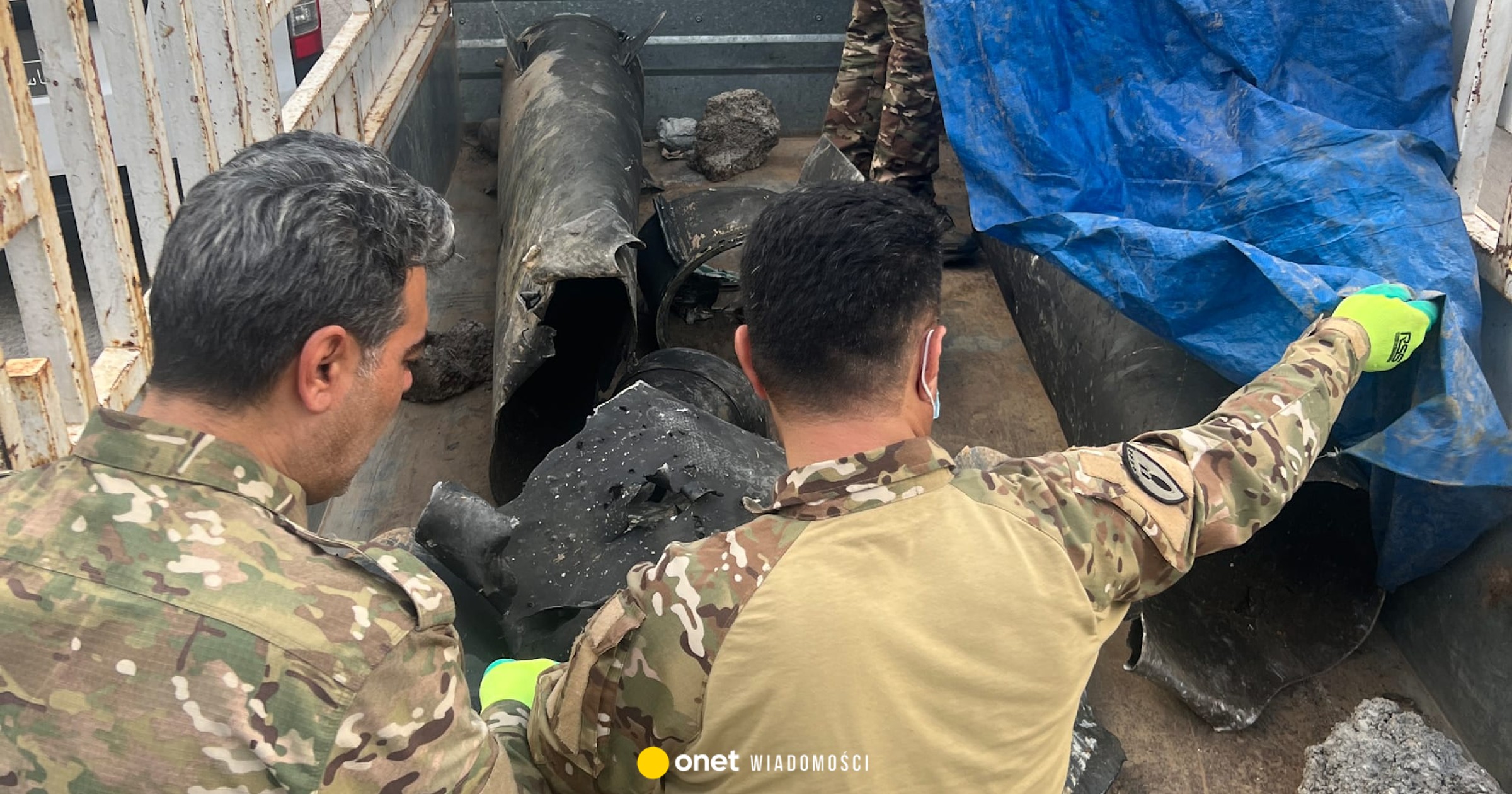
On Tuesday at noon, three men unload the remains of the monstrous weapon from a white van in Erbil. Here, in the fenced courtyard of Asaish — the security forces of the Kurdistan Autonomous Region in northern Iraq — bomb specialists examine every Iranian missile from the war.
“Zolfaghar,” says one of the Kurds, tapping the dark black metal. — This rocket hit a mosque on the outskirts of the city a few hours ago.
Zolfaghar is a short-range solid-fuel ballistic missile. It has a range of approximately 700 km and carries a warhead weighing up to 500 kg. This bullet is only a part extensive arsenal of weaponswhich Tehran has been using to attack countries in the region in recent weeks.
The Asaisz unit presents “Die Welt” a selection of drones and missiles that have struck across Kurdistan since late February. 17 people died as a result of Iranian attacks.
— Thanks to the help of Russia, China and North Korea, Iran has managed to build in recent decades an impressive arsenal of effective, technologically advanced long-range weapons – says Austrian military analyst Markus Reisner.
Tehran's ability to launch 60 to 90 drone strikes a day – combined with missiles – even into the sixth week of the war has prolonged the conflict and increased pressure on global energy markets.
The fact that Iranian authorities are capable of military action could also affect negotiations between Iran and the US that begin this weekend. Despite an official ceasefire, Iran attacked targets in the region, and the blockade of the Strait of Hormuz was only partially eased.
The United States and Israel attacked over 13,000. targets in Iran, but have failed to significantly weaken the country's military potential. According to estimates by American intelligence services, approximately half of Iran's missile launchers remain intact. Additionally, the country still has thousands of long-range kamikaze drones.
The destructive power of Iranian weapons was demonstrated in this war, Reisner says. — Drones are used here in intensive combination with cruise missiles and rockets. When these weapons systems are combined with precise satellite reconnaissance of Russia and China, they achieve further disturbing precision – adds the expert.
Iran's most used weapon
In a courtyard in Irbil, Kurdish security forces are placing pieces of rubble in a row. Center: Iran's most widely used weapon – long-range Shahid-class drones with a range of up to 2,000 km. Russia uses them en masse in the war against Ukraine, mainly in improved versions.
Shahid long range dronesIbrahim Naber / Die Welt
“We have identified three types of Iranian Shahid drones,” says Halmat, a member of a team of Kurdish bomb analysts. The most commonly used model, Shahid-136, has a rather leaded, metallic surface, others are lighter or black and made of various materials.
However, their design elements are very similar. In Kurdistan, Iran also used other models of combat drones, such as the Meraj-532. It is launched from vehicles, has a range of approximately 450 km and carries a 50-kilogram warhead.
“And this is Iran's new drone, the Hadid-110,” Halmat explains, pointing to the remains of another model. It is a jet drone that reaches speeds of up to 510 km per hour. and has a range of approximately 350 km. Typically carries a 30 kg warhead.
The article continues below the video
Smaller combat drones have also been used. Videos released in March by Iran-backed militias show FPV drones striking hangars and a helicopter near a US base in Iraq. They are another reminder of that distance and advanced defense systems no longer provide reliable protection in modern drone warfare.
“We are ready to sacrifice our lives”
Completely behind lie the black, massive remains of a Cheibar-class ballistic missile. “They also hit civilian areas here in the region,” says Pishtiwan, also a member of the Asaish special unit. He points to the writing he left on the rocket.
— It happened on March 19 in the Mala Omer area, outside the city. We found her at 12.55 noon – he says.
Halmat says Iran attacked the Irbil region alone with more than 400 drones and ballistic missiles. – And we disarmed and collected over 200 bombs – he adds.
His colleague Pisztiwan explains that after each explosion, a special unit goes to the site of the impact to analyze the damage and the weapons used. The risk of falling victim to the so-called a double-tap attack – that is, a second attack on the same target a few minutes later – is real. — But it is our duty to protect our people. We are ready to sacrifice our lives for this country, he emphasizes.
Iranian weapons also did damage, according to military expert Reisner significant damage to the United States and Israel. Europe must be aware that the threat also concerns itself.
— Iranian hits in Israel and in the middle of American bases have made this clear in recent weeks. The range of Iranian missiles reaches as far as the periphery of Europe. Therefore, the American anti-missile defense systems stationed in Europe and national purchasing initiatives, such as Germany's introduction of the Israeli “Arrow” system, are of great importance, he concludes.
I’m Ashley Davis as an editor, I’m committed to upholding the highest standards of integrity and accuracy in every piece we publish. My work is driven by curiosity, a passion for truth, and a belief that journalism plays a crucial role in shaping public discourse. I strive to tell stories that not only inform but also inspire action and conversation.