The wave of layoffs from 2026 sweeps Romania. Big companies that have already started massive layoffs

The labor market in Romania is going through a period of adjustment, marked by layoffs in several key sectors, and not necessarily because of a generalized crisis, but because of the need for economic recalibration.
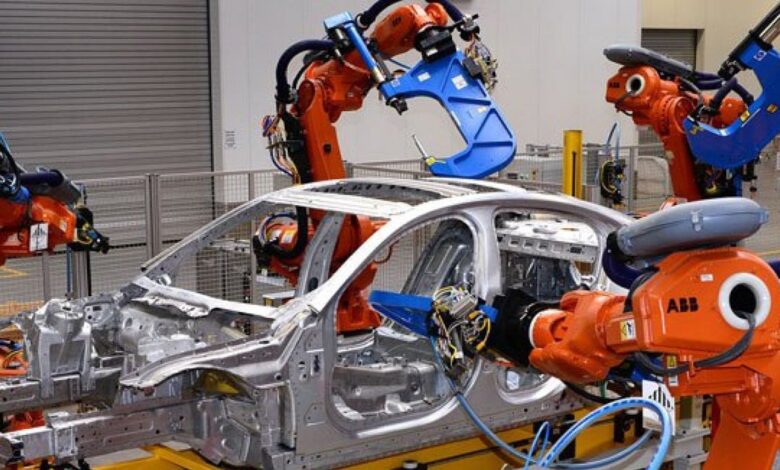
The automotive industry is the most affected by layoffs. Archive photo
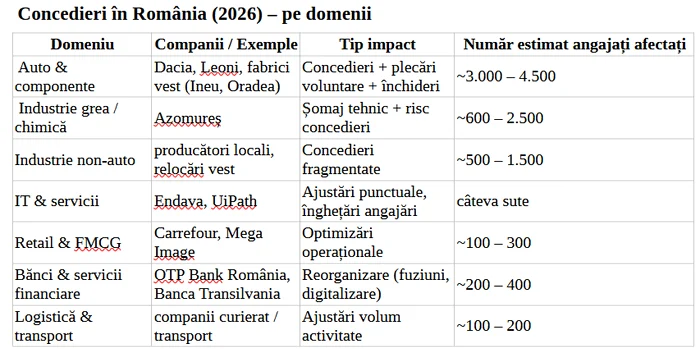
The most visible impact is felt in the automotive industry and in the supply chain. Companies such as Dacia, part of the Renault Group, have announced voluntary redundancy programs that may reach around 1,000–1,200 employees.
In parallel, important suppliers such as Leoni closed or restricted the activity of some units in Romania, which led to several hundred layoffs. Other specific cases, such as factory closures in the west of the country (for example in Ineu or Oradea), confirm the tendency to reduce production capacities. Overall, the auto industry is the most affected by the layoffs, amid falling external demand and the transition to electrification.
There are also layoffs in the non-automotive industrial sector. Various manufacturing companies in the west of the country resorted to staff reductions or relocations, amid high costs and pressure on competitiveness. The total impact is estimated at several hundred to over a thousand employees, but without a single major event to focus public attention.
Technical unemployment and layoffs in Azomureș
In the heavy and chemical industry, the situation is dominated by the case of Azomureș, one of the largest producers of fertilizers in Romania. Here, production stoppages caused by high energy costs have led to the technical unemployment of a significant number of employees and collaborators, with scenarios that may involve up to several thousand people affected.
Recently, the union at Combinatul Azomureș announced that approximately 2,500 employees are at risk of losing their jobs.
“The employees of Azomureș and those of the contracting companies, approximately 2,500 employees, will lose their jobs if the authorities do not find a correct solution for the production of fertilizers to continue in Romania. Examples from the past show that postponing a decision can create irreversible effects, and in the case of Azomureș it can lead to the complete closure of the company, with devastating effects for Romanian agriculture and the state budget”. the union said.
Redundancies in IT and services as well. eMag lays off 3% of employees
The IT and services sector is going through a period of moderation after years of accelerated growth. Companies such as Endava or UiPath have made specific personnel adjustments, in line with global reorganizations. At the same time, the e-commerce area is also starting to feel pressure: eMAG has recently announced an internal reorganization that involves reducing the team by around 3%, which could mean several hundred employees affected at group level, depending on the estimates.
Although at the international level giants such as Meta or Amazon have operated massive layoffs, the direct impact in Romania remains rather limited and fragmented. The local market is mainly characterized by hiring freezes, the reduction of external projects and an increased pressure on efficiency.
In retail and consumer goods, the adjustments are moderate. Big players like Carrefour or Mega Image are not facing a crisis, but are optimizing costs through internal reorganizations and automation, which may lead to limited staff reductions in certain areas. The situation is similar in logistics or the food industry, where layoffs are punctual and mainly driven by falling volumes or rising costs.
In the financial-banking sector, the changes are structural rather than conjunctural. The integration of OTP Bank Romania into Banca Transilvania may generate overlapping roles and staff reductions, but these are part of a normal consolidation process, not a sectoral crisis. In parallel, digitalization continues to reduce the number of traditional jobs.