Mikołaj Kunica, editor-in-chief of Business Insider Polska: It's not your first time in Poland. What brings you to us this time?
Kingsley Wheaton, Chief Corporate Officer at BAT: Poland is a very important market for British-American Tabaco. Especially in the context of our transformation towards building a smoke-free world. I took some of my management team colleagues with me from London and wanted them to see the market. In Poland, we have a strong position in the heated tobacco industry and it is probably our strongest market in the world for this category.
Does this mean that Polish consumers are the so-called early innovators, customers who are the fastest to adopt new products?
I think so. This is a more complex picture. Firstly, Poland has a remarkable economic success story that takes your breath away. I first came here 25 years ago, it was a completely different country. In this civilizational leap, the element of a high level of education has certainly always been important. The issue of appropriate regulations is also important. Every transformation needs clear rules of the game.
Let me give you a simple example: I was recently in Australia. There 80 percent nicotine business is a black market, which results directly from poorly established rules of the game. Excise tax was raised so high that there was space for criminal activities. As a result, social unrest occurs and shop windows are literally thrown with incendiary bombs. Classic criminal behavior. That is why business needs wise regulations.
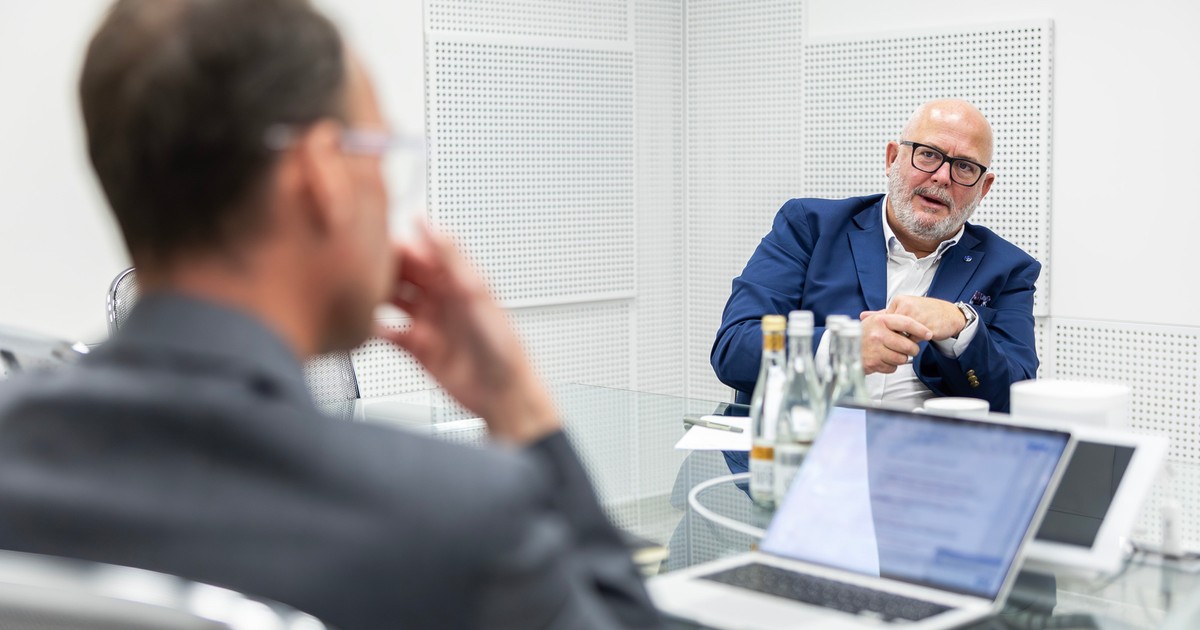
Editor-in-chief of Business Insider Polska, Mikołaj Kunica and Kingsley Wheaton, Chief Corporate Officer at BAT.
|
Piotr Kucza / Business Insider
Regulations as a foundation for the transformation of the nicotine market
You praise Poland's economic transformation, but I see shortcomings. Even the lack of strong, globally recognizable Polish brands.
I don't know, a great example of success is your chain of stores convenience under the Żabka logo. It's a very strong brand.
Yes, but local. This is not 7-Eleven, the chain you can find at every intersection from London to Thailand.
If we are talking about large, international brands, it is worth remembering that many of them have an established position, built on foundations laid decades ago. This is the story of Coca-Cola, Pepsi, McDonald's, etc. They are the incumbents. For new brands, going beyond the domestic market and becoming an international brand is quite difficult, although it is not impossible.
You are coming to Poland at the moment when the government decides to introduce a ban on the sale of disposable e-cigarettes – both those containing nicotine and nicotine-free heaters. What will be the consequences of these restrictions for BAT's business in Poland?
Poland has always been a major market for us and the Polish government has always been reasonable and balanced in its regulations. We would like this to also apply to heated products, e-cigarettes and sachets. Wise regulations are needed, which should be based on facts and consultations. Additionally, they should not generate consequences that are counterproductive, so as not to cause such effects as is the case in the previously mentioned Australia. Therefore, I hope that the regulatory environment in Poland will remain sensible, predictable and sustainable.
In an ideal world, regulations would enable the introduction of new products that give consumers the chance to switch from smoking to less harmful alternatives.
I think that the Swedes have found a golden mean in this respect. According to WHO data, less than 5 percent population smokes. It's a virtually smoke-free country and the fact is that when you eliminate the process of burning tobacco and nicotine, you get rid of a huge part of your toxicological profile and health problems. I think it is a good idea for the excise tax to be proportional to the harmfulness. In an ideal model, taxes should follow harmfulness, and even the International Monetary Fund supports this attitude.
Margins, competition and the realities of global business
Let's look at the numbers. In 2025, BAT achieved global revenues of over £25 billion and net profits of over £7.5 billion. It's a very profitable business. How long can you generate such margins?
I think our shareholders would say they think this is possible for quite some time. This is reflected in the price of our shares on the stock exchange, which has almost doubled over the last two years. So I think that faith in our business is significant. This industry has always generated high margins, and we have been in business for 125 years. The challenge has always been whether we can build a new market for smokeless products, which currently accounts for 20%. our business, and maintain margins. That's what investors are looking at. Looking at the profit and loss statement, a good item is the gross margin, it tells you in a very pure form how much money you make. In the case of innovative products, as the scale increases, these margins will increase.
What is BAT making the most money on today? Which business line contributes the most to the result?
Much depends on the maturity of a specific geographical market and the size of the gray zone. For example, we estimate the size of the entire e-cigarette market in the United States at USD 10 billion, of which the legal part is only USD 2 billion. Therefore, the margin profile on e-cigarettes is quite good, but hampered by illicit trade. In the segment of tobacco heaters and nicotine pouches, profitability is also good.
I don't know the data from Poland for last year, but looking at 2024, it can be seen that BAT margins are much lower on our market. Why?
Poland has a long history predating new product categories and there are some quite specific factors for this market. First, most international manufacturers compete here with reasonable market share. There was no situation where one large player with a large market share ruled. All the market leaders are here, which creates a very competitive market. Poland is constantly entering cycles of very aggressive pricing policy.
However, business profitability is improving as we transform. Our ambition is for half of our business to be smoke-free by 2035. In Poland this should have happened earlier. However, I don't have a crystal ball. I have no control over regulations. They can blow the wind in or out of your face.
You joined the company in 2012 as a management board member responsible for regulations and then marketing. 24 years is a whole epoch in our fast-paced world. How this business has changed, BAT and how you have changed?
I still remember my first day like it was yesterday. This is a company that has become my passion. On the one hand, little has changed. Of course, the market has changed dramatically. 30 years ago 100 percent we were a cigarette company. That's all we sold, and that's mostly what we've been doing for 100 years. In the USA in 1998, our company Reynolds introduced the first solution with heated tobacco to the market. I've seen technical drawings of what looks like a vaping product dating back to the 1960s. Someone drew a theoretical model, but they couldn't build it. Everything changed around 2007 when a gentleman named Hon Lik invented vaping in China. Today, if you look at our earliest device and compare it to today, in just ten years it has changed beyond recognition.
ESG in an industry with historical burden
Even before you became No. 2 in the corporation, you took responsibility for the ESG strategy. I think this is one of the most difficult areas in this business. The tobacco industry has a historical debt in this field. How to convince consumers that cigarettes, which are not good for our health, do not have to be a public enemy?
We all understand that the tobacco industry is a controversial industry. What we are trying to do is change. And even if you see us as a potential problem, there's no reason why we can't be an integral part of the solution. I think what we're trying to do is say we're trying to transform. We would like to act faster. We need to support policymakers and regulators.
We have a pretty good track record on sustainability. I don't entirely agree with the premise of this question. You know, our product is agricultural, it comes from tobacco farms around the world. We do a lot of work in the circular economy. We are the first international company in the world to create vaporization and heating devices with a removable battery. However, the challenge of transitioning our portfolio from smokable to smokeless products remains – but we are on the way.
Generation Z, which is about to take over, is strongly focused on quality of life, a healthy diet and free time. Don't you have the impression that this is not good news for the tobacco industry?
Throughout the world, the number of young adults who smoke is decreasing. In the US, the smoking rate among 21-25 year olds is less than 3%. In some parts of the world we already have a smoke-free generation. It is not nicotine that is inherently bad for humans. Rather, they are products of the combustion process.
On your official LinkedIn profile, you write that, apart from his involvement in business, he is also a sports fan – rugby, F1, Tennis – but also a part-time poet and a father. You once wrote a poem for your children, there are three of them, right?
I wrote various poems. They are quite personal to me. I don't force myself to do it. I don't sit down on Saturday and say: write. I do it when I feel like it. Sometimes I don't write for a year. I write about all kinds of things. I wrote poems about my favorite sport after England lost the Rugby World Cup final. I submitted two poems to the National Poetry Competition, neither of them won.
Apparently you dream of getting into the Master Chief program. What's your signature dish? Are you more interested in main courses or desserts?
When I was 18 I went to a place no one had probably heard of, the Isles of Scilly, small islands off the coast of Cornwall. I worked in a small tea shop and restaurant. I lived in a tiny tent and started out as a guy who peeled potatoes. It was my first job. Then I was a dishwasher and then I worked my way up so I could operate the cash register. And the man who ran the place taught me how to make lasagna. So 35 years later I would cook lasagna. I love cooking. My food tastes great, even though it doesn't always look that way.