There are already growing concerns that the election results will be challenged by the losing side, given that the election campaign was marked by smear tactics and accusations of foreign interference. And this only increases the importance of election observers.
Orban faces the biggest fight of his political career to stay in power after 16 years in power. His rivals accuse him of profiting from unequal conditions of competition through media control, manipulation of electoral districts and vote buying. Orban's ruling Fidesz party denies these allegations.
The Organization for Security and Co-operation in Europe (OSCE) has sent observer missions to more than 30 countries over four decades, but is now facing accusations of foreign interference in Hungary over the role given to a former Russian Foreign Ministry employee who worked as Vladimir Putin's translator.
Orban's conservative allies are using disputes over election supervision to create their own surveillance team — one who can wreak havoc by presenting his own version of what happened on Election Day.
— If pro-government missions are sent, there could be a clash of narratives that will obscure the election results, says Peter Kramer, an EU election observer with over 16 years of experience who is involved in observer training ahead of this year's elections in Hungary.
The OSCE sends teams of international election observers to assess whether the elections meet democratic standards. In recent years, the group has criticized Hungary and published reports pointing out the candidates' “lack of equal opportunities.”
However, before this year's elections, the organization had to face accusations regarding its activities in Hungary. In March, Hungarian journalists and human rights groups identified Daria Bojarska — who worked as Putin's translator during key meetings with the United States — as a senior adviser at the OSCE Parliamentary Assembly, helping to coordinate the assembly's monitoring of this year's elections.
Orban is the EU leader closest to the Kremlin, and this sensational news prompted, among others, Marta Pardavi, co-chair of the Hungarian Helsinki Committee, a civil society NGO, to question whether the OSCE mission can be relied upon to assess the integrity of the vote.
Russian President Vladimir Putin meets with Hungarian Prime Minister Viktor Orban at the Kremlin in Moscow, November 28, 2025.ALEXANDER NEMENOV / AFP POOL / AFP / AFP
“When Putin's former translator organizes a mission to the OSCE Parliamentary Assembly, it undermines much-needed trust,” she said. – How can we ensure that the information we share stays within the mission? she asked.
OSCE spokesman Nat Parry said Boyarskaya never served as President Putin's full-time “personal translator” and condemned the “continuous public attacks” against her, arguing that the accusations were based solely on her nationality.
“She was an employee of the Russian Ministry of Foreign Affairs who was occasionally entrusted with interpreting for foreign delegations,” Parry said. “This is a standard function in the foreign ministries of most countries and has no particular significance,” he assured.
The article continues below the video
However, civil society groups such as the Hungarian Helsinki Committee and Transparency International Hungary say Bojarskaya's previous employment and the security clearance required of her call into question the integrity of the OSCE's monitoring activities. The director of the legal department of Transparency International Hungary, Miklos Ligeti, emphasized that because of these doubts the organization will boycott this year's observation mission.
— In the undemocratic context of Hungary, where the government regularly threatens and intimidates civil society and journalists, international election observers should ensure that their mission enjoys the full trust of the people and organizations who share sensitive information with them, said Pardavi of the Hungarian Helsinki Committee.
Muddying the waters
The parliamentary assembly mission to which Bojarska is assigned is responsible for coordinating visits of foreign parliamentarians to polling stations on election day.
However, Parry expressed concerns about the controversy over Boyarskaya's role in the OSCE may undermine the work that this organization does. “The public campaign around this issue risks doing precisely the kind of damage to the credibility of the mission that its authors supposedly want to prevent,” he said.
In parallel to the parliamentary assembly, the OSCE Office for Democratic Institutions and Human Rights also sends hundreds of specialists to observe the vote at a technical level and provide a final legal assessment of the fairness of the elections. This risks involving this group of observers in controversies related to its sister mission.
International right-wing groups linked to Orban's Fidesz party used the incident to establish their own monitoring group: the Coalition for Free and Fair Elections. And this maybe further weaken the chances for a smooth voting process.
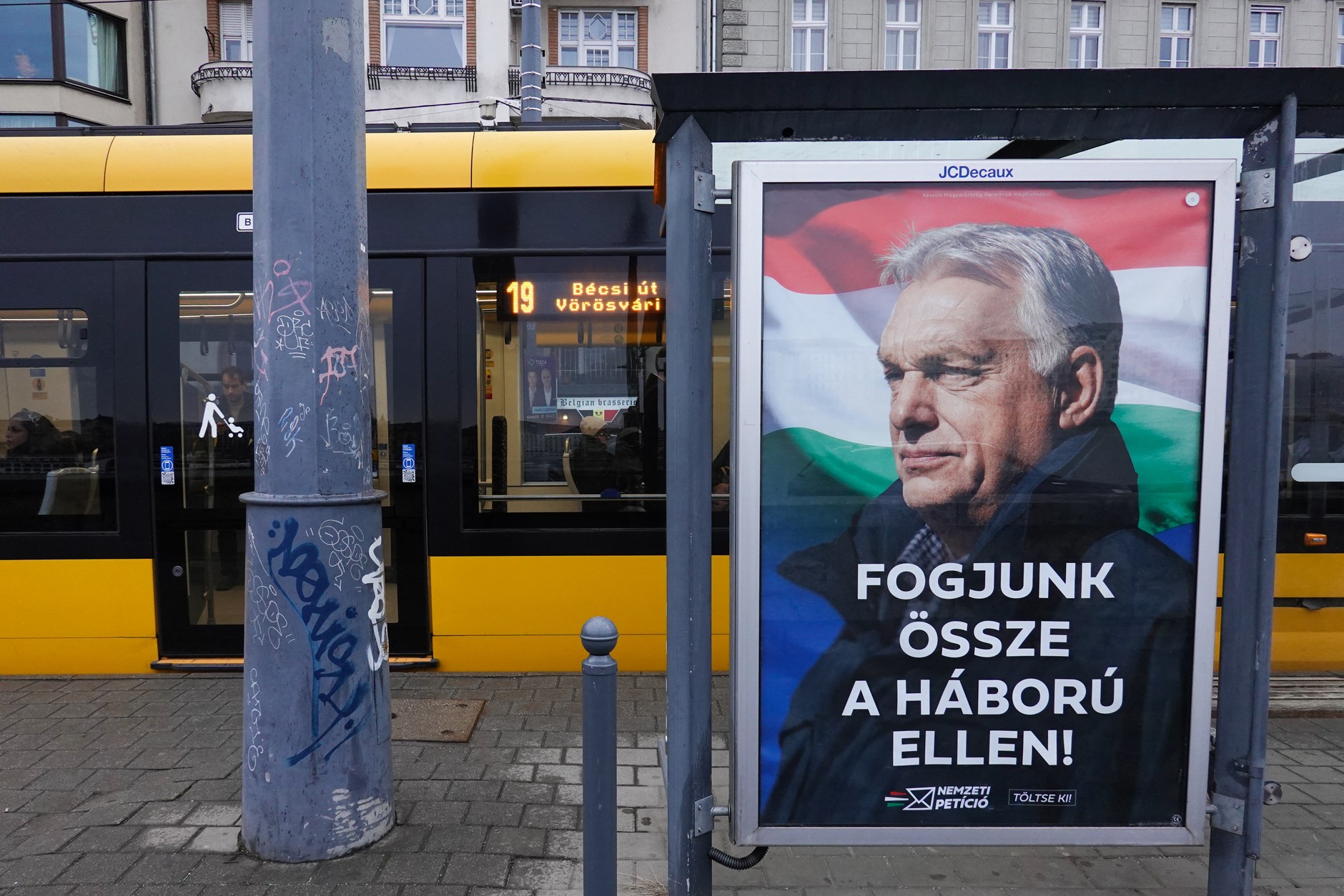
A poster with the image of Hungarian Prime Minister Viktor Orban on a street in Budapest, March 30, 2026.JPix / NurPhoto / NurPhoto via AFP / AFP
The mission is co-led by Anna Wellisz, president of the conservative Edmund Burke Foundation, and Polish lawyer Jerzy Kwaśniewski, head of the fundamentalist Catholic Ordo Iuris Institute for Legal Culture.
Both co-chairs are affiliated with large right-wing conferences such as CPAC and the National Conservatism Conference. In the past, they participated, among others: US President Donald Trump, Nigel Farage from the Reform UK party and Orban himself.
In its statement, the Coalition for Free and Fair Elections states that the decision to observe the vote in Hungary was made in response to allegations against the OSCE from “across the political spectrum”, as well as the organization's decision to reject “the candidacies of several highly qualified experts.”
Hungarian government spokesman Zoltan Kovacs told POLITICO on Monday that he did not trust some parts of the reports of the OSCE Office for Democratic Institutions and Human Rights, calling them “political opinion.”
Balazs Orban, political advisor to the Hungarian Prime Minister, expressed enthusiasm about the new mission. “An independent view helps ensure that the result speaks for itself,” he said.
I’m Ashley Davis as an editor, I’m committed to upholding the highest standards of integrity and accuracy in every piece we publish. My work is driven by curiosity, a passion for truth, and a belief that journalism plays a crucial role in shaping public discourse. I strive to tell stories that not only inform but also inspire action and conversation.