Investors want to have shares for Easter. Are they counting on the opening of the Strait of Hormuz?

publication
2026-04-02 22:05
Despite galloping oil prices, the last session on Wall Street this week ended with only minimal changes in the main indices. It looks like someone wants to be left with shares that they won't be able to sell for the next three days.
It was another tumultuous day on the financial markets. The mood on the markets was significantly worsened by President Trump's defiant message that the conflict with Iran is close to ending, but at the same time he announced further attacks within 2-3 weeks. He also threatened the Persians with a “return to the Stone Age”. Later, reports emerged of the destruction of two of Iran's largest steelworks. Asian markets reacted with quite strong declines. Indices in Western Europe also dropped significantly. The biggest problem was the strong increase in oil prices. Late in the evening, Brent crude oil prices rose by over 7%, and Texas WTI rose by over 11%. In both cases, prices approached (or even exceeded) USD 110 per barrel.
However, in the late afternoon the mood on the stock markets improved significantly. This was said to be the result of reports of talks between Iranian and Omani authorities on a protocol to “monitor” the Strait of Hormuz. Moreover, Lloyd's List reported that some ships sailed through Hormuz and paid Tehran in Chinese yuan (read: without the knowledge or consent of the US government). Since March 13, 26 ships have passed through the Strait this way. In turn, Bloomberg reported that an LNG carrier had entered the high seas from the Persian Gulf. It was supposed to be the first such case since the outbreak of the war.
Advertisement
There is also speculation that Tehran will reach an agreement with Asian and European countries regarding shipping via Hormuz, bypassing the United States. Great Britain also made diplomatic efforts, gathering 35 countries interested in opening the Strait. The USA is not among them.
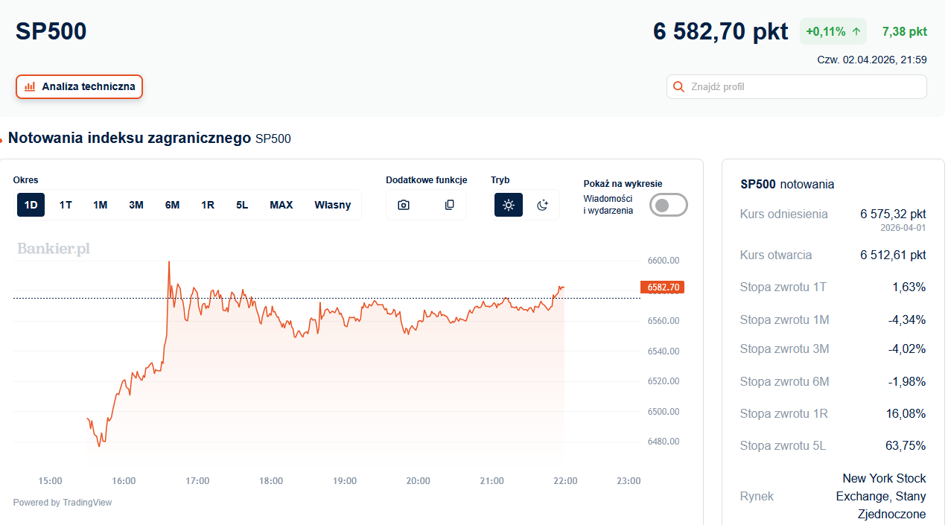
All these reports significantly improved the results of stock indices. The S&P500, which dropped by over 1.5% just after the opening of Thursday's trading, quickly rose above the mark to spend the rest of the day comfortably just below Wednesday's reference price. Ultimately, he even managed to gain 0.11% in the context of such a weak opening, it looks like a clearly upward session.
The Nasdaq Composite closed 0.18% above the mark, or at 21,879.18 points. The Dow Jones industrial average gave up a symbolic 0.03% and finished with a score of 46,504.67 points. The VIX volatility index decreased slightly (by 1%), and gold futures contracts decreased by 2.5%.
It looks like investors are betting on the end of the war, which is basically what they are doing despite what President Trump has been saying recently. So they are doing exactly what the speaker of the Iranian parliament told them to do on Tuesday. – If they inflate the price – open a short position. If they drop it, open a long one, wrote Mohammad Bagher Ghalibaf on the X website.
This is quite a bold strategy considering the Easter calendar. On Good Friday, all major stock exchanges in the Western world will be closed. Same as Saturday and Sunday. And in Europe also on Monday. So those who bought shares today will stay with them for at least three (or even four) days. And a lot can happen during this time. Not only in the context of Iran and the Strait of Hormuz, but also on Friday we will receive a monthly report on the American labor market.
The publication contains affiliate links.