When Trump talked about a conflict that could last “four to six weeks,” it was not necessarily an exaggeration. Rather, a hint. An initial stage designed to weaken Iran's ability to react — either to recover enriched uranium or to occupy strategic points in the Gulf.
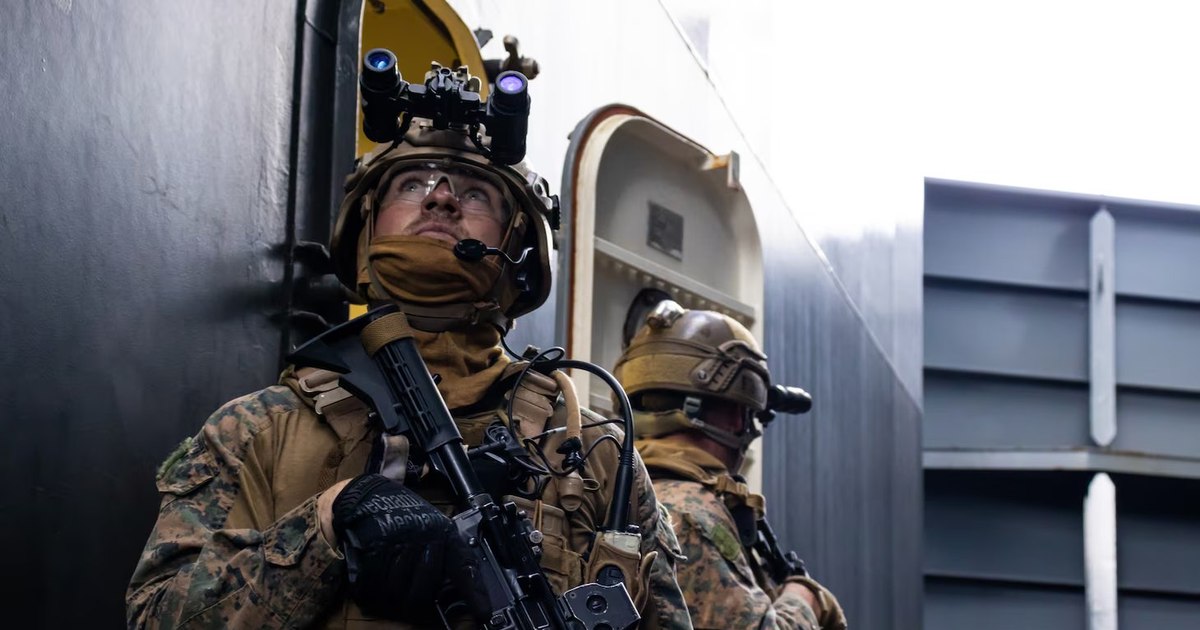
US Marines/PHOTO:X
In parallel, however, the White House has been careful to constantly convey to the financial markets that the end is near. A visible strategy: harsh threats quickly followed by soothing messages. A calculated balance, designed to avoid economic panic.
Trump is betting, as so often, on his own ability to control the game — even when the logic or context is not on his side. A pattern already known.
Meanwhile, the reality on the ground seems to confirm that it is not just talk. American troops are mobilizing. Marine expeditionary forces, paratroopers from the 82nd Airborne Division and special forces — all converging on the region.
The emerging scenario is not one of protracted war, but of quick, one-off operations aimed at securing key areas near the Strait of Hormuz and eliminating threats to shipping.
The chosen moment? Not by chance. A period when markets are closed — the long Easter weekend, when stock markets in the US and Europe are closed. The perfect window for “short and decisive” military action.
Thus a question arises that no longer seems at all speculative: is a land offensive being prepared for Easter?
With Trump, certainties are rare. But the patterns — more and more visible.
How long would a possible American invasion of the Strait of Hormuz last?
A possible US ground intervention in the Strait of Hormuz area or on Kharg Island could take weeks or even months, depending on the scope and objectives of the operation, according to divergent assessments within the US administration.
Israeli defense sources cited by the Jerusalem Post indicated that the evolution of the war with Iran depends largely on a decision by President Donald Trump: to launch a ground invasion — even a limited one — or to quickly end the conflict by including control of the sea route in post-war negotiations.
The duration of such an operation remains uncertain. No official estimates it could be completed in less than a few weeks, but views range between short-term and much longer scenarios.
The differences in assessment seem to reflect not only military uncertainties but also distinct objectives. Estimates on the order of “weeks” could involve limited operations — spot raids and increased airstrikes — while “months” scenarios would involve a larger and longer-lasting military presence.
Rising fuel prices in the United States quickly highlighted the impact of the conflict. Within two weeks, the price of gasoline had risen from about $3 a gallon to nearly $4, increasing pressure on the administration in Washington to act to reopen the sea route.
Military planners are taking into account Iran's reaction
Initially, the strategy would have been based on airstrikes and the possibility of regime change in Tehran or a negotiated surrender. But as the conflict continued, it became apparent that air power could not completely eliminate the threats, such as drones, missiles or naval mines, scattered in the area.
Even with the destruction of a large number of targets, Iran could maintain pressure on maritime traffic if it manages to hit merchant ships sporadically, thereby deterring transit.
In this context, the deployment of thousands of US Marines in the region was interpreted as a signal of the preparation of larger operations. However, delays in launching an intervention have fueled speculation that the plans are more complex than initially anticipated.
Some sources suggest that optimistic estimates would come from political or military officials favorable to expanding the conflict, while more cautious assessments would reflect the position of those who warn of the risk of a prolonged engagement.
A sustained scenario could involve not just spot operations, but actual control of limited areas of Iran, which would require additional resources and significantly prolong the conflict.
Military planners are also taking into account Iran's reaction and the risk that an initially small intervention could escalate into a wider conflict to ensure lasting control of the strait.
Another factor is the possibility of combining military actions with diplomatic negotiations, conducted in parallel, which could extend the overall duration of the operation.
Ambiguity about the timing may itself be a strategy to maintain uncertainty among Iranian authorities. However, this approach carries risks, particularly if the United States will at some point have to secure a diplomatic agreement and cannot rely solely on military pressure.
While these estimates do not provide clear answers, they illustrate the complexity of the decisions at stake and the high stakes of the conflict, which will determine both the course of the war and its duration.