US Defense Secretary Pete Hegseth warned on Tuesday that “the next few days will be decisive” in the conflict with Iran, arguing that Tehran finds itself in a weakened military position and can do “almost nothing” to change its trajectory, reports CBS News.
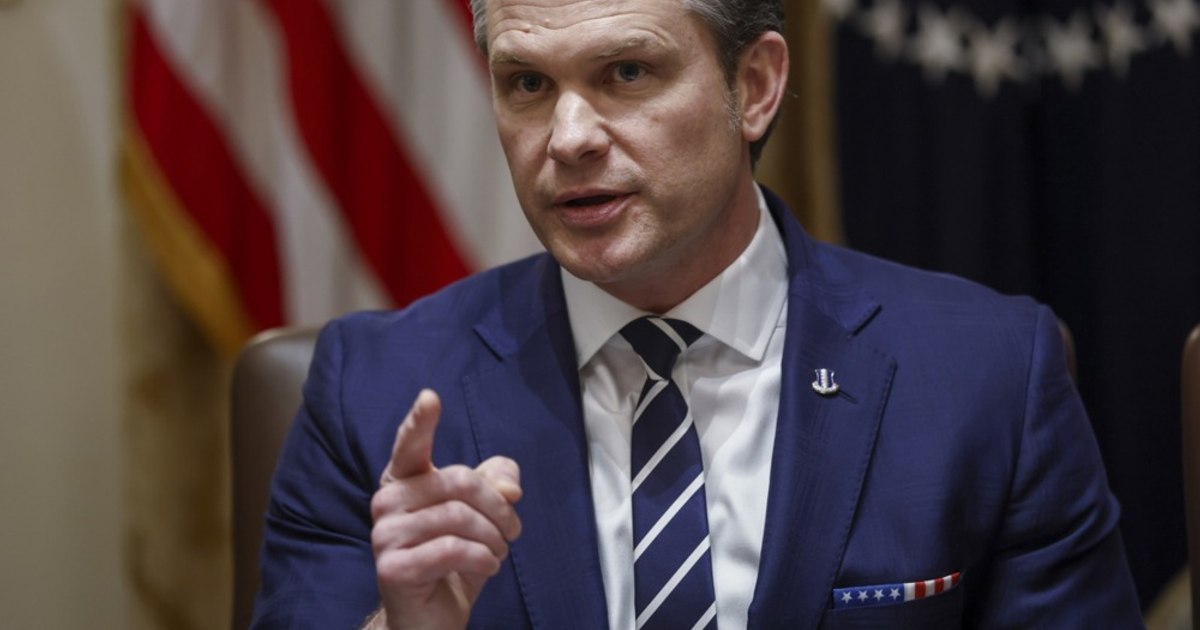
Secretary of War Pete Hegseth at a cabinet meeting at the White House PHOTO EPA-EFE
Speaking at the Pentagon after a recent visit to US troops in the Middle East deployed in Operation Epic Fury, Hegseth spoke of increased pressure on Iran and a sharp decline in Iranian attacks. “The last 24 hours saw the lowest number of missiles and enemy drones launched by Iran”he said, presenting the decline as evidence that pressure from the US and allies is paying off.
“Iran knows this and there is not much they can do militarily to change the situation,” Hegseth said, adding that “American firepower is steadily increasing”while that of Iran is “declining”. He emphasized the pace of the campaign: “After just one month – just one month – we set the terms.”
Hegseth echoed statements aligned with those of President Donald Trump, suggesting that the recent joint US-Israeli strikes have already reshaped the dynamics of Iran's leadership. “This new regime should be wiser than the previous one,” he said, while stressing that Washington still prefers a negotiated solution. “Talks with Iran are very real, ongoing and gaining momentum,” he added. “Our goal is an agreement.”
At the same time, he clarified that military pressure will continue if diplomacy fails. “If Iran is wise, it will make a deal,” Hegseth said. “We would prefer to reach an agreement. If Iran were willing to give up its materials and ambitions and reopen the strait – that is the goal.He added: “We don't want to do more militarily than is necessary. But I didn't jokingly say that in the meantime, we're going to negotiate with bombs.” If no agreement is reached, he warned, the US “they will continue with even greater intensity.”
General Dan Caine, chairman of the Joint Chiefs of Staff, said US forces have extensive capabilities in the region. “We have a wide range of military options beyond the presence of troops on the ground” he said, describing a campaign designed to apply constant pressure. Caine added that in the past 30 days, operations have struck more than 11,000 targets and are increasingly focused on dynamic threats, also significantly degrading Iran's naval capability.
“Our combined force continues to focus on military objectives as we systematically degrade and destroy Iran's ability to project its power and threaten stability beyond its bordersCaine said, noting that the efforts specifically target Iran's ballistic missile and drone programs, as well as their supply chains.
The briefing came amid heightened regional tensions, including after an Iranian drone attack on a Kuwaiti oil tanker off the coast of Dubai. “The giant Kuwaiti crude oil tanker was subjected to a direct and malicious Iranian attack while in the anchorage area of Dubai Port in the UAE,” reported Kuwait's official news agency, identifying the vessel as the VLCC Al-Salmi.
The conflict has also raised economic concerns in the US, where gasoline prices have topped $4 a gallon for the first time since August 2022. Prices have risen by more than a dollar in the past month after the first US-Israeli strikes on Iran, according to AAA data. White House spokeswoman Karoline Leavitt said that “gasoline prices will fall back to the multi-year lows that American drivers enjoyed before these short-term disruptions”adding that President Trump is “committed to fully unleashing America's energy dominance.”
Trump indicated he was not ready “right now” to give up on efforts to force Iran to reopen the Strait of Hormuz, a critical global sea route. He reiterated his criticism of allies for what he sees as insufficient support. “Countries need to step in and deal with it”he said, urging countries like the United Kingdom to act more firmly.
In a social media post, Trump wrote: “I have a suggestion for you: Number 1, buy from the US, we have plenty of it, and Number 2, muster up your belated courage, go to the Straits and just TAKE IT. You're going to have to start learning to fight for yourself, the US will no longer be there to help you, just as you were not there for us.”
Hegseth reinforced this message, saying that “there are countries around the world that should be prepared to take their turn on this critical waterway,” noting at the same time that traffic through the strait has increased. He added that the president was “clearly with Iran: “open it for business or we have options”, and we certainly have them.”
US Central Command confirmed that Admiral Brad Cooper met with Israeli army chief Lieutenant General Eyal Zamir to review the progress of joint operations and reaffirm cooperation. “The two leaders discussed progress in ongoing operations to eliminate Iran's ability to project its power significantly beyond its borders,” CENTCOM relayed.