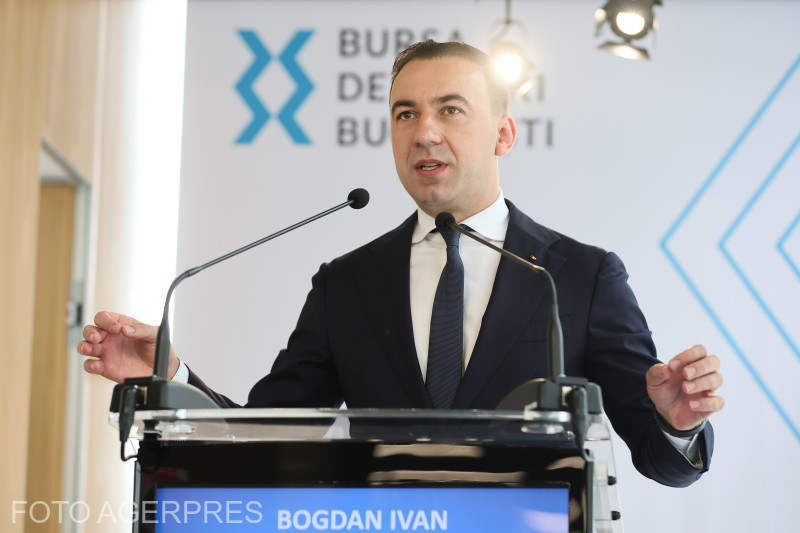
The Minister of Energy, Bogdan Ivan, declared that there will be a meeting on Monday regarding the price of fuels, reiterating that he made two proposals: the reduction of VAT or the proportional reduction of excise duty, informs News.ro.
“Tomorrow there will be an extremely applied work session, on scenarios, regarding what we said a month ago, from the Ministry of Energy and the PSD, on what we said a month ago, namely that a real decrease in the final price at the pump can come, in addition to the market regulation mechanisms, in addition to the regulation mechanisms of commercial additions and the overtaxation of exceptional incomes, it can only come from two sources that are directly related to the fuel price taxation segment”, said Bogdan Ivan, on Sunday, in a press conference held in Brăila.
“It's normal for the state to bear part of the pressure”
The Minister of Energy mentioned two options for reducing fuel prices: reducing VAT or reducing excise duty.
“During this period, the Romanian state has additional income from price increases, additional collection from VAT. We calculate everything that the Ministry of Finance collects additionally, during this period, in March, plus the 3 months of crisis in the fuel sector. And all this money, in a very clear and transparent form, goes back into people's pockets”, explained Ivan.
Bogdan Ivan stated that it is normal for the state to support people in this period of crisis.
“It is normal for the state to be the one that comes to support the people at the moment and bear part of this pressure, from the additional money it collected during this period,” Bogdan Ivan said.
The government announces the new measures on Monday
Prime Minister Ilie Bolojan announced that a new set of measures will be taken, “until the end of Monday” to reduce fuel prices, most likely it will be the reduction of the excise duty.
He said that the Government must evaluate, on the one hand, the capacity that the Romanian state can support in reducing the excise tax, including from the perspective of the period of applicability.
The Minister of Finance, Alexandru Nazare, announced, on Friday, in a post on Facebook, that the next stage of the Government's intervention on fuel prices will be done by changing the excise duties, the minister mentioning “a dynamic excise duty mechanism”.
He did not give details related to the mechanism invoked, but it is possible that “dynamic excise duty” consists in changing the level of excise duties depending on the evolution of prices, a change that is made at small intervals of time, depending on how international quotations evolve.
Such a mechanism was introduced in Italy on March 19, when the Meloni government decided to reduce the excise duty on fuel by 0.25 euros per liter for a relatively short period of time, for only 20 days. The measure was included in a wider package to limit the shock of the increase in fuel prices.
The liter of standard diesel registered a new increase in price on Saturday morning at Petrom pumps, the Economica website announces.
New price increases
Thus, the new price was 10.27 lei per liter, 15 money more than on Friday. At the same time, the price of standard gasoline was 9.28 lei per liter, unchanged from yesterday.
According to Economica, diesel fuel rose in March by 2.03 lei per liter, and standard gasoline by 1.23 lei per liter.
At other gas stations, the price of premium diesel is approaching a new threshold of 11 lei per liter, Economica writes. At OMV, the company's premium diesel, Maxx Motion Diesel, costs 10.97 lei per liter.
According to the International Road Transport Union (IRU) website, fuel prices have risen by an average of 29% in the European Union and the UK since the start of the Gulf War.
The biggest price increases, with 35-40%, were registered in Poland, the Czech Republic, Austria, Latvia and Norway, the latter being part of the European Economic Area.
Romania falls within the Union average of 25-30%, along with Hungary, Croatia, Italy, Spain, Portugal, the Netherlands, Lithuania and Great Britain.