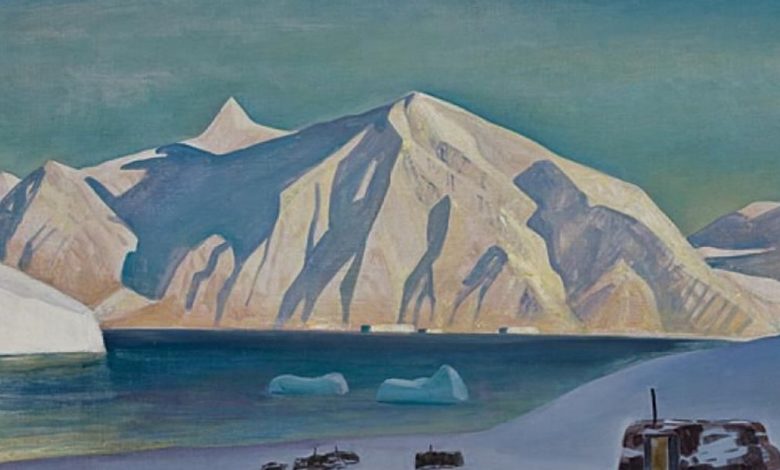
A 30 -year mining concession, recently signed in Greenland with a European consortium, seems to put an end to – at least for the moment – the ambitions of the United States in the Arctic region. In a long-beaten movement, the authorities in Nuuk have granted Greenland Anorthosite Mining (GAM) the right to exploit an essential rock for aluminum production, a key element for aerospace, car and defense industries.
Greenland values its mineral/photo resources: X
The agreement, signed with a Danish-French consortium supported by Jean Boulle Group in France and state investment funds in Denmark and Greenland, is aimed at anortositis extraction-a white rock rich in aluminum, silica and calcium-to be exported to the fiberglass industry.
The moment is not accidental: the agreement comes a few years after former US President Donald Trump generated international rumors suggesting that the US could “buy” Greenland, an autonomous territory belonging to the Kingdom of Denmark. Although the statement was initially treated as a diplomatic joke, it highlighted the geopolitical interest increasing for a resource -rich region, but also strategically located between the North Atlantic and the Arctic Ocean.
“We have European investors. American investors … less”
Naaja Nathanielsen, the Minister of Mineral Resources in Greenland, has been sharp: “I received several US business delegations, but so far I have not seen any concrete investment from their local economy.” She stressed that the dialogue with European partners evolved at a significantly faster and coherent rhythm.
In the official announcement of the concession, Nathanielsen said that the project aims to become an environment with the environment for traditional bauxitis, used in aluminum production. An ambition that aligns with both the EU environmental goals and Greenland's desire to diversify its economy, still strongly dependent on Danish subsidies.
Why don't the Americans invest?
Jesper Willaing Zeuthen, a lecturer at Aalborg University in Denmark, explains the absence of American capital through the rigidity of Greenland's legislation. “If this territory were regulated according to American legislation, investors could directly buy land and basement rights, then wait for the glaciers to withdraw. But in Greenland, the Earth belongs to the state, and the concessions are limited in time and require constant expenses to be maintained.”
In other words, Greenland is not an “empty land” available for sale, and the local law prioritizes environmental protection and the involvement of communities.
Greenland Anorthosite Mining will, despite the concession obtained, have to attract significant investments to effectively start the works-a stage where many other similar projects have been stuck. Meanwhile, the local government hopes that the project will become a model of sustainable extraction, which does not affect the neighboring communities and respects the assumed climatic commitments.
In an international context in which the Arctic region becomes more and more disputed-not only economically, but also military-Greenland seems to gradually claim a role as an autonomous actor, capable of negotiating his future between the great powers. Not with spectacular gestures, but with small steps, calculated, in collaboration with partners who understand that the future of Arctic cannot be bought at kilogram or square kilometer.