
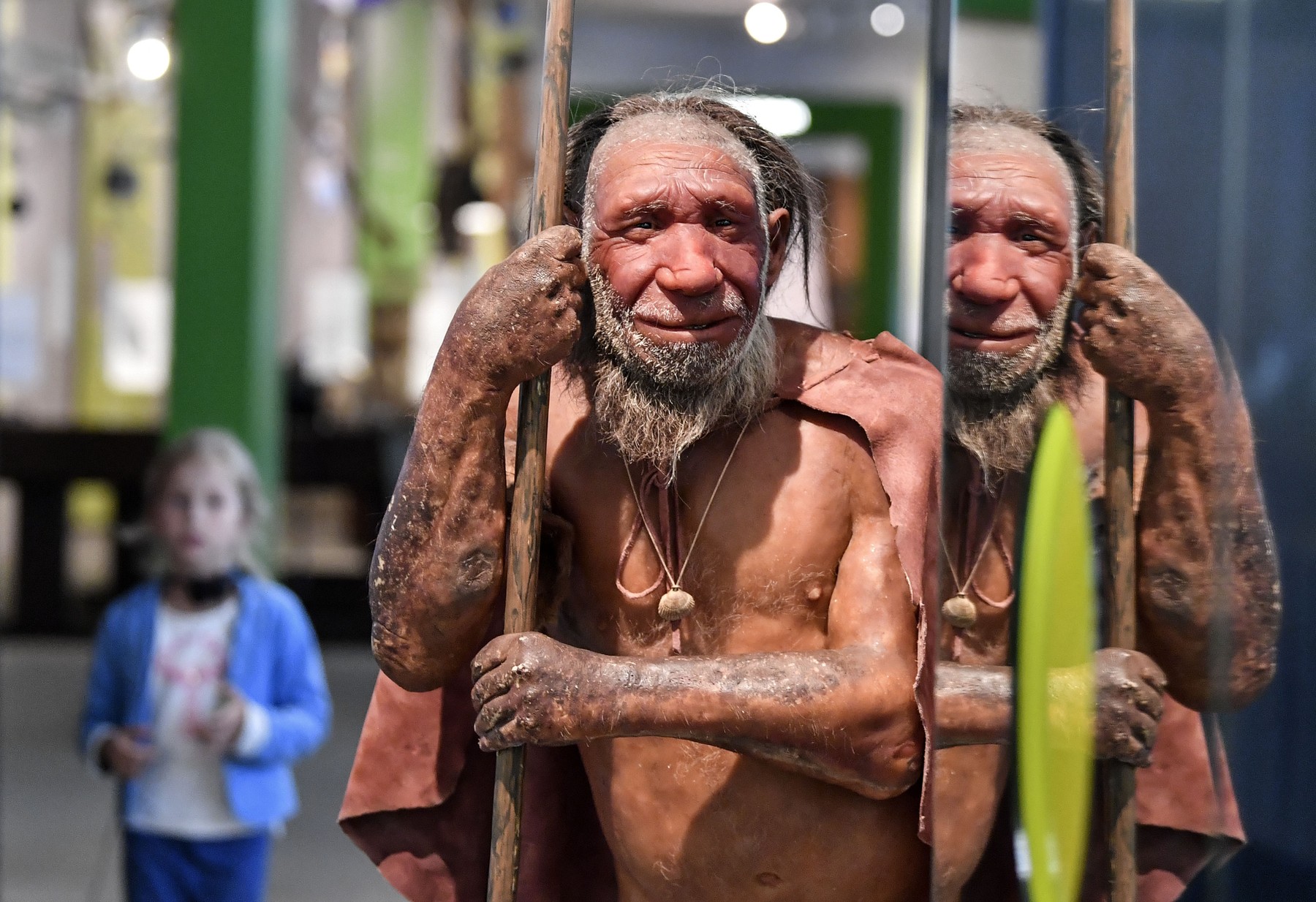
Between 400,000 and 45,000 years ago, Neanderthals had most of Eurasia to themselves, hunting large mammals, gathering plants, skillfully carving stone tools and making clothing from animal skins. But their existence was precarious. Two new studies show that many Neanderthals lived in small groups scattered over long distances; they probably experienced a significant level of inbreeding and survived on the brink of extinction about 75,000 years ago, Science.org reports.
The findings, based on ancient DNA obtained in some cases from bone fragments no bigger than a french fry, show how advances in fossil identification and genomics are helping scientists tell new stories about our distant relatives.
“We find little pieces in many places. And with the methods that geneticists have now, they can actually make them 'talk,'” says Hélène Rougier, a paleoanthropologist at Northridge State University in California, co-author of one of the new papers, published this week in the journal Proceedings of the National Academy of Sciences.
One of the researches provides detailed genomic information obtained from a Neanderthal bone fragment just 2.5 centimeters long. It was found at the back of Denisova Cave in the Altai region of southern Siberia, where Neanderthals and another extinct relative, the Denisovans, were sheltering from harsh conditions more than 100,000 years ago.
A history hidden in DNA
By comparing the newly sequenced genome with two others from the same region and a more recent specimen from a cave in Croatia, the team found that Neanderthals accumulated numerous genetic differences rather quickly. The researchers say this likely reflects inbreeding in small, scattered populations of only a few dozen individuals, particularly in the east, where Neanderthal populations were at the edge of their range.
“Neanderthals were more likely to breed between close relatives,” says geneticist Diyendo Massilani of Yale University, one of the authors of the Denisova Cave study. As a result, the groups quickly accumulated different sets of mutations, leading to their genetic divergence.
“Evolution happens faster in small populations,” says Joshua Akey, a geneticist at Princeton University who did not work on either paper. “What they observe is that the global population of Neanderthals was small—perhaps a few thousand reproductive individuals—and, moreover, spread over a very large geographic area,” he explains.
Harmful mutations can accumulate through inbreeding. However, Neanderthals somehow managed to survive in most of Eurasia for almost 400,000 years, a time interval longer than the existence of modern humans. Massilani speculates that the mutations posed little problem as long as the environment remained stable.
“If a population or family is well adapted to the environment, and the environment remains constant, it may not need to change very much to survive,” he says.
Some Neanderthals took refuge in southwestern Europe at a critical time
The second study supports this hypothesis. Wanting to analyze the fate of the Neanderthal population in Europe over the past 130,000 years, the researchers correlated Neanderthal distributions across the continent with genetic information from mitochondrial DNA – a smaller subset of genetic material passed from mothers to their offspring – from dozens of individuals.
The team found that Neanderthal sites and skeletons were widely distributed across the continent, and their genomes were relatively diverse, until about 75,000 years ago. Then, as an ice age engulfed the continent between 75,000 and 65,000 years ago, “we see the number of sites decrease,” says study co-author Rougier. Archaeological evidence shows that some Neanderthals found refuge in southwestern Europe, sheltering in caves in the valleys of southern France, while the rest disappeared.
After the retreat of the ice, the surviving Neanderthals spread again, following big game from Spain to the Caucasus Mountains. However, “all the genetic diversity we were seeing in mitochondrial DNA before 60,000 years ago disappears, and only one lineage survives,” explains paleogeneticist Cosimo Posth from the University of Tübingen, also an author of the study.
Even after they spread back into Eurasia, genetic data show that the number of reproductive individuals—what geneticists call “effective population size”—remained small for millennia. “Perhaps the available resources are not sufficient to support large groups,” postulates Posth.
When did the Neanderthals disappear?
About 45,000 years ago, sudden changes in climatic conditions coincided with the arrival of anatomically modern humans in Europe. Those two events could have been disastrous for these fragile, inbred survivors, says Qiaomei Fu, a geneticist at the Institute of Vertebrate Paleontology and Paleoanthropology of the Chinese Academy of Sciences, who was not involved in either study.
“When the environment changes, it's not easy for them to adapt,” he points out.
The genetic data show that then, within just 3,000 years, the effective population size of Neanderthals declined sharply again, reaching a low around 42,000 years ago, before disappearing entirely.
“It's pretty impressive how quickly they're going down,” says paleoanthropologist Bence Viola of the University of Toronto, who was not involved in any of the research.
“The climate could have weakened them, and then modern humans came along, which were a much larger population, so the Neanderthals were absorbed and diluted,” he says.


