The president of Finland draws a brutal scenario. “This is not my war”

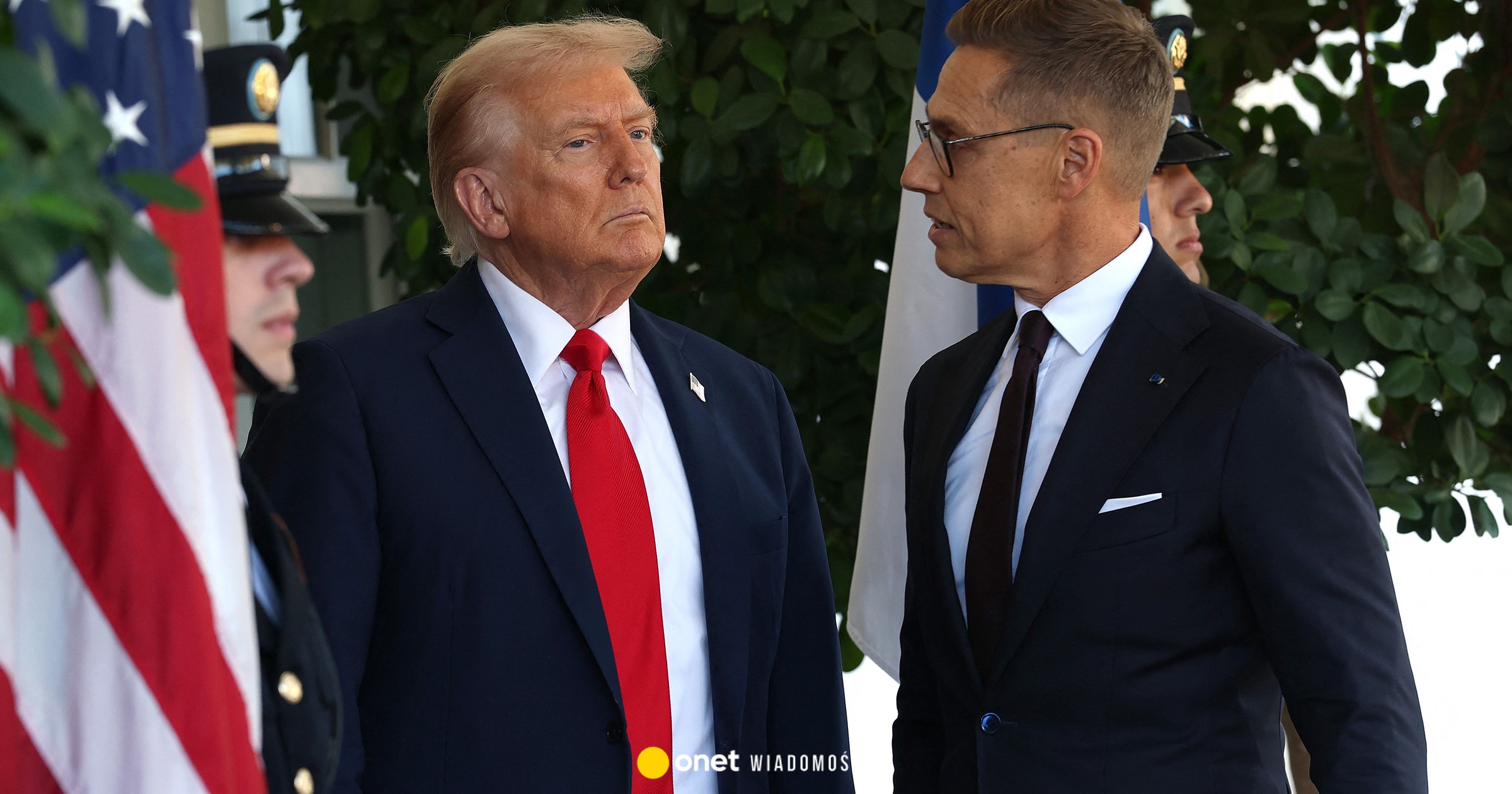
The interview with the President of Finland was conducted as part of the Global Reporters Network, of which Onet is a part.
No, when it comes to peace talks, I was probably more optimistic in the fall than I was this year. This is probably because the negotiations collided with Putin's political reality. In fact, we see no signs that the Russian side wants to make peace.
The good news is that we tried, and Ukraine is in a much better military situation today than it was a year ago. We have more or less secured it financing for the next two years. The bad news is that I am quite skeptical about a quick peace agreement.
Yes, at least all summer long. I just don't expect there will be a resolution anytime soon.
Do you think President Trump is losing interest in Ukraine? Is he retreating?
I hope not. He's very busy with Iran right now, so I think it all depends on when this war ends. And of course it is better for the US to get involved than to withdraw. But I also think that Europe has done most of the actual work in the last 12 months – in virtually all areas except intelligence.
It's basically a double chance. On the one hand, trust, expertise and know-how are being built between Ukraine and the Gulf states, which are currently in a difficult situation – in a war they did not start. And Kyiv was able to help.
On the other hand, hopefully Americans now realize that they need Ukraine — more than they need Russia. And that Russia will always be on the other side. This would allow the pendulum to swing in the right direction and make it clear how much security guarantees are really worth. We'll see.
Would an agreement with President Trump be possible in this context? For example, that Europe – and Ukraine – will support the US on Iran if Trump ensures that Ukraine gets what it needs to reach a fair peace agreement with Russia?
There is certainly potential for an agreement here, but it is too early to say what it might look like. Whether we like it or not: we must understand that the current US government operates in a rather transactional manner.
Alexander StubbGlobal Reporters Network
His actions are rarely based on traditional values, but rather on unconventional interests. That's why I think we should address this, but I emphasize again that while we are ready to help, we do not want to get drawn into this war because it is not our war.
It is widely known that you and President Trump play golf and have a good relationship. Do you keep in touch with him as often as before?
I would say a bit rarer. We talked to each other after the war with Iran began — not about Ukraine, but about Iran. Let me repeat, although it may sound a bit harsh: the war with Iran is not my war.
My war is Ukraine. And I try to help Ukraine as best as I can.
We do not conduct official telephone conversations. We talk informally on the cell phone. And we write messages to each other. I don't use WhatsApp.
How do you see the future of what you have called the “global West” in the past?
It is the global South that will continue to determine whether we will enter a multipolar, conflict-ridden world based on transactional agreements or a multilateral world based on institutional norms.
In my book I write that this change in world order began with the Russian war four years ago. Now, however, it is driven by the change of the US government, which, as we know, pursues a completely different policy in international relations than previous administrations. And I tell everyone that we must accept the world as it is, not as we would like it to be.
It could be said that we may not be experiencing a breakdown in the transatlantic partnership at the moment, but there is a deep chasm running through it. That's why I talk about a “power rectangle” in which the global North takes on the role of defender of the liberal world order, while the United States, as the global West, acts in a rather transactional way.
I have the impression that Europe is uniting. We are probably more united today than ever before, as we feel pressure from the East from Russia and a headwind from the West from the Atlantic.
President Trump has said he would like to be seen as a president of peace. Do you think this description fits him well?
Given the fact that Russia is providing Tehran with intelligence information in the war with Iran, and given the conflicts in alliances and international relations, do you see the danger of a global war, a third world war?
I would like to put this a little more gently, because talking about a world war has very far-reaching consequences – probably too far-reaching for the human mind to comprehend at this stage of international relations.
However, I can say that after the Cold War, many conflicts were local. They took place within national borders, almost like civil wars. What we are currently experiencing is an escalation leading to regional wars: Russia against Ukraine, Israel against Palestine, Israel and the US against Iran, Iran against the Gulf states.
We must now do everything to ease tensions and ensure that these wars do not spread further.
The problem is that conflict lurks everywhere if there are not enough international rules and norms to guide us. I'm afraid it's human nature. We need institutions for this, but these institutions are not present enough.
When a power vacuum is created, someone will fill it. And peace mediation cannot be transactional because transactions rarely last. They must be based on a win-win mentality, not zero-sum thinking. We have seen many times what happens when someone is defeated: they always come back.
So we have to find a new way of dealing with the world. That is why I would not like to talk about World War III just yet.
You say the transactional approach is dangerous, but you also used that word to refer to Donald Trump.
Do you think that the world, and Europe in particular, must face the real prospect that the crisis in Iran and the Middle East could lead to a recession?
Well, I won't reveal my source, but someone from the global South whom I respect very much told me that this situation may turn out to be worse than the coronavirus pandemic. I think we have to take this into account.
If this is another oil crisis, it will be different from the oil crisis of the 1970s. With hindsight, we have been able to determine the causes of that collapse. However, I believe that we are currently in a situation where a global recession may be the result of our own actions.
We now see what happens when we go beyond the framework of international rules and norms. Everything is interconnected. Oil price with gas price, gas price with food prices, food prices with fertilizer prices, fertilizer prices with drug prices – and I could go on and on.
The Finns have once again been recognized in an international study as the happiest nation in the world. What is their secret? Is this a sauna?
I think it all starts with equality. Then there is education. Then trust. And finally, I think, our connection with nature. Peace and quiet.
We are here, in the capital Helsinki, surrounded by the sea and islands. If there are five cars at the traffic lights here, it's a really serious traffic jam. It's just a pretty good place to live. We are also a relatively modest and generally rather relaxed nation.
I'm very happy that Finns consider themselves happy, but our society is not perfect. No society is perfect.
What in Europe gives you reasons to be optimistic?
What makes me optimistic is that we have open societies, societies that function. And you know – when you ask people where they would like to live, they answer: in Europe.