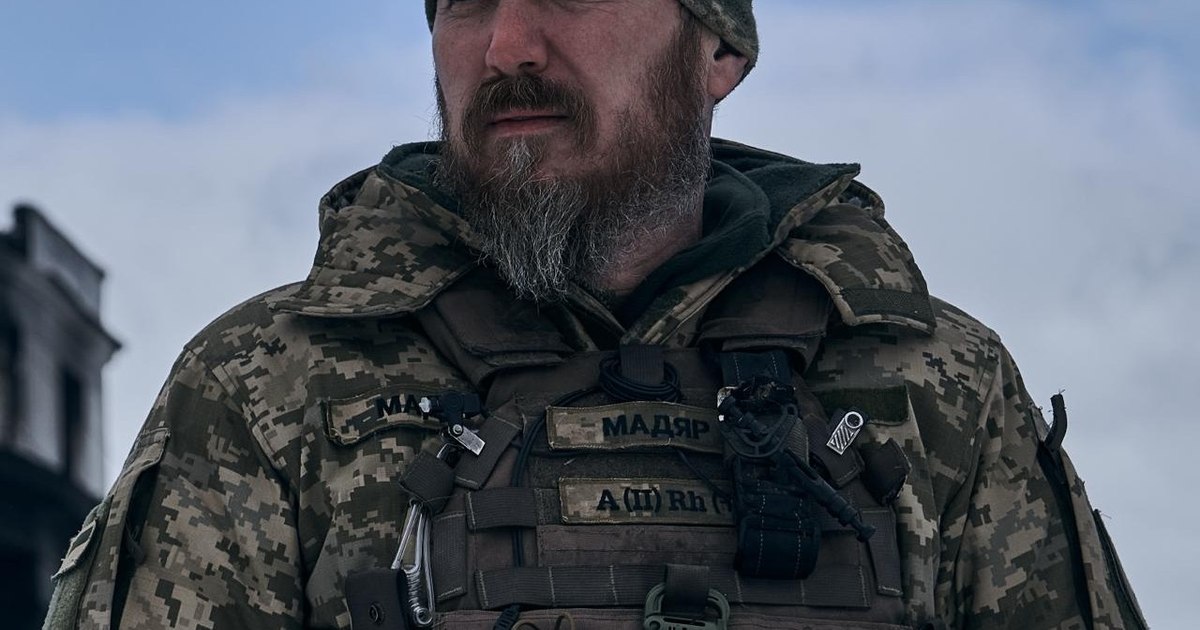
In the midst of war with Russia, a new military doctrine is taking shape among Ukrainian forces, relying on the intensive use of drones to directly strike enemy troops. At the center of this strategy is Robert Brovdi, known by the nickname “Madyar”, one of the most influential commanders of unmanned systems units in Ukraine.
Robert Brovdi, known by the nickname “Madyar”/PHOTO:X
An unusual command
His headquarters, an underground bunker, reflects the unconventional style of the leader: compact rest areas, gym and walls covered with screens that display real-time data on operations and losses of the opponent. In contrast, elements of Ukrainian art suggest an attempt to preserve cultural identity even in the midst of conflict.
A former grain businessman, Brovdi became, after the Russian invasion, one of the main architects of modern drone-based warfare, writes slate.fr.
A paradigm shift
Unlike classical strategies, which mainly target military equipment, the doctrine promoted by “Madyar” emphasizes the direct neutralization of enemy soldiers.
According to an analysis published by The Economist, after taking over the leadership of the drone units in 2025, the losses suffered by the Russian military increased significantly. In some periods, the number of eliminated soldiers would have even exceeded Russia's recruiting capacity.
The units coordinated by Brovdi — nicknamed the “birds of Madyar” — are said to be responsible for a significant part of these losses, although they represent only a small fraction of the total Ukrainian forces.
“The Russian army is a cow that needs to be milked until exhaustion”
Battalions of “Madyar Birds”, as the military official calls its squadrons of remotely piloted drones, are believed to be responsible for a sixth of these losses. All of its forces and drone operators, who make up only 2% of the Ukrainian military contingent, are believed to be responsible for over a third of enemy casualties. In December, nearly 400 Russian fighters were killed every day.
“When a unit runs out of infantry, the Russians send in clerks. They don't know how to fight, so they die quickly.” remarked Robert Brovdi curtly. His doctrine: target people before machines. He summarizes his philosophy with an agricultural metaphor: “The Russian army is a cow that needs to be milked.”
“A War of Attrition”
The commander describes the conflict in pragmatic terms, comparing the Russian military to “a resource that must be depleted.” In his view, the objective is the continuous weakening of the human capacity of the adversary.
How did the Russians send a drone covered in strange symbols without an explosive charge over Kiev? What signals does Moscow send?
His rapid rise began in 2022 on the frontline in southern Ukraine, where he improvised the first coordinated drone operations to identify and strike targets. Since then, these tactics have been expanded and integrated on a large scale.
Originally from the Hungarian border region, “Madyar” (“Hungarian” in Ukrainian) joined the war as a simple civilian volunteer. His spectacular rise is entirely due to his business acumen. In 2022, on the Kherson front (southern Ukraine), he improvised the first “kill chain” with drones. At the time, he only had a small drone he had bought for his son, but he was using it to locate hidden Russian tanks, transmitting their coordinates via the Discord app to a nearby artillery unit. This crucial action paved the way for the widespread use of Ukrainian combat drones.
Technology and organization
Today, operations are coordinated through a complex digital system that monitors every mission—from attacks to jamming or demining operations. The model is inspired, according to Brovdi, from the logic of commercial markets, adapted to the realities of war.
“It's not just about drones, it's about the whole ecosystem,” he claims, referring to the integration of technology, data and human resources.
The military officer has built a real digital warfare ecosystem: “Americans want to know what the best drone is. I tell them, 'The best drone is the ecosystem'.”
He claims to have a ratio of 400 enemy soldiers taken out of combat for every Ukrainian soldier killed. “We trade plastic and metal for dead Russians. It's the best price on the market.”
Controversy and criticism
The success of his tactics is not without controversy. Images shared online of attacks on Russian soldiers have been criticized by some observers, who raise ethical and legal issues.
On social networks, videos of attacks carried out by these units, often mocking the Russian enemy, sometimes cause outrage. Some see them as a moral failing, even a violation of the laws of war. Robert Brovdi remains unfazed: “I have no qualms. Whoever comes onto my land with a gun is coming to kill me. I either kill him or he kills me.” For him, every image of destruction galvanizes an exhausted society, giving his mother and millions of Ukrainians reason for hope.
The numbers prove him right: for the first time, Russia is losing more soldiers than it is recruiting, and Ukrainian troops are regaining their ground. Whether this momentum will be enough to wear down Vladimir Putin and his vast fighting force remains to be seen. Robert “Madyar” Brovdi, for his part, is under no illusions: “I have no romantic vision of the imminent end of this war. Let's see if we can keep this pace up for another year.”