

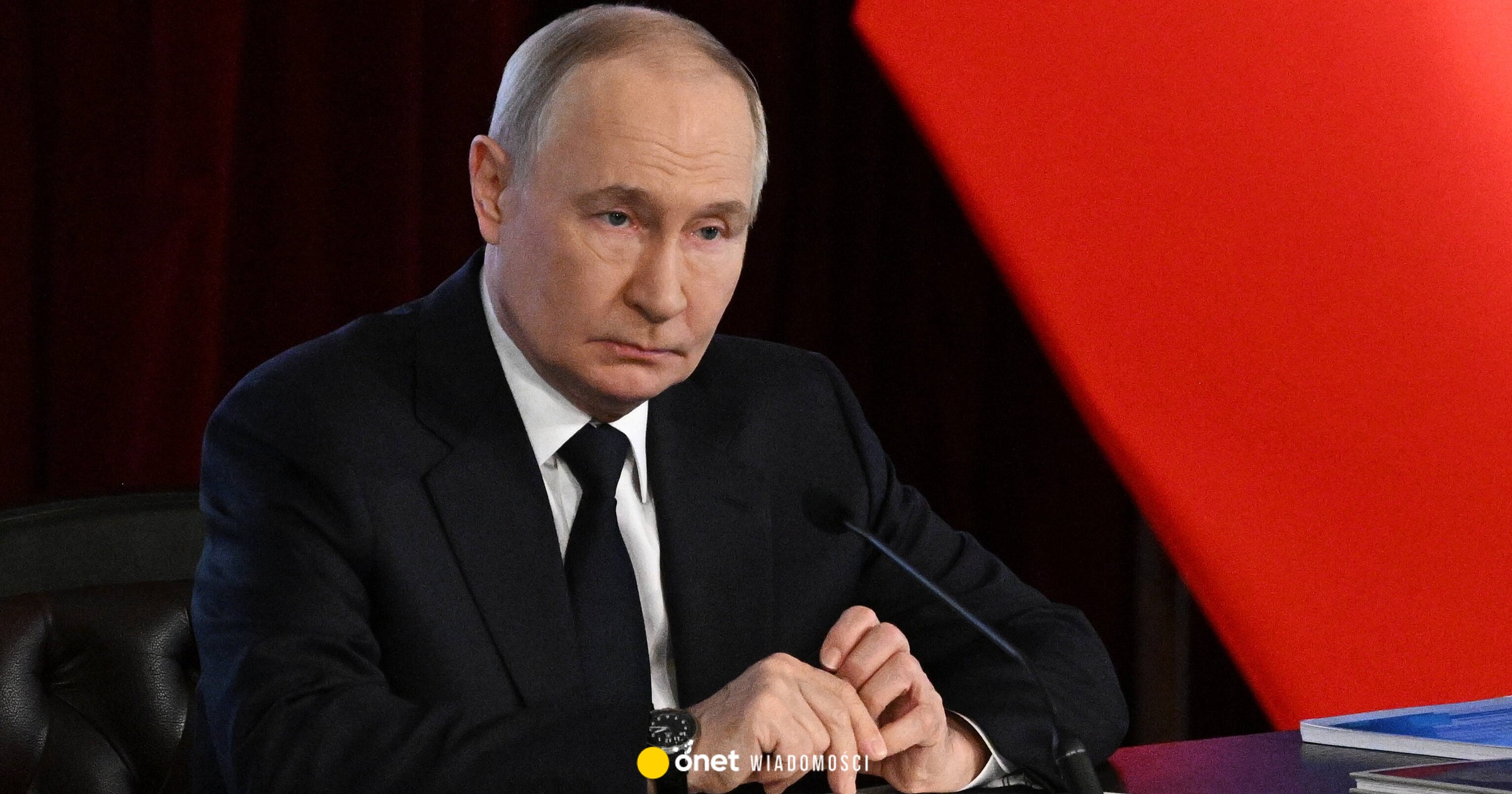
Could Vladimir Putin take advantage of the attention on the Middle East to launch an attack on Europe or step up attacks on Ukraine?
John Foreman: I would say that Putin probably thought that Christmas had come early again because we all know about the pressure [prezydent USA Donald] Trump pressed the peace process about economic problems, losses and lack of progress.
Then, as we saw after the attacks [Hamasu na Izraelczyków] on October 7, 2023, the entire world's attention turned elsewhere. Then it was Israel and Palestine, now it is the Middle East.
And no one talks about Ukraine, though [prezydent Ukrainy Wołodymyr] Zelensky has been in London in recent days. That's why I'm convinced that Putin wants to make the most of this situation, both in terms of helping Iran and from a political point of view – he's very glad that the attention has moved elsewhere. That Americans focus on something else.
Putin is constantly looking for ways to increase attacks in Ukraine. I believe that his ability to take advantage of the situation, whether economic or political, or to gain an advantage, is an opportunity for him, but not a turning point that would make him change his strategy towards Europe.
The regimes in Syria, Venezuela and Iran, all allied with Russia, are falling one by one. Does this affect Putin's authority or legitimacy abroad?
Definitely yes. From a strategic point of view, what we have seen over the last four years shows how weakened Russia is. In Venezuela, Syria and now Iran, the limits of Russian power have been revealed. One moment Maduro is Russia's biggest and most powerful ally, the next he is removed from power.
How alone is Putin when it comes to external support?
Of course, he still has support from China, which helped keep the war going [z Ukrainą]. He gets support from North Korea. It receives political support at the UN from countries such as South Africa and Zimbabwe.
However, I believe that if we compare Russia's past situation with its current one, it has certainly lost friends. Relations with Europe have broken down. I also think everyone else is looking at Russia, wondering, “Maybe I should look for other options against China or America.”
In some regions, such as Central Asia, past relations with Russia are being analyzed against the current situation and a conclusion is reached that due to the way Russia operates, the threats and blackmail it is subjected to, [inne kraje]other alliances should be sought. Russia is desperately looking for friends on the international arena.
To what extent does the war in Iran change Russia's strategy?
Russia has been involved in the Middle East for years, especially in Iran, both to ensure the security of its southern flank and to strengthen its position in the Middle East in opposition to the Americans.
I believe this strategy has been defeated. The Russians are very concerned that if Trump's war succeeds and the Americans change their position on Iran, there will be some kind of agreement between America and Iran, regardless of who is in power. Of course, this will be to the detriment of Russian power.
Russian commentators say on TV: “Listen, in practice we are on our own. We have no friends. National self-sufficiency is much more important. We will move away from Europe and seek balance in the Middle East; we should retreat home to our Eurasian homeland and strengthen ties with China.”
Russian President Vladimir Putin (L) and Chinese leader Xi Jinping at the Great Hall of the People in Beijing, China, September 2, 2025.XINHUA / Huang Jingwen / PAP
“Russia will strive to create a multipolar world,” Yevgeny Primakov, then Russian prime minister, said in 1998. How valid is the narrative about a sustainable multipolar world?
If I had a pound for every time Putin talked about a multipolar world and that we were on the verge of it, both you and I would be rich. It is a kind of totem of faith, almost a religion, that a multipolar world is almost just around the corner. According to this vision, great powers – Russia, China, North America – would rule the world and divide it into spheres of influence. They would decide the fate of the others.
I believe that the war in Ukraine, the weakness of Russia, the conflict in Iran and relations with China show us that the multipolar world is a failed project. And Russia is not a great power.
Russia cannot dominate the world. There are no allies. There is no hard power, economic power, or divine power necessary to achieve this goal. That's why I believe that the multipolar world will forever remain a fantasy from the 1990s. Putin's actions have prevented Russia from functioning as a great power on the international stage, because while he believes that he has strengthened his country, in fact he has destroyed it. He pledged the future of Russia, [rozpętując] war in Ukraine.
How do you think the Kremlin will manage relations with China?
Before the war in Ukraine, Moscow sought a partnership on equal terms with Beijing. However, currently China is a rising power and Russia is a declining one. Russia's dependence and, as we call it, “falling to its knees” before China has accelerated over the past four years.
China respects strength and power. And great Russia failed to capture Kiev and is stuck in a four-year war of attrition that it is not winning and in which there is no sign of progress. This has not escaped the attention of Beijing, which is conducting tough negotiations on the support it provides to Russia to keep it afloat, and as a result, it is buying Russian raw materials, oil and gas at reduced prices. China has cornered Russia.
Why has no one found Putin's Achilles heel so far?
I think one of the things we've learned is that dictatorships are more resilient than people think. It's quite interesting how, not long ago, we viewed Russia as almost lost, believing that another blow, the killing of a few more Russians, more sanctions or propaganda would be the straw that broke the camel's back. However, it turns out that in fact the regime built by Putin is much more resilient than we thought.
However, Russia is gradually weakening. It is like a balloon with air leaking out of it. They're trying [Putin i jego ludzie] patch it and put plasters on it to keep the air in it, but it doesn't work. Even though in the run-up to the war, Putin eliminated some of the weak points.
This is a way to really force change. AND [Joe] Biden i [Donald] Trump never actually used American power to put pressure on the Russian economy.
**
John Foreman, Commander of the Order of the British Empire, one of the highest honors in Great Britain, is currently an independent consultant specializing in Russia, Ukraine and international security. He knows both countries very well – from 2019 to 2022 he served as the UK's military attache to the Russian Federation, advising ministers on strategic issues and representing the UK Chief of the Defense Staff.
Previously, he was also the British military attache in Kiev in 2008–2011 and held diplomatic positions in the field of military affairs in the USA, NATO and the EU (in 2016–2019 he served as chief analyst at the European Union Staff in Brussels, and in 2012–2016 he was section chief at the NATO Joint Forces Command in Naples).
During his career in the Royal Navy, he participated in global naval operations, commanding two warships.
He completed postgraduate studies at the NATO Defense College, has a diploma in Ukrainian from the University of Westminster and a master's degree in defense studies from King's College in London.


