London enraged Beijing by changing the rules. “The Chinese embassy got furious”

Great Britain adopts a “calm and stable approach to ensure economic growth and international trade,” said a spokesman for a government on Tuesday. “The pragmatic relations of Great Britain with China will always be based on the interests of working people in Great Britain.”
However, signs of change are increasingly difficult to ignore.
After years of cool relations with Beijing, in July last year the Labor Party came to power, promising a reset of relations.
In January, finance minister Rachel Reeves resumed long -suspended economic and financial dialogue, presenting it as a platform “full of respect and consistent relations with China in the future”. There is also plans to visit the Prime Minister of Great Britain Keira Starmer in China.
However, four months later, the government in a short time forced the Chinese company Jingye to resign from control over British Steel, initiated a review of tax regulations conducive to electronic trade giants, such as this and Shein, and took action to prohibit the use of solar panels associated with forced labor in Xinjiang in energy projects supported by the state.
When the British deputy and critic of China Wora Hobouse was refused to enter Hong Kong, Great Britain called this “deeply disturbing” matter and raised her directly with the Governor of Hong Kong.
Changing tactics did not escape the attention of China observers.
– after a few months of feverish contacts [z Chinami] There has been a clear change towards the restoration of a balance against the short -term evil mission of economic growth and re -drawing geopolitical issues and sovereignty in the foreground – said Sophia Gaston, a manager of foreign policy of the Australian Strategic Policy Institute.
While Downing Street No. 10 tries to prove to the United States that it is a country with similar views, here are all the moves that can send a signal to Washington.

The Prime Minister of Great Britain Keir Starmer at the headquarters of Downing Street in London, Great Britain, April 28, 2025.
“Positive reception by the administration of Donald Trump”
Beijing voltages intensified when the Chinese owner British Steel, Jingye, threatened to close the last operating steel steel in Great Britain, exposing about 3,000 jobs.
Despite the multiple government attempts to finance the funds necessary to maintain the plant, Jingye rejected the rescue plan, which resulted in intervention in the politically sensitive industry. The discussions ended with a dramatic convening of parliament, where a high -high emergency law was adopted, which took control of British Steel.
Business Minister Jonathan Reynolds said that now you would have to set high requirements to trust Chinese enterprises operating in the British steel sector, while Beijing accused the UK government of “politicization of trade cooperation”.
Fears of Chinese shares in steel smelters are not limited to Great Britain.
Dutch on steel and aluminum were imposed by the US during the first term of Trump, citing national security issues. Although both countries reached an agreement in 2022 during Biden's rule, Trump began the war again.
Considering that Great Britain produces many steel elements for the American defense industry, Gaston said at the beginning of this month that “the takeover of British Steel from Chinese hands back to the British hands will be positively accepted by the Trump administration.”
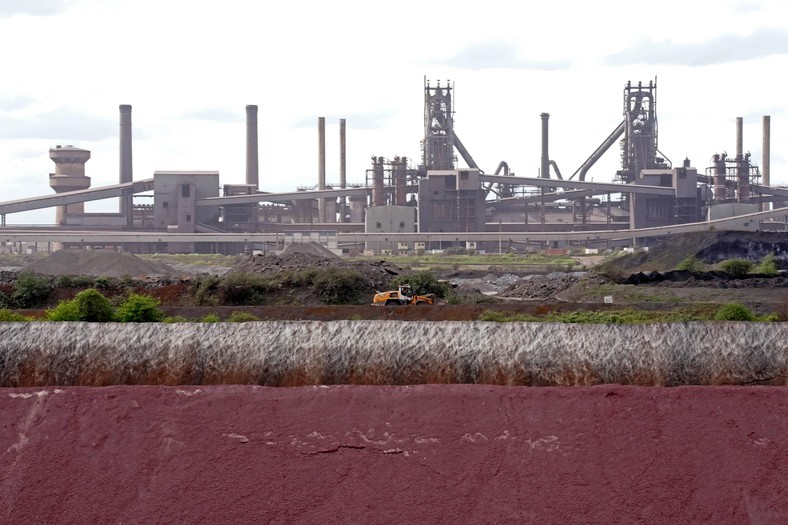
British Steel plant at Scunthorpe in Lincolnshire, England, April 14, 2025.
Chinese fury
The British ecological transformation has long depended on cheap Chinese solar panels – according to the investigation by Guardian, up to 40 percent. Solar farms in Great Britain were built of panels, the production of which was related to the forced to work.
Energy Secretary of Ed Miliband bowed last week under the pressure of legislators and human rights groups, changing the provisions prohibiting the state -owned GB Energy company to use solar panels associated with forced work in China.
This move caused the fury of the Chinese embassy. She issued a statement in which she accused “some British politicians of obsessed with inventing various stories.”
“They try to slander and slander China by all means and stick the label of” forced work “,” said the embassy. “Any attempts to politicize economic and commercial issues and disturbing normal trade between China and Great Britain will harm both us and others.”
This step is a consequence of the American Act on the prevention of forced work of Uighurs, introduced in 2021, which prohibits the import of products produced in Xinjiang to the United States. American regulations assume that all imported products are produced using forced labor, unless it is proven that it is different.
Although Great Britain's proposals are not so rigorous, some British legislators are in favor of duplicating a more severe American approach.
“Dirty secrets” shein and this
In connection with the preparations of the Chinese Electronic Trade Giant Shein to enter the London stock exchange, Minister of Finance Rachel Reeves announced a review of the tax gap, which according to many enables the prosperity of the company's business model of this company and another internet giant, ago.
This move may lead to an exacerbation of the provisions regarding de minimiswhich currently allow companies to import cheap packages to Great Britain without incurring duties.
The United States has already tightened the provisions regarding the threshold of $ 800. [3000 zł]which allows the duty -free entry of goods with a value below this amount, although the Trump administration suspended this regulation after over a billion parcels gathered on the border.
“As soon as the United States announced an exacerbation of the regulations, it almost immediately prompted other countries to look at these principles,” said Susannah Streter, director of markets at Hargreaves Lansdown. “It was just a matter of time before the UK government dealt with tightening this legal gap,” she added.
Before taking office by Trump Marco Rubio, a long -time critic of Shein, and currently the Secretary of State of the US, he warned the British government against “commercial tricks that are a dirty secret of Shein's success.”
The previous attempt to enter the company in New York was reportedly blocked by the American regulatory bodies, and experts say that the stock debut in London would be criticized if Great Britain seemed to offer milder treatment.
– By allowing Shein to enter the stock exchange without a solution to this issue, Great Britain may be at risk for enabling practices that the United States actively tries to eliminate – said Lizzi C. Lee, a scientific employee of the Chinese Analysis Center at Asia Society Policy Institute.
Shein “with satisfaction accepts the opportunity to cooperate with political decision -makers and industry representatives in order to review the current RAM de minimis” – the company said in a statement. The company emphasizes that its success results from efficient production, not from tax breaks.
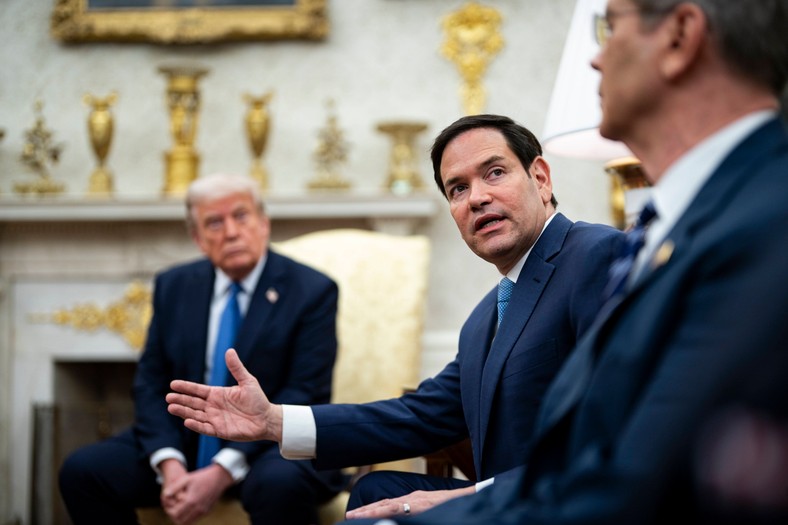
US President Donald Trump (L), US Secretary of State Marco Rubio (Ś) and US Secretary of Treasury Scott Bessent in the Oval Office of the White House in Washington, USA, April 24, 2025.
The long -awaited “Chinese audit”
The long -awaited “Chinese audit” of the government, which is to be published in spring, will be a clue about the general position of ministers in relations with Beijing. The government claims that the famous British Steel case has not changed its position.
But there are other difficult issues on the table. The British Act on National Security and Investments (NSIA), which controls transactions that may pose a threat to national security, can strain relations with China.
The group of TheCityuk banking lobbyists claims that if the government does not want to stop economic growth, the wide range of NSIA should be more targeted.
At the same time, ministers are wondering whether to include some Chinese entities related to the state in the “extended category” of the long -awaited new system of registration of foreign influence, which would probably also tighten tensions with Beijing.
However, this should not harm the position of Great Britain in the eyes of Trump's administration.