The exploits of a Chinese sailor during World War II have become the symbol of human endurance and a true model of survival in the open ocean. Poon Lim managed to escape alive after the ship he was in was torpedoed by a submarine and survive 133 days on the water.
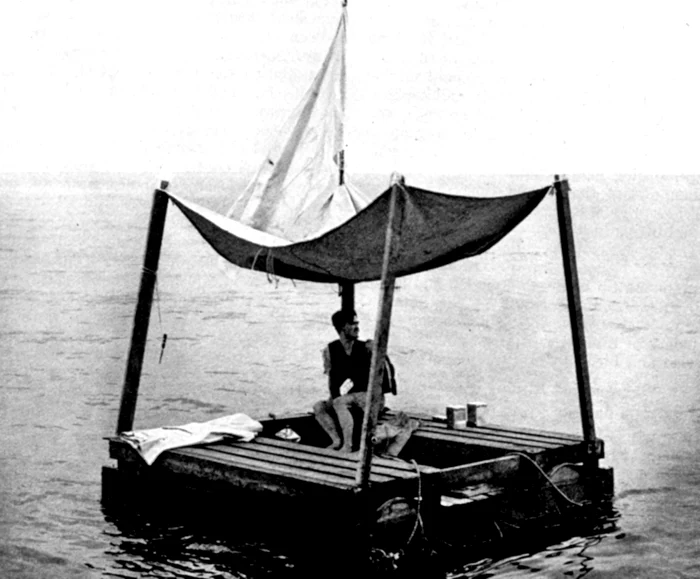
Poon Lim on a makeshift raft PHOTO wikipedia
Probably one of the most nightmarish scenarios a man can end up in is shipwreck. Alone on the ocean with limited supplies and little chance of rescue. It is a situation that few people have faced. Shipwrecks also speak of man's capacity for endurance in harsh conditions. Although we seem fragile, easily broken beings, able to survive a little without water, food and in difficult conditions, the experiences of the castaways show that man, animated by a lot of will and desire to survive, has an extraordinary capacity to resist in the most difficult situations. The best example is the story of Poon Lim, a Chinese sailor in World War II. He broke any record of survival up to that time, managing to live 133 days on a raft in the open ocean. He was the sole survivor of a British merchant ship that was torpedoed by a German submarine. The methods by which Poon Lim was able to survive in the ocean were incredible, especially for a man who had no special military training or intensive survival training. In fact, the endurance and resourcefulness of the Chinese have inspired many survival courses.
A Chinese sailor in the service of the British Crown and a nightmare night
Poon Lim was born on March 8, 1918, on the island of Hainan, belonging to China. He migrated with his family to Great Britain and from his teenage years began working in British ports. Later, around the age of 20, he became a sailor, serving on various English merchant ships. In 1942, during World War II, Poon Lim boarded as a flight attendant on the SS Benlomond, a British merchant ship that was to make a transatlantic voyage from Cape Suez to New York via Cape Town and Paramaribo. Her officers were British, but most of her crew were Chinese, as was Poon. The Benlomond had defensive armament, especially in the context of war and the threat of submarines, but sailed unescorted.
On November 23, 1942, Benlomond was sailing off the Atlantic towards Brazil, about 400 kilometers from the Brazilian coast. A German submarine, U-172, which had just ventured to South America, intercepted the British merchant ship. He immediately launched two torpedoes at the steel belly of the vessel. The torpedoes hit full force. Some of the sailors died when the ship was hit by the torpedoes. Poon Lim was in his cabin at the time of the attack. Feeling the impact and explosions, he quickly grabbed his life jacket and went to the boat station, where two officers and a sailor were trying to launch one of the boats. Benlomod was sinking fast. Lim was pulled underwater. With great effort he managed to get to the surface and grabbed onto two floating planks.
The Chinese sailor recalls seeing the German submarine surface. The German crew saw him struggling to swim in the choppy water, full of debris, oil and fuel, clinging to planks floating on the surface. Instead of rescuing him, Lim said, the German sailors laughed at him and waved him away. The Chinese sailor spent two hours in the water and miraculously survived. Finally he saw a life raft made of wood. It was a wooden deck, set on two barrels, with raised edges in front and back, like two benches. He was the only one of the 55 crew to survive the torpedo attack. But he was alone in the open ocean, on a wooden raft, with no means of propulsion and no navigational instruments to take him close to shore. In addition, he did not have the necessary training to navigate or apply survival techniques. Lim seemed doomed to a slow death, either drowned by the big waves or knocked down by thirst.
An incredible lesson in survival in the middle of the ocean
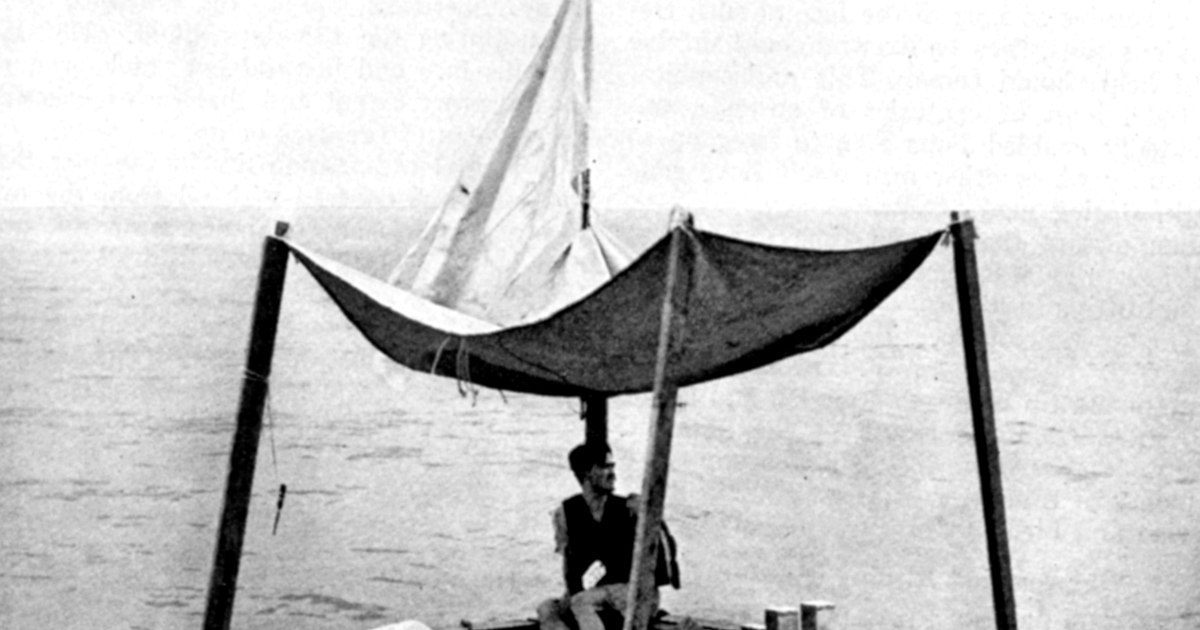
Poon Lim never thought for a moment of giving in or giving in to despair and fear. From the first moment, after the German submarine moved away, the Chinese sailor set his mind to the contribution. He was an intelligent young man with a wild imagination. He fished out some long pieces of wood and a tarp to make a sort of screen to protect him from the sun and rain.
Afterwards, he jumped into the water and began gathering resources from the wreckage of the sinking of the British ship. He got hold of a 40-liter can of drinking water, a few boxes of biscuits, ten cans of pemmican (a mixture of tallow, dried meat and sometimes dried berries, being a high-calorie food), almost a kilogram of chocolate, a bottle of lemon juice and five cans of condensed milk. In addition, he found a working flashlight, some flares, and canisters for smoke communication. With these resources, Lim could only survive for 12 days. To banish his dark thoughts and keep fit, the Chinese sailor began to swim around the raft, tying himself with a string to his wrist, so as not to be swept away by the waves and away from the raft.
Treasure discovered in Florida waters three centuries after the wreck of Spain's famous lost fleet
At one point he had to give up these forms of fitness because he attracted the attention of sharks. Two weeks' worth of supplies were rationed and fed Lim for about a month. On several occasions, the Chinese sailor was spotted by cargo ship crews. However, no one came near to save him. Even his cries in English were ignored. Lim said they refused to help him because he was Asian and looked like a Japanese sailor, or because of rumors that German submarines were using human decoys. Only one of the US Navy patrol planes saw it and dropped beacons into the water to locate the raft. The plane's crew reported to US authorities stationed at Belém in Brazil.
Rescue teams were dispatched, but a tropical storm hit hard and tossed Lim and raft much further away. The Americans lost track of him. The Chinese sailor was as if lost. He had no food or water left and had lost all hope of recovery. Lim did not let himself be beaten this time either. He obtained water by collecting it, when it rained, in a box made in the tarpaulin above the raft. At the same time, he started fishing. He took a bow from the flashlight and turned it into a fishing hook. Then he untied the hemp rope from the tarp strings to make a fishing line. He attached the wire hook to the rope. Later, to get the bait, he crushed some scraps of biscuits. He caught small fish. He needed more food, for more days, so that he wouldn't have to tire himself with fishing. He took a nail out of the planks of the wooden raft to make a stronger hook.
He would then use the small fish as bait to catch larger fish. To gut and descale the fish, he made a knife from the metal lid of a can. He even developed a technique to catch the seagulls that sat on the edges of the raft, attracted by the fish remains. Because he had no way to cook seagull meat, he would cut it up, soak the pieces in seawater to salt it, and then dry it on deck. During a period when it didn't rain and he started to get dehydrated, Lim improvised again. He used the remains of a seagull tied to a rope in the hook made of a nail to catch a shark. He managed to hook a one meter long specimen, which he pulled onto the deck. Then he killed him with a metal can used for water. Lim cut him open and drank the blood from his liver so he wouldn't die of thirst. He dried the meat and later ate it.
Hope on the coast of Brazil and the five months of torment
Poon Lim had survived for 133 days on the ocean, which is almost five months, using only survival techniques he invented. He braved storms with only a wooden raft and a lot of will. He had lost almost all his clothes and lost 10 kilos. On April 5, 1943, deliverance also came. Sea currents pushed it towards the coasts of Brazil. About 10 kilometers from the shore, three Brazilian fishermen out to sea spotted him. They approached and managed to save him. Although he was extremely weak, the Chinese got up and stepped into the Brazilian fishermen's boat by himself.
Almost a hundred migrants trying to reach Britain have been rescued after a shipwreck in the English Channel
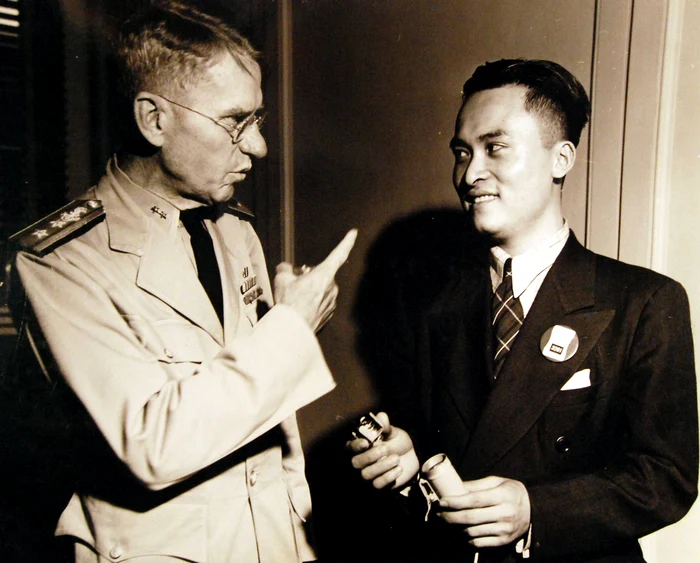
Lim with a British official PHOTO wikipedia
His story shocked those in Salinas, where the sailor was taken. There he ate well, consumed a lot of liquids, and after three days the fishermen took him to Belem. “I never lost hope that everything would be alright. Maybe today someone will see me, I told myself. Then a key to survival was planning. I had so much time to think quietly and come up with solutions. I did not allow myself to lose hope that one day I would be saved”Lim said in an interview.
On 10 April, the British Consul in Para telegraphed a report to the Ministry of War Transport in London requesting confirmation of the loss of the Benlomond. After two weeks in a Brazilian hospital, Lim left for the UK, with stopovers in Miami and New York. His story went around the world. After he returned to England, King George VI awarded him the British Empire Medal. After World War II, Lim immigrated to the United States. He lived in New York City and died at the age of 72. He summed up his incredible experience in one sentence – “I hope no one will have to break my record.”