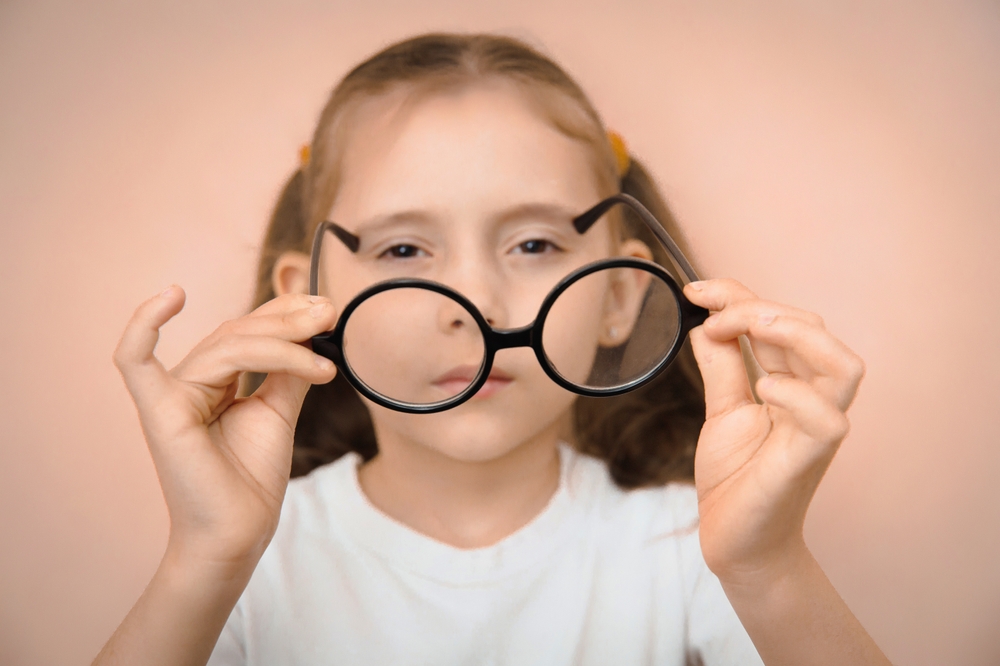
A child almost never says “I can't see well”. To him, the world looks as he has always seen it. For this reason, vision problems are often discovered late, often after difficulties at school or frequent headaches occur. However, there are some signs that may indicate that a child is not seeing well.
Just one hour spent daily in front of digital screens can increase the risk of myopia by about 21%, according to a study published in 2025 by Jama Network Open. The risk increases as time spent in front of screens increases.
Myopia—blurry vision at a distance—has become more common in recent decades. If in the 1970s about a quarter of the population (25%) was myopic, today the percentage is estimated at about 42%. Research indicates that by 2050 nearly 50% of the world's population could be nearsighted.
Modern lifestyle plays an important role. Refractive defects – myopia, hypermetropia (difficulty seeing clearly up close) or astigmatism (distorted or blurred vision at any distance) – can affect a child's ability to see clearly at the blackboard, when reading or in everyday activities.
Signs that may indicate that a child does not see well
There are some behaviors that parents can observe without medical equipment. Information provided by Johns Hopkins Medicine shows that certain repeated gestures or habits may suggest that a child needs an eye evaluation:
1. Squint
It is one of the most common signs that a child is trying to compensate for blurry vision. When he closes his eyelids, the amount of light entering the eye is reduced and the image may temporarily become clearer.
Children do this instinctively when trying to distinguish details at a distance – for example, text on a blackboard, subtitles on a TV, or an object in the distance. If this gesture occurs frequently in such situations, it may indicate myopia or another refractive defect. Sometimes squinting occurs only in certain contexts – in the classroom, at the cinema or during sports activities – when the child has to distinguish details that are far away.
For parents, the important clue is the repetition of the behavior. If it constantly appears when the child tries to see something further, an ophthalmologist's consultation is recommended.
2. Brings eyes closer to screen or book
Another common sign is getting too close to the objects the child is looking at. Children who cannot see clearly at a distance tend to get very close to the TV, tablet or phone to see the picture better. The same can be observed when reading or writing. The child brings the notebook or book too close to the eyes or leans their head over the page.
Sometimes parents interpret this behavior as a posture problem and try to correct it by telling the child to sit up straight. In reality, this may be the child's way of trying to compensate for the lack of visual clarity.
Myopia is the most common explanation for this behavior. In this condition, the image of distant objects is blurred, and the child instinctively tries to reduce the distance to see better.
3. He gets headaches and gets tired when he reads
A child with blurred vision makes an extra effort to focus the image. This effort can lead to headaches, especially after longer periods of reading, writing or using digital devices. The pain often occurs in the forehead area or around the eyes and may be accompanied by a feeling of eye strain.
The child may say that his eyes hurt or that he has “foggy vision” after reading for a long time. Other times, parents notice that their child quickly loses focus when doing homework or reading. It's not necessarily a lack of interest. If the vision is blurry, reading becomes much more demanding and the child gets tired faster than normal.
4. It is frequently rubbed into the eyes
Repeated eye rubbing can be a sign of eye discomfort. Children make this gesture when their eyes are tired, irritated, but also when they have to make an effort to focus the image.
This behavior often occurs after activities that require close vision, such as reading or using tablets. Although eye rubbing can have other causes—allergies, dry eyes, or fatigue—if it occurs consistently during visual activities, this behavior may be a sign of vision problems.
5. He bows his head or covers one eye
Some children tilt their head to one side when looking at something or cover one eye with their hand. This gesture may indicate that they are trying to get a clearer picture or reduce visual discomfort.
Head tilt can occur when the eyes do not focus in the same way or when there is an astigmatism that distorts the image. In other situations, the child instinctively covers one eye to eliminate blurred or double vision. The problem should be investigated if this behavior occurs frequently, especially while reading or when the child is looking at a distance.
Warning signs in young children are more subtle
In preschoolers, the signs may be harder to spot because they can't clearly describe their vision problems. Parents may notice that the little one is not interested in things further away, or that they struggle with activities that require hand-eye coordination, such as puzzles, drawing, or picking up a toy. The child may avoid these activities because they cause discomfort.
According to specialists at Johns Hopkins Medicine, these symptoms are not a diagnosis, but they are sufficient reasons for an ophthalmological evaluation. “A child's visual system is still developing in the first seven to eight years of life. In some situations, glasses may be necessary to help with normal vision development,” says Johns Hopkins ophthalmologist Megan Collins. Untreated vision problems can affect school performance and can be mistaken for difficulty paying attention or lack of interest.
When consultation is necessary and what treatment options are available
The only sure way to find out if a child needs glasses is an ophthalmologist's consultation. During the evaluation, the doctor checks how clearly the child sees far and near, if the eyes focus the image correctly, if both eyes work in coordination and if there are diopters that need to be corrected. The structures of the eye are also examined to detect possible eye health problems.
The general recommendations are:
- a first check before entering the school;
- periodic evaluations, especially if there is a family history;
- consult immediately if the symptoms described above appear.
The most common treatment consists of glasses with corrective lenses. In the case of myopia, there are also modern methods of controlling the progression, such as special lenses or other options recommended by the ophthalmologist.
In addition to optical correction, specialists recommend simple lifestyle measures:
- limiting continuous time spent in front of screens;
- regular breaks when reading or using devices;
- daily time spent outdoors.
Early detection of vision problems can prevent school difficulties and daily discomfort. Without a medical evaluation, a child can adjust to blurred vision without parents realizing there is a problem that can be corrected relatively easily.