When the Romanians actually appeared on the stage of history and how the Hungarians found them in Pannonia

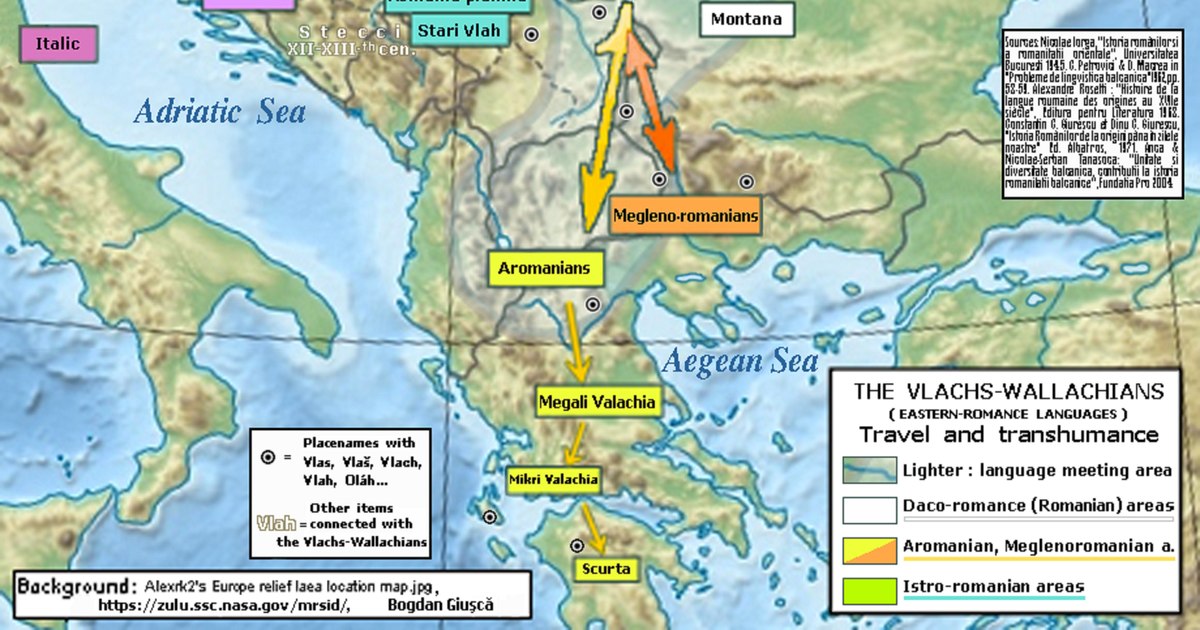
The first information about the existence of the Romanian people is over a millennium old. These show that the Romanians lived south and north of the Danube, but also in areas of Pannonia, i.e. present-day Hungary.
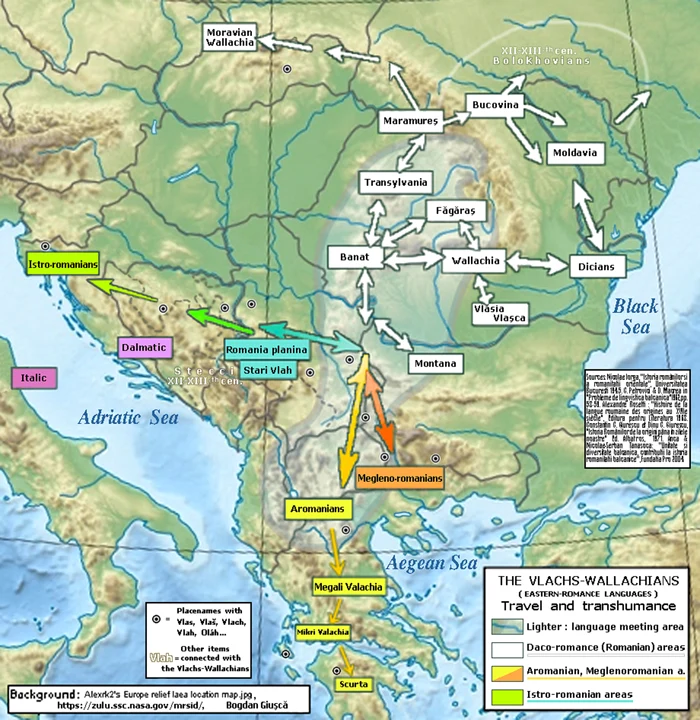
Map showing the movement of different non-Romanian communities PHOTO wikipedia
Most likely, the Romanian people were formed 1300 years ago.
The formation of the Romanian people has sparked wide controversies over the course of approximately two centuries. After the Union of 1859, the Habsburg Empire, a fierce opponent of the double election of Alexandru Ioan Cuza, launched a campaign of “scientific fight against Romanian law”, which wanted to demonstrate the fact that there was no continuity of residence of the Romanian peoples north of the Danube and that in fact the Romanians formed much later, in the Middle Ages, south of the river, in the Balkans. The main exponent of this anti-Romanian offensive was the well-known Robert Roesler, the one who developed the theory that bears his name.
Later, these theories, as well as others, were also supported by part of Hungarian historiography in the 20th century, especially from the nationalist period. On the other hand, Romanian historiography counterattacked with other counterarguments and theories. Some of them also born from the nationalist vein. And finally, when and where was the Romanian people formed? What was the first concrete information about the existence of these people on the stage of history? Here are two questions that many specialists have struggled to answer over the course of a century and a half. Archeology but also the study of documents led to the formulation of some answers, trying to shed light on this espionage issue.
Knights, Tatars and some rich and well organized Romanian states
The first mention of the existence of Romanian state structures took place in the middle of the 13th century. More precisely, in 1247, the king of Hungary, Bela IV, called the Ionian knights to defend the Hungarian kingdom from the invasions of the Tatars, offering them territories in the area of Severin, the mountains of Transylvania and the Olt river in return. The Ioannites received the lands, but had the obligation to provide military defense and pay taxes to the king, except for part of the revenues that remained in their administration. Well, in the description of the offered territories some state formations are mentioned, in the form of voivodeships and principalities inhabited by Romanians. More precisely, the Diploma mentions Severin County, the Voivodeship of Litovoi (left of Olt), the Voivodeship of Seneslau (right of Olt), as well as the princedoms of Ioan and Farcaș.
It is possible that these voivodeships and princedoms were vassals of the Kingdom of Hungary. This Diploma is of overwhelming importance for Romanian history, confirming the existence of organized Romanian state formations. In addition, this document provides valuable information. More specifically, it attests to a developed economy, recalling agriculture, cattle breeding, fishing and advanced land development techniques such as dikes or ponds. This indicates that these communities lived in those territories for a long time, being led by a partially Romanian, partially Cumano-Slavic elite. Archeology and other series of documents confirm the fact that the Romanian people were formed much earlier than the 13th century, most likely a few hundred years ago.
The first indications, but no certainties
The first possible mention of Romanian populations comes from the 8th century. In the military treaty “Strategikon”, the Byzantine emperor Mauriucius wrote that “Romans” live north of the Danube. You may have noted that the populations there spoke a Romance language similar to Latin. But at the same time it is possible that Mauricius was referring to certain Byzantine or Roman enclaves north of the river. Then in the 9th century, in Moise Chorenati's “Geography”, a Byzantine scholar of Armenian origin mentions an unknown country called “Balak”. Romanian specialists believe that it is about the “Country of the Wallachians”. But these are only interpretations, not certainties.
Also in the 9th century, specialists identified a possible mention of the presence of Romanians in today's Moldova, in Oguzname, an old Turkish chronicle about the deeds of the Cumans. In Oguzname, in addition to Russians and Hungarians, a population called «ulahi» is mentioned. “The inn, being informed of this adventure, decided to raise this child thinking that he had lost his father in his service, and gave him the name of 'Kipceak', which in the Turkish language means 'a leafless tree.' When the boy reached a suitable age, Oguz-Khan gave him a considerable army to fight the Russians, the latter, the Hungarians and the Bashkirs, who lived on the banks of the rivers Tin, Atell and Jaigik”it was shown in the Turkish chronicle.
Atell refers to Atelkuzu, meaning a region between the Dniester, Siret, Prut, Dnieper and southern Bug. Under these conditions, the conclusion was reached that the latter are the Wallachians, and the chronicle refers to the non-Romanian populations in the eastern part of today's Romania. Obviously, and this time without certainties, only with working hypotheses.
An internal document of the imperial court and the first concrete mentions about the Romanians
If those mentions from the 8th-9th centuries, from Oguzname and “Georgafia” by Moise Chorenati, raise questions and seem more like speculations, in the 10th century there is a very clear mention about the existence of Romanians north of the Danube, but also about the Romanity of the Wallachians. It is about the work “De Administrando Imperio”, a historical and political work written in the 10th century by the Byzantine emperor Constantine VII Porphyrogenet. The title means “On the Administration of the Empire” and the book was written around 948–952 and was intended for the emperor's son, Romanos II, as a guide to running the Byzantine Empire.
It was not a book for the general public, but an internal document of the imperial court. The work contains approximately 53 chapters and provides information on how the Byzantine Empire was to be administered, details regarding the foreign policy towards neighboring peoples, the description of the peoples of Eastern Europe but also of the Balkans, the origin and customs of peoples such as the Slavs, Hungarians, Pechenegs or Bulgarians. The text is of great value to historians because it provides information on the political and ethnic situation of Eastern Europe in the 10th century. The work is important for Romanian historiography because it contains references to Romanian populations from the Danube area and the Balkans, considered by many historians to be related to the ancestors of the Romanians. “They are called Romans because they came from Rome and bear that name to this day”says the Byzantine emperor about them. “The Romanians are the descendants of the Romanian settlers and live in the regions north of the Danube”, shows another quote from the work. Which shows that these populations come from Roman settlers settled in the Danube provinces of the empire.
Also, in the same century, the Byzantine emperor Vasile II mentions the Wallachians twice. Another important source is the medieval Russian chronicle “The Tale of Years Ago”, attributed to the monk Nestor the Chronicler and written at the beginning of the 12th century. This chronicle relates the events and migrations of the peoples of Eastern Europe. The term “volohi” appears in the text, which refers to Vlachs, i.e. Romanic populations. A well-known fragment states that “the Volochians attacked the Slavs and settled among them.” From the 13th century, mentions about Romanians continue.
“Hungarians live in a closed territory. In this closed country live several peoples who speak various languages. Some of these peoples are not Christians. Among these peoples are the Kitzilians, inside Hungary, the Cumans and the Romanian savages, whose country stretches beyond the snowy mountains”wrote Rudolf of Ems in the 13th century.
At the same time, Jens Enikel, also in the 13th century, in a versified chronicle, called “Chronicle of the world”, narrated an episode that happened in the 9th century, with Charlemagne as the protagonist, who came to Christianize the Avars and Romanians. “The valiant king went to the Land of the Hungarians (no – it was about the Avars). And he began to convert the Hungarians and the Romanians into Christians. And he stationed his armies there”Enikel wrote.
The Hungarians would have found the Romanians, even in Pannonia
One of the most important mentions regarding the existence of Romanians in Transylvania is undoubtedly the “Gesta Hungarorum”, written around 1200 by the anonymous chronicler of the Hungarian king Béla III, known as Anonymus. The work describes the coming of the Hungarians to the Pannonian Plain and the situation of the populations that lived there before this migration. According to Anonymus and other chronicles, such as that of Rudolf of Ems, on the territory of today's Pannonia, the Hungarians would have found a mixed population consisting of Slavs, Bulgarians and Vlachs, called “shepherds of the Romans”, meaning of Latin origin. “That this country is inhabited by the Slavs, the Bulgarians and the Blachi, that is, the shepherds of the Romanians. Because, after Attila's death, the Romans called the land of Pannonia a pasture, because their flocks grazed in the land of Pannonia. And it was rightly said that the land of Pannonia would be the pastures of the Romanians, because even now the Romanians graze on the estates of Hungary”Annonymus pointed out.
The consideration is not unique, being found in another Hungarian chronicler, Simon de Keza, but also in Nestor's Russian chronicle.
“In the eastern part of the plain on one side and the other of the Tisza, the Hungarians came across our ancestors who were engaged in farming and raising cattle. That is why they are remembered in the Hungarian chronicles as “shepherds of the Romans””stated in “History of the Romanians”, Constantin C. Giurăscu.
As for Transylvania, the story is known. As can be deduced from the “Gesta Hungarorum”, a Slavic-Romanian population lived in the area, with a Bulgarian or Wallachian elite (the case of Gelu).
What do the archaeological discoveries say?
Archaeological discoveries indicate that around the 8th-9th centuries in the Balkan area but also north of the Danube, on the territory of today's Romania, a new population, a new ethnic reality, emerged from the crucible of migrations and ethno-cultural syntheses. Mainly, it is about the Dridu culture, a synthesis civilization that proves the existence of some cohesive rural communities in which the emergence of a new ethnos was seen, with its various influences, especially Slavic and Romanic. “Dridu culture must be understood for the rural environments of the 8th-11th centuries”said the renowned researcher Ion Nestor.
In the settlements of the Dridu culture, the presence of rural, sedentary populations can be noted, who lived in villages, sometimes with places equipped with a palisade and a mound of earth. In these settlements, numerous agricultural tools were discovered, as well as carbonized grains.
At the same time, Romanian archaeologists noted the presence of a cultural aspect even older than Dridu. It is about the Ipotesti-Cândesti culture, spread over a vast area, from the Dniester to the Balkan Mountains. It is considered that the settlements of the Ipoteşti-Cândeşti culture, with its regional or local aspects, such as Răducăneni, for example, in the north of Moldova, date from the VII-VIII centuries AD. Just like the Dridu culture, Ipoteşti Cândeşti is a rural civilization, dominated by shepherds. Slavic but also Romanic influences can be observed within these cultures and they are considered the first manifestations of a new population that crystallized in Europe.
As noted by Keith Hitchins, an American historian, the Romanian people most likely formed on both banks of the Danube, both south and north, over a long period of time, with regional differences and following an extensive and complex ethno-cultural-linguistic synthesis, in which Romanic and Slavic elements are the most obvious. As some specialists note, the populations from the north and south of the Danube, from the east and west of the Carpathians were constantly moving, on one side and the other of the mountains or the great river.