Expensive oil and weak zloty. These will be the consequences for inflation and economic growth


The study by NBP economists takes into account data available until February 19, 2026, so it does not take into account the impact of the war in Iran and the tense situation in the Persian Gulf, in particular the lack of navigation safety in the Strait of Hormuz, on the prices of energy raw materials. The increase in oil prices (on Monday, prices exceeded $100 per barrel), resulting from the conflict, is not visible in the NBP forecasts.
Key assumptions of the forecast: stabilization and decline in oil prices
The commodity shock prompted Credit Agricole economists to simulate its impact on inflation in 2026-2027. It was assumed that starting from April, the probability of the situation in the Persian Gulf region stabilizing will increase significantly, which will be reflected in a gradual decline in oil and gas prices. As a result, the prices of these raw materials at the end of this year will reach a level similar to that observed in January (the price of oil then fluctuated around USD 60 per barrel).
This may seem quite an optimistic assumption, taking into account reports from around the world suggesting that the war in the Middle East may last several weeks (the Americans are considering a land mission in Iran). On the other hand, there are also opinions that Iran will not be able to block the Strait of Hormuz for a long time and effectively.
According to Credit Agricole economists, the normalization of the situation in the Persian Gulf region will also contribute to the gradual strengthening of the zloty exchange rate against the euro (on Monday, the zloty is losing against the dollar and euro). They assumed that at the end of 2026 the EUR/PLN exchange rate will reach 4.18, and the strengthening of the Polish zloty will be accompanied by a further decline in the EUR/USD exchange rate, supported by weakening expectations for rate cuts in the US as a result of a temporary increase in inflation.
See also: Polish bonds under pressure after the attack on Iran. Intervention of the Ministry of Finance is possible
“The assumptions we have made are consistent with the gradual extinction of the inflation impulse related to the strong increase in prices of energy raw materials recorded in recent weeks.. In our scenario, we took into account secondary and delayed inflation effects related to the increase in production costs leading to a temporary increase in core inflation and food price dynamics. Accelerating the growth of food prices “is largely related to the strong increase in natural gas prices, which leads to higher fertilizer prices, driving up the costs of plant production and then increasing the costs of animal production (more expensive feed),” economists said.
Inflation will be higher and growth lower than in the NBP projection
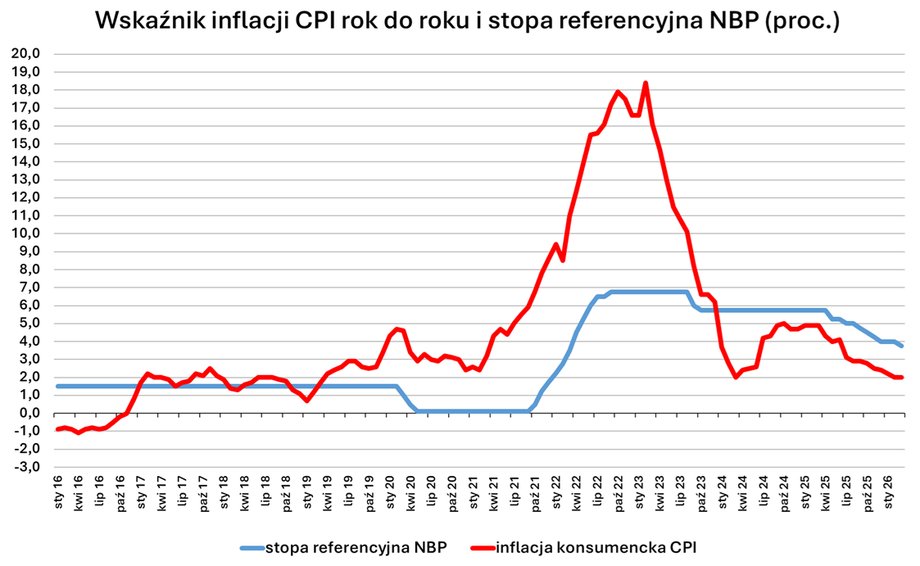
In the scenario carried out in accordance with the assumptions described above, inflation increases to 3.1%. y/y in May (in January, according to preliminary data, inflation was 2.2% year on year), and then, after a temporary reduction to 2.6%. in August, it increases to 3.4 percent. in December. In the first quarter of 2027, inflation will permanently decline below 3%. “As a result, the average annual inflation in 2026-2027 is 2.8%. and 2.7 percent , being above the levels predicted in the March NBP projection” – they wrote. Let us recall that according to the central projection path, inflation at the end of 2026 will be 2.3%, at the end of 2027 – 2.4%, and at the end of 2028 – 2.3%. In 2025 it was 3.6 percent.
Credit Agricole economists wrote that the materialization of this scenario would mean that economic growth in 2026 will be lower than expected in the projection, mainly due to slower consumption growth. According to the NBP projection, GDP growth will amount to 3.9%. in 2026, and in 2027 and 2028 – 2.9 percent.
Moreover, in the scenario they considered, the space for further easing of monetary policy would be insignificant, and the next and last cut in interest rates in the cycle could only take place when our scenario of stabilizing the situation in the Persian Gulf region materializes, i.e. in May or June. On Wednesday last week, the Monetary Policy Council lowered rates – which was a bit of a surprise considering the situation around Iran – by 0.25 percentage points, to 3.75%. in the case of the reference rate. This is how President Adam Glapiński justified the decision.
Due to the significant uncertainty regarding the development of the situation in the Persian Gulf region and the impact of this situation on domestic inflation, economic growth and the zloty exchange rate, we decided that we would present our adjusted macroeconomic scenario for Poland after the publication of February data on inflation and industrial and construction and assembly production.
|
own study based on data from the Central Statistical Office and the National Bank of Poland.
Bank Millennium economists noted in Monday's report that since the outbreak of the war, the price of Brent crude oil has increased by approximately 40%. and if it stays at around $100. per barrel for a long time, this will translate into an increase in inflation by approximately 0.9 percentage points. Gas prices on international exchanges jumped by 70%. Their impact on the CPI will be visible with a delay, mainly as a result of the increase in the costs of goods and services.
“Despite the increase caused by the increase in fuel prices, the CPI should remain within the NBP target band. In such conditions, it is justified to maintain interest rates at the current level. In the scenario of faster normalization on the energy markets, the Monetary Policy Council could return to the discussion on cuts in the second quarter,” they added.
“Our updated forecast assumes an average annual increase in consumer prices of 2.5 percent, while previously we expected a result closer to 2 percent. Currently, our average inflation forecast range for 2026 is 2.5-3.0%, depending on the duration of the war in Iran and the blockade of the Strait of Hormuz” – ING wrote in Monday's report.