Amazing details about the hypocrisy of the Ceaușescu regime. How he “built socialism” on the money of the “imperialists” in the West

Ceaușescu built “socialism” in Romania with the money of the “imperialists”, the documents show, as well as the research done by specialists. Concretely, the famous industrialization of the “Golden Age” was achieved mainly with the help of loans taken from international banking bodies.
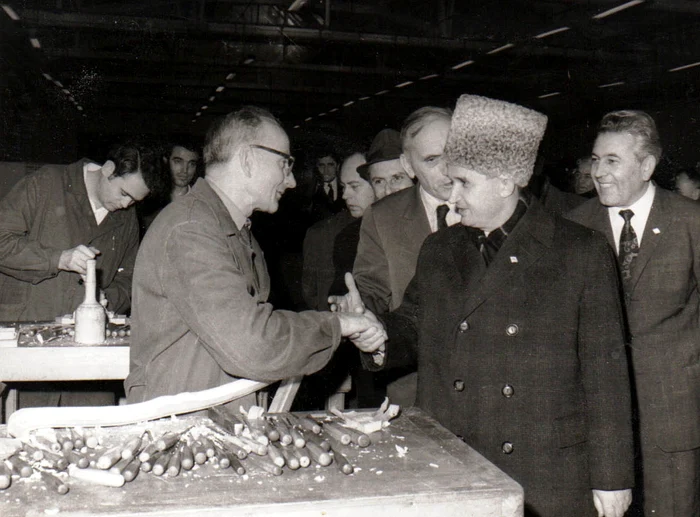
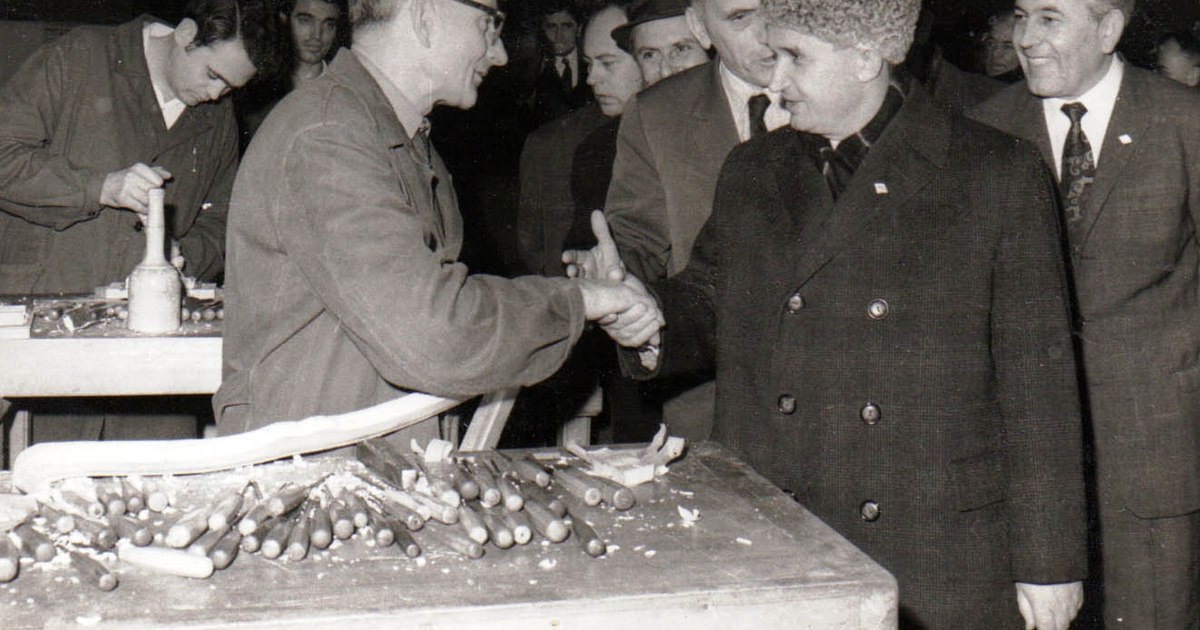
Working visit to the factory in Arad PHOTO “Online Photo Library of Romanian Communism”
Communist propaganda from the period of the Ceaușescu dictatorship opposed Romanian socialism, promoted as the only fair way of real development in society, the decadent imperialism of the West, marked by the “exploitation of man by man”. In addition, the idea was promoted that Romanian socialism led to an unprecedented development, through its own forces, independent of any foreign intervention in the internal affairs of the state. Propaganda of this type worked so well that even today there are many Romanians who are convinced that Romanian socialism was full of achievements, managing to achieve outstanding economic performances only through its own forces, thanks to the administrative genius and so-called patriotism of Nicolae Ceaușescu.
The historical reality, as it emerges from documents and studies, is that in fact Romanian communism, especially during the Ceaușescu era, was marked by a strong hypocrisy from this point of view. Although Ceaușescu promoted the achievements of the Romanian people, through their own forces, through the creative genius of working people and other similar slogans, in reality, the “great achievements” of Romanian socialism were based on the money and technologies of the “imperialists”. In other words, Ceaușescu imported technologies from the West and borrowed massively from international banking institutions, from the West, to implement his plan to industrialize communist Romania. Not to mention the fact that Ceaușescu was not afraid to export and benefit from commercial privileges, from the countries he ideologically adopted, in front of the Romanians, through the propaganda apparatus.
He forgot about the “class struggle” and got his hands on the money of the West
Once he came to power in 1965, Ceaușescu's biggest dream was the industrialization of Romania. The bad part was that he needed significant funds for the megalomaniac constructions he dreamed of. Thus, the dictator did not shy away from conducting secret negotiations with the representatives of two important financial organizations in the West: the IMF and the World Bank.
Negotiations with these two financial-banking institutions began only two years after taking power. While the USSR and other communist states maintained the ideological line and renounced or refused to join the IMF and the World Bank, Comrade Ceaușescu was no longer hindered by ideological reasons. More precisely, at the end of the 70s, the Romanian ambassador to the United States, Corneliu Bogdan, was sent to announce that Ceaușescu wanted to join the IMF and the World Bank. Pierre-Paul Schweitzer and Robert McNamara, representatives of the two institutions accepted. “The International Monetary Fund granted short-term loans (0-5 years), with an advantageous interest rate of 0.5% per year. The IMF did not finance investments, providing credits only for balancing the balance of payments (the so-called treasury loans). Development plans (construction of hydropower plants, regularization of water courses, irrigation systems, construction of communication roads) were supported by the World Bank. The member countries they received amounts between 15 and 200 million dollars, with an interest rate of 7.25% per year, repayable after five years. The two institutions were dependent on each other because only the member states of the IMF could join.stated Ilarion Țiu in an article for “Historia”.
In 1972, Romania received the green light for joining the IMF and the World Bank. Later, in order to penetrate, through Romania, into the area of socialist states, those from the IMF and the World Bank made concessions to Ceaușescu. More precisely, the credits were only for infrastructure works. However, the conditions were changed and Ceaușescu received money for industrialization, as he had requested. Romania took over 6 billion dollars in loans from the IMF and the World Bank, to “build socialism”. “Relying on IMF and World Bank loans, Ceausescu initiated an extensive program of industrial development. This was approved by the 11th Congress of the PCR (November 1974), with the title of the Program for the Creation of a Multilaterally Developed Socialist Society and the Advancement of Romania towards Communism”specified Ilarion Țiu in “How Ceaușescu hid from the IMF the real situation of the Romanian economy”.
A bankrupt industry dependent on foreign imports
In short, a good part of the Romanian industry was created with the money borrowed from the “imperialists”. Obviously, the communist propaganda took care to put into Romanians' heads that everything is done thanks to the creative genius of Ceaușescu and on the own forces of the Romanian socialist nation. In any case, the industry and the economy from the communist period are still perceived today, by a part of the Romanian society, as a standard of performance and the avatar of a “glory era” of Romania. A mythology is perpetuated of a prosperous, sovereign communist Romania, “which did not depend on anyone”, exported and ensured prosperity. In reality, Romanian industry was bankrupt.
Because it was not built on sustainable economic principles. It was a planned economy, which did not take into account the evolution and laws of Western markets. It was done by ear, according to Ceaușescu's megalomaniac impulses. Huge sums borrowed from the IMF and the World Bank went to bankrupt behemoths. Production was carried out based on standards, at impossible values, imposed by the dictator. In addition, many Romanian industrial facilities were in close interdependence. The Galati Iron and Steel Plant, for example, in the 1980s had an economic relationship with 1,480 other enterprises. “Any imbalance leads to a fall in the chain”states Lavinia Betea in “Ceaușescu and his era”.
Romanian industry was dependent on imports. The giant combines and factories were gobbling up more raw material than the country's holdings could provide. On the one hand, the communists imported everything from the “imperialists”, and on the other hand, from the Soviet Union. Very large and expensive imports, in relation to production, made the communist economy totally unprofitable.
“Even during the years of Ceaușescu's power, the situation of economic resources evolved drastically. If in 1971-1975, Romania was in second place in CAER in the export of electricity, after 1975 it is no longer among the exporters, but, soon, among the importers of this important resource as well. If it was from the beginning of industrialization dependent on iron ore and Soviet coking coal, more recently it was also on crude oil, the price of which had exploded since 1973. In the ratio between domestic production and oil imports, its processing becomes unprofitable. Comrade, however, continues on the same line, tying himself more closely and with more strings to the dependence of these foreign raw materials” said specialist Lavinia Betea in “Ceaușescu and his era”.
The best example was represented by the raw materials of the automobile manufacturing industry. “Instead of profit, losses were recorded in certain assortments. For example, the Romanians manufactured and exported tin at 150 dollars/ton. But the car building industry was advertising imported sheet metal paying $2000/ton“, adds Lavinia Betea in the same work.
Including in the agricultural field, things were done in the same way, with areas of the country divided by targeted, exclusive agricultural productions, sometimes without taking into account the relief and the type of climate. With the same aberrant production claims. Obviously, inefficiency and losses followed. Ceaușescu borrowed more and more from “imperialists” such as the IMF or the World Bank to keep alive the industrial giants, the pride of Romanian socialism. ”
Approximately 19% of the total external credits were used to recover the losses of companies. The economy endures chain deadlocks. With annual losses of around one hundred billion lei“, it is shown in “Ceaușescu and his era.
Not to mention the fact that he bought Western licenses to obtain cars produced in Romania. Dacia was after a Renault license, Oltcit after Citroen and Aro after Fiat Campanola. That is, cars for socialists according to “imperialist” projects and ideas. In the 70s, during a visit to the USA, Ceaușescu confided in the famous Rockefeller, confessing that the Romanians stole the plans of a petrochemical plant, based on which one was also built in Romania.
Everything up to the rights and freedoms of Romanians
Ceaușescu did not take into account the ideological impediments in doing business of all kinds with the West. He even enjoyed the most favored nation clause, granted by the Americans. He wooed American officials intensely to receive her. He also exported to America, but also to other Western countries, in order to earn foreign currency. Moreover, Ceaușescu also wanted to make the “banker” in a collaboration with the Arab countries. Basically, together with the Arab states, he was thinking of founding a bank, through which he would offer loans with low interest rates, to the banana states, elegantly called “developing”.
Not to mention all sorts of joint ventures across Africa. When it came to money and earnings, Ceaușescu did not stumble in ideology. But when it came to the moment when he should have offered civil rights and freedoms to the Romanians, he became intransigent.
He didn't care about anything anymore. A kind of “after me the flood.” Both the IMF and the American officials began to condition the loans, respectively the renewal of the most favored nation clause with the granting of rights, freedoms, private property to Romanian citizens. When he heard about such a thing, Ceaușescu turned the page. Suddenly he noticed the interference in internal affairs and the “violation of sovereignty”. He later starved his population to prepay the huge debts he had incurred at the IMF and the World Bank. He even waived the most-favoured-nation clause.