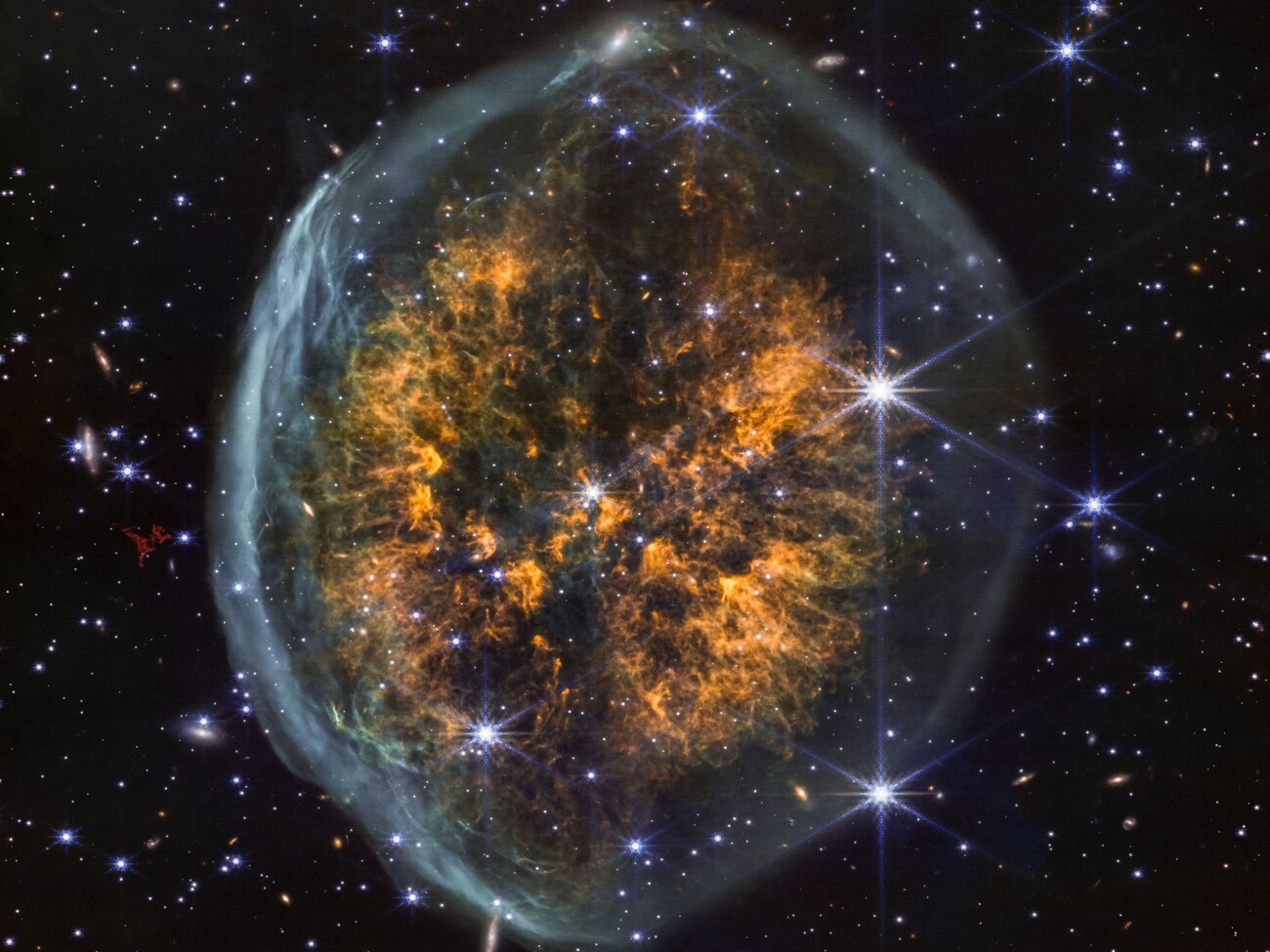
Object PMR 1 has been informally named “Open Skull” because it is shaped like a brain inside a transparent skull.
The nebula was first discovered by the Spitzer Space Telescope more than 10 years ago, but it remained mysterious to astronomers until more modern James Webb instruments allowed us to examine its structure in much more detail. The images were taken in the near and mid-infrared using NIRCam and MIRI instruments.
In near-infrared images, the outer shell of the nebula has a bright white edge, while the inner clouds are tinted orange. Stars and distant galaxies are visible through the gas shell. In the mid-infrared, the outer part appears bluish, and the inside shows more glowing cosmic dust.
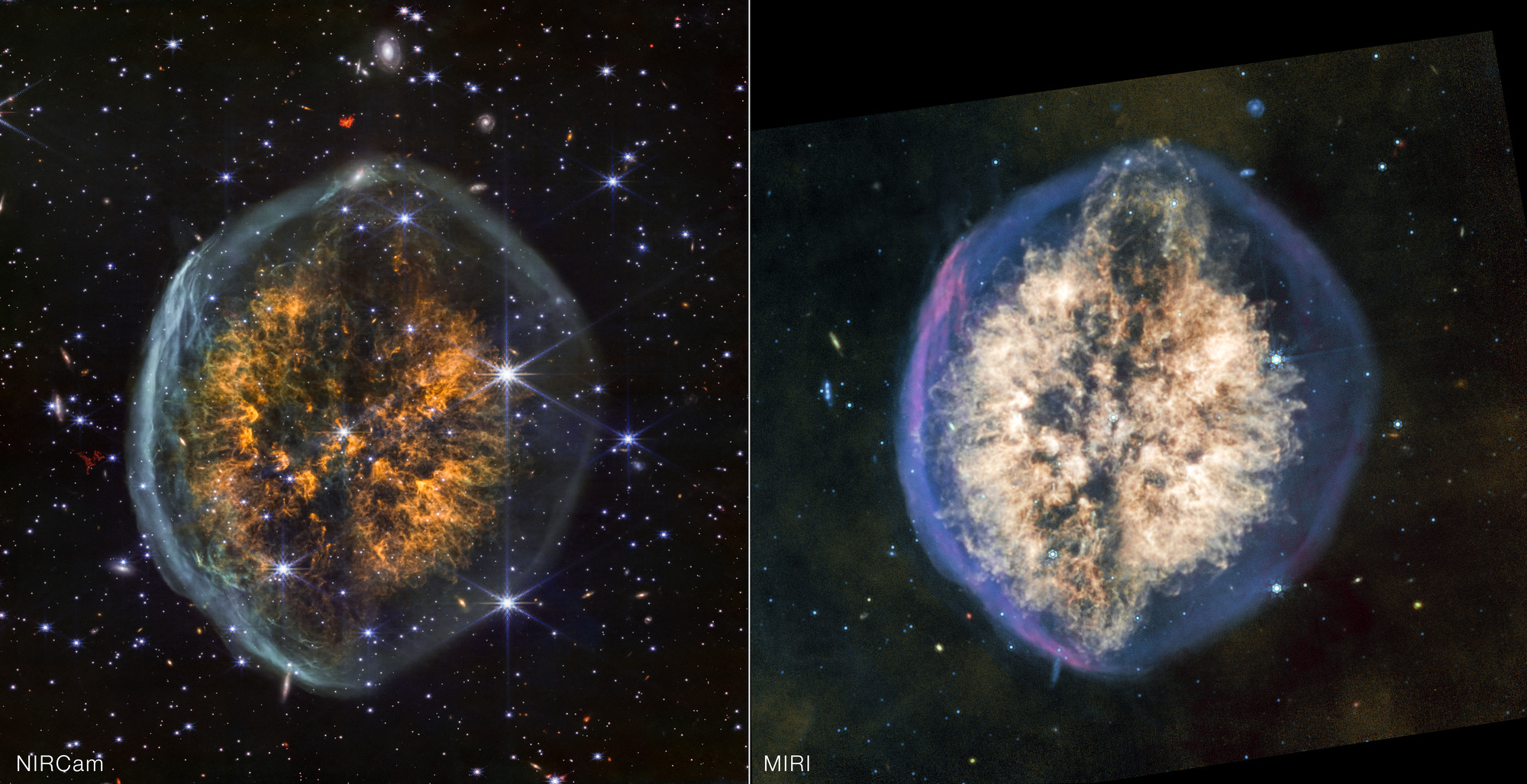
The nebula is divided into hemispheres by a dark vertical stripe. Scientists suggest that this band is associated with ejections of material from the central star – probably in the form of two opposing jets.
The structure of PMR 1 reflects the different stages of its formation: the outer shell consists mainly of hydrogen and was ejected earlier, while the inner region contains a mixture of different gases and has a more complex shape.
Astronomers note that the nebula is formed by a star at the final stage of its evolution. Depending on the mass of the star, it will either explode as a supernova or gradually shed its outer layers and become a white dwarf, which will cool over billions of years.