2026-02-23 22:05
publication
2026-02-23 22:05
The sell-off in technology and financial companies led to a clearly downward session on the New York stock exchanges. Concerns about the consequences of generative AI and uncertainty resulting from Friday's Supreme Court ruling on tariffs remained in the background.

Friday's optimism evaporated from Wall Street quite quickly. On Monday, the S&P500 index dropped by 1.04% and landed at 6,837.75 points. The Nasdaq Composite, after losing 1.13%, reached 22,627.27 points. The Dow Jones industrial average fell by 1.66%, falling to 48,804.06 points. The VIX volatility index – commonly known as the fear index – jumped by over 12%.
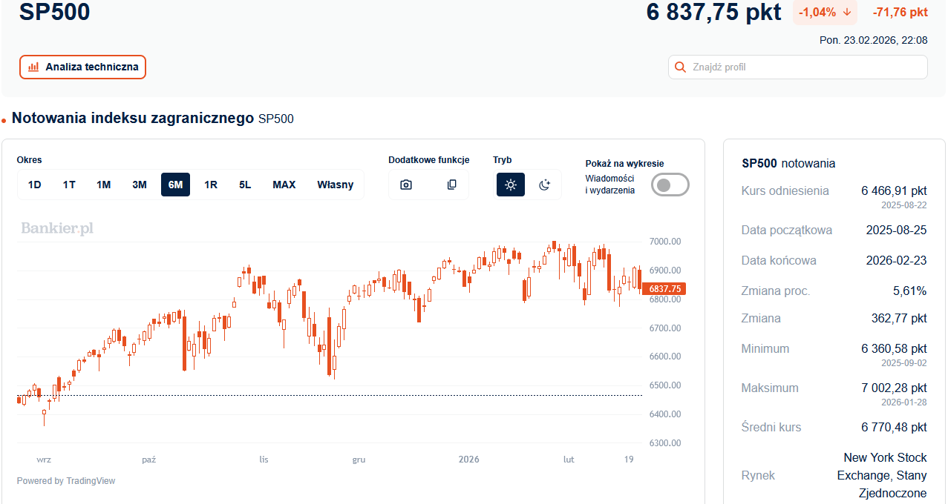
At first glance, Monday's session does not change much in the broader picture of the US stock market. Both the S&P500 and the Nasdaq have remained in a rather nervous sideways trend since November, from time to time weaving significant declines into gentle upward streaks. Ultimately, this results in a sideways movement with increasing volatility since the beginning of 2026.
What was most noticeable on Monday was the sharp decline in the price of companies from the financial sector, especially card companies. Mastercard's shares fell by 5.8%, rival Visa's by 4.5%, and American Express fell by 7.2%. The quotations of large banks fell significantly. The capitalization of JP Morgan Chase fell by 4.2%, Bank of America by 3.75% and Morgan Stanley by 4.9%.
However, we have already become accustomed to large fluctuations in the prices of IT and technology companies. Thus, Oracle's shares fell by 4.6%, Microsoft's by 3.2%, and Meta's by 2.8%. And this is nothing compared to the over 13 percent decline in IBM shares. Investors are increasingly asking whether the business model of traditional software companies is even sustainable in the environment of AI algorithms.
This all fits into the pattern of sector rotation that we have been observing on Wall Street for several months, in which investors are abandoning the leaders of the bull market that started in autumn 2022 in favor of market outsiders. Since the beginning of 2026, the energy sector (i.e. oil and gas companies) has performed best, ahead of raw materials and industrial companies. However, financial, technology and consumer companies are in retreat.
Now, an additional risk factor in general (and for US stocks in general) is the Friday ruling of the US Supreme Court, which found that US President Donald Trump did not have the authority to impose tariffs under the IEEPA Act. As a result, American business has no idea what duties it has to pay and how much. Especially after President Trump retaliated by announcing the introduction of 10% tariffs based on other regulations.
– Any country that wants to play games with the US due to the Supreme Court's decision to eliminate tariffs will receive significantly higher tariffs – US President Donald Trump threatened on Monday. This means – at least rhetorically – a resumption of the tariff wars that so frightened investors around the world last spring.
K.K